


For HDFC Bank, this appointment is not merely about filling the chairman’s chair. It is about defending the credibility of that chair. His CEC tenure makes the appointment sensitive.

By Rusen Kumar
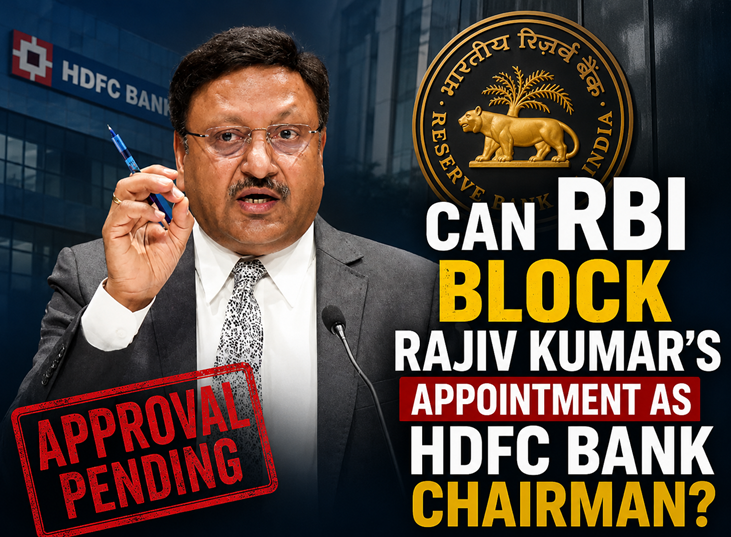
The appointment of Rajiv Kumar as HDFC Bank’s Chairman-designate is not just another boardroom development. It sits at the intersection of banking regulation, corporate governance, political memory and public trust. HDFC Bank’s board has approved his appointment as an Additional Independent Director for four years from June 30, 2026, and as Part-time Chairman for three years, subject to approval from the Reserve Bank of India. This makes the appointment legally incomplete until the necessary approvals are secured.
The Central Question
Can the RBI or shareholders create a hurdle in Rajiv Kumar’s appointment? The answer is yes, in principle. The RBI has the authority to approve, question, delay, modify or reject the appointment of a Part-time Chairman of a bank. Shareholders also have the right to approve or oppose his appointment as Independent Director when the matter is placed before them. But whether they will actually block the appointment depends on legal suitability, governance concerns, investor confidence and the larger reputation risk surrounding the candidate.
Why This Case Is Unusual
Rajiv Kumar is not an ordinary former bureaucrat entering a bank board. He is a former Finance Secretary, former Secretary of the Department of Financial Services and former Chief Election Commissioner of India. His supporters see him as a financial sector reformer who helped clean up public sector bank balance sheets, push recapitalisation, drive consolidation and strengthen banking discipline. HDFC Bank’s appointment has also been read by some market observers as a governance-strengthening move.

The Reserve Bank of India (RBI) routinely uses its statutory powers under the Banking Regulation Act to veto or restrict the appointments of Chairmen, Managing Directors (MDs), and Chief Executive Officers (CEOs) in both private and cooperative banks to ensure proper corporate governance and stability.
High-Profile Rejections & Interventions: Examples
Tamilnad Mercantile Bank (TMB): In April 2024, the RBI rejected the names of candidates proposed by TMB’s board to succeed outgoing MD & CEO S. Krishnan, stating the candidates were “not found suitable”. The RBI forced the bank to restart the selection process and submit a completely fresh panel of candidates with appropriate experience.
Bandhan Bank: In late 2023, the RBI declined to clear the re-appointment of founder and CEO Chandrashekar Ghosh for a new term, pending a forensic audit and governance evaluations. This led to Ghosh stepping down in July 2024, with the bank subsequently appointing a new external executive (former SBI official Partha Pratim Sengupta) as the new MD & CEO.
Axis Bank: In 2018, the RBI denied an extension to the bank’s long-serving MD & CEO, Shikha Sharma. The board had sought a fresh three-year term for her, but the RBI asked the board to reconsider due to asset quality and non-performing asset (NPA) concerns. Sharma’s tenure was drastically cut short, and she had to request to be relieved of her duties early.
YES Bank: In late 2018, the RBI refused to grant incumbent CEO Rana Kapoor an extension, cutting short his tenure. The central bank cited underreporting of bad loans and significant governance concerns. The board was forced to seek a new CEO and eventually, by 2020, the RBI superseded the entire board of the bank to safeguard public depositors.
A Test for RBI
For the RBI, the appointment is a test of regulatory confidence. If it approves, it must be satisfied that all fit-and-proper expectations are met. If it delays or questions the appointment, the market may interpret that as a sign of concern. Either way, the regulator’s decision will carry significance beyond one individual appointment.
How the Process Works: Under RBI’s “fit and proper” criteria, banks must seek prior regulatory approval before appointing or re-appointing any Whole-Time Director, MD, or part-time Chairperson. If the regulator finds any red flags—such as past regulatory violations, disproportionate compensation, poor performance, or compromised independence—it will block the appointment and order the bank to propose new names.
The CEC Shadow
The complexity arises from his later constitutional role as the 25th Chief Election Commissioner of India. His tenure oversaw the 2024 Lok Sabha elections and the Jammu and Kashmir Assembly polls. It was also marked by repeated allegations of bias from opposition parties, even as the Election Commission conducted elections at a historic scale. Reports on his demitting office noted both the scale of electoral participation and the political criticism that followed his tenure.
Allegations Are Not Disqualification
Criticism of a public official, however sharp, is not the same as legal disqualification. Allegations of bias, political criticism, public disagreement or loss of confidence among some political parties do not automatically make a person unfit to serve as a bank director. Unless there is a formal adverse order, regulatory finding, legal conviction, conflict of interest, integrity concern or fit-and-proper objection, such criticism remains part of public debate rather than a direct legal bar.
But Perception Matters
Banking is not only about legal eligibility. It is also about confidence. A bank chairman must command trust across regulators, investors, depositors, employees and the wider market. In that sense, Rajiv Kumar’s appointment may generate debate because the Election Commission is expected to be above political suspicion. If a former CEC’s tenure was politically contested, questions may be raised about whether such controversy follows him into a financial institution of systemic importance.
RBI’s Real Power
The RBI’s role is decisive for the Part-time Chairman position. HDFC Bank’s board approval alone is not enough. The appointment becomes effective only from the date approved by the RBI. This gives the central bank a clear gatekeeping role. It may examine suitability, independence, governance credentials, reputation, regulatory comfort and whether the appointment supports sound banking governance.
What the RBI May Examine
The RBI is likely to look at the candidate’s experience, integrity, independence, public record, possible conflicts and ability to provide effective board oversight. In Rajiv Kumar’s favour, his financial sector experience is extensive. He served as Secretary, Department of Financial Services between 2017 and 2020, was associated with major banking reforms, and sat on or chaired important financial bodies. That profile gives him strong technical and institutional credentials.
Where Questions May Arise
The challenge may not come from lack of experience. It may come from public perception. A bank of HDFC Bank’s size needs a chairman whose appointment does not become a continuing source of political controversy. If civil society groups, investor advisory firms, opposition voices or governance experts argue that his CEC tenure damaged public confidence, the RBI may have to consider whether perception risk affects the bank’s governance image.
Shareholders Have a Voice
Shareholders also matter. Rajiv Kumar’s appointment as Independent Director is subject to shareholder approval. HDFC Bank has included the relevant resolution in the revised notice for its 32nd Annual General Meeting scheduled for August 5, 2026. Shareholders can vote in favour or against. Institutional investors, proxy advisory firms and minority shareholders may study his profile not only as a former Finance Secretary but also as a former CEC whose tenure attracted political criticism.
Why Shareholders May Support Him
Many shareholders may support the appointment because Rajiv Kumar brings rare financial sector experience. He was closely associated with the clean-up of public sector banks, the recognition and provisioning of NPAs, recapitalisation exceeding ₹3 lakh crore and consolidation of public sector banks. For a major bank, such a profile can be seen as valuable. Investors often welcome board members who understand regulation, banking stress, financial stability and government policy.
Why Shareholders May Question Him
At the same time, some shareholders may ask whether the appointment strengthens independence or introduces reputational sensitivity. A bank chairman must not only be competent but also be seen as institutionally neutral. If a section of public opinion associates his CEC tenure with allegations of bias, even if unproven, shareholders may ask whether HDFC Bank has chosen the right person for a role requiring broad public trust.
The Governance Dilemma
This is the real dilemma. Rajiv Kumar’s financial credentials make him a strong candidate. His election-related controversies make the appointment thought-provoking. The question is not whether he knows banking. He clearly does. The question is whether a person who moved from a politically sensitive constitutional office into the chairmanship of India’s largest private sector bank can remain insulated from the public controversies of his previous role.
HDFC Bank’s Defence
HDFC Bank’s defence is straightforward. The bank has confirmed that Rajiv Kumar is not debarred from holding the office of director by SEBI or any other authority. It has also stated that he is not related to any director or key managerial personnel of the bank. Legally, these disclosures support his eligibility and independence. The board also acted on the recommendation of its Governance, Nomination and Remuneration Committee.
Legal Eligibility Versus Moral Scrutiny
Yet modern corporate governance is no longer limited to legal eligibility. Boards are increasingly judged on moral credibility, public perception and stakeholder trust. A technically valid appointment can still become controversial if stakeholders believe the board ignored reputational concerns. This is why Rajiv Kumar’s appointment may face public debate even if it passes formal legal tests.
The CEC Debate Cannot Be Ignored
His role as CEC cannot be treated as irrelevant. The Election Commission is one of India’s most trusted constitutional institutions. Any allegation of bias against the CEC, even when contested or politically motivated, carries public weight. Reports at the time of his retirement noted that his tenure was marked by both electoral successes and repeated allegations from opposition parties.
No Proof, But a Public Question
There is no public regulatory finding in the available material that legally disqualifies Rajiv Kumar from a bank board role. That must be clearly stated. But the absence of legal disqualification does not eliminate the public question: should India’s largest private bank appoint a former CEC whose tenure remains politically debated? This is not a legal accusation. It is a governance question.
Why the RBI May Ask Hard Questions
The RBI may still approve the appointment because the banking-related case in his favour is strong. Rajiv Kumar has deep experience in banking reforms, financial stability, regulatory bodies and public sector bank governance. His appointment may be seen as strengthening HDFC Bank’s board at a time when leadership continuity and governance oversight are important. Market reports have also suggested that brokerages viewed the move as supportive of governance and continuity.
However, the RBI may ask hard questions before approval. It may want comfort that the appointment will not create governance distraction. It may examine whether he can devote adequate time, whether his independence is beyond doubt, and whether any reputational concerns need board-level mitigation. The RBI may not judge political criticism as a disqualification, but it can still examine whether the overall appointment is fit and proper for a bank chairman.
The Shareholder Test
The shareholder test is different. Shareholders may not conduct a regulatory investigation, but they can express confidence or discomfort through voting. Large institutional investors may rely on proxy advisory recommendations. If governance advisers raise concerns about independence, perception or public controversy, the appointment may face sharper debate. If they focus on banking expertise and legal eligibility, the appointment may pass comfortably.
The Larger Issue
The larger issue is the revolving door between powerful public offices and major financial institutions. When former regulators, secretaries or constitutional authorities join large corporations, the public naturally asks whether the movement is appropriate, timely and transparent. Rajiv Kumar’s appointment will likely revive that debate because he held both financial policy roles and a politically sensitive constitutional post.
A Test for HDFC Bank
For HDFC Bank, this appointment is a test of communication. The bank must explain not merely who Rajiv Kumar is, but why he is the right person now. It must show that the appointment is based on competence, governance need and institutional fit, not proximity to power. The stronger the bank’s explanation, the lower the controversy.
For HDFC Bank, Rajiv Kumar’s appointment is a test of transparency. The bank has disclosed the legal route: the Governance, Nomination and Remuneration Committee recommended him, and the Board approved him. But the larger public question remains unanswered: who first brought his name to the table, and why was he considered the right person at this exact moment? There is no public evidence that the Government proposed his name, nor is there evidence that he approached the bank himself. But in the absence of a fuller explanation, speculation will continue. For a systemically important bank, silence is not always neutrality; sometimes silence becomes the space where doubt grows.
A Test for Rajiv Kumar
For Rajiv Kumar, the role will also be a test. He must demonstrate that his chairmanship is independent, professional and focused entirely on the bank’s governance. His public career gives him stature, but it also brings scrutiny. In a bank boardroom, credibility will be measured not by past offices held, but by the quality of oversight delivered.
What Could Become a Hurdle
The real hurdles may include reputational concerns, shareholder activism, proxy advisory objections, public-interest criticism, political debate and regulatory caution. A formal legal hurdle would arise only if there were adverse findings, disqualifications, conflicts of interest or failure to meet RBI requirements. At present, based on available public material and HDFC Bank’s disclosure, the issue appears more about perception and governance confidence than legal ineligibility.
The author, Sr Journalist, is an editor at India CSR.