


Corporate Governance 3.0 is redefining boardroom priorities through accountability, transparency, digital oversight and long-term value creation.
By Vineet Kumar
India’s corporate landscape is entering a defining decade. As the country aspires to become a developed economy and attract unprecedented levels of domestic and global capital, corporate governance is rapidly moving from the margins of compliance to the centre of business strategy. Investors today evaluate not only financial performance and growth prospects but also the quality of board oversight, risk management, transparency, ethical leadership and long-term value creation.
This shift could not come at a more critical time. India has emerged as one of the world’s largest equity markets, with a market capitalization exceeding US$5 trillion, making it an increasingly important destination for global investors. As capital becomes more mobile and discerning, governance quality is becoming a decisive differentiator between companies that merely survive and those that consistently create sustainable value.

The phrase “corporate governance” traditionally evoked images of board meetings, regulatory filings and compliance checklists. For decades, governance was viewed primarily as a mechanism to prevent fraud, protect minority shareholders and ensure compliance with statutory requirements.
That perception has fundamentally changed.
Today, corporate governance is no longer simply about complying with laws. It has evolved into a strategic capability that influences investor confidence, access to capital, organisational resilience, market valuation and corporate reputation. Governance has entered a new phase—Corporate Governance 3.0—where boards are expected not only to monitor management but also to navigate emerging risks arising from artificial intelligence, cybersecurity, sustainability, geopolitical uncertainty, stakeholder activism and rapidly evolving business models.
The boardroom of 2030 will look very different from the boardroom of 2020.
India’s Governance Journey: From Compliance to Value Creation
India’s corporate governance framework has undergone remarkable transformation over the past two decades. The Companies Act, 2013, strengthened board accountability through enhanced responsibilities for directors, mandatory board committees and improved disclosure requirements. SEBI’s Listing Obligations and Disclosure Requirements (LODR) Regulations further elevated governance standards by enhancing transparency, regulating related-party transactions and strengthening the role of independent directors.
These reforms have undoubtedly improved governance standards among listed companies. Yet governance failures continue to emerge across sectors. Whether involving accounting irregularities, inadequate risk oversight, related-party transactions or governance lapses in fast-growing startups, recent episodes demonstrate an important truth: regulations alone cannot guarantee good governance.
The distinction between compliance and governance has never been more relevant. Compliance asks whether a company follows the rules. Governance asks whether the company consistently makes responsible decisions that create sustainable value for shareholders, employees, customers and society. Increasingly, investors reward the latter. Research by organisations such as the OECD, World Bank and McKinsey consistently indicates that companies with stronger governance frameworks often enjoy lower cost of capital, greater investor confidence and superior long-term performance. Good governance is gradually becoming a measurable competitive advantage rather than merely a regulatory obligation.
The Rise of the Empowered Investor
A decade ago, governance discussions largely remained confined to regulators, auditors and company secretaries. Today, the landscape is dramatically different. Institutional investors, sovereign wealth funds, pension funds, mutual funds, proxy advisory firms and even retail investors actively scrutinise governance practices before making investment decisions. Institutional ownership has risen significantly across India’s leading listed companies, giving investors unprecedented influence over board decisions.
Annual General Meetings have increasingly become forums for genuine shareholder engagement rather than procedural formalities. Voting patterns demonstrate that investors are willing to challenge management proposals relating to executive compensation, board appointments, related-party transactions and strategic decisions whenever governance standards appear inadequate.
Proxy advisory firms now analyse thousands of shareholder resolutions annually, significantly influencing institutional voting behaviour. This growing shareholder activism reflects the maturation of Indian capital markets. Investors are no longer satisfied with impressive earnings alone. They increasingly seek transparency, accountability, succession planning, effective board oversight and robust risk management. For companies seeking long-term capital, governance quality is becoming almost as important as financial performance itself.
ESG: Moving Beyond Reporting to Accountability
Perhaps no area illustrates the evolution of governance more clearly than Environmental, Social and Governance (ESG) considerations. Initially, many organisations approached ESG primarily as a reporting exercise. Sustainability reports were often viewed as compliance documents or public relations initiatives rather than strategic management tools.
That era is ending. SEBI’s introduction of mandatory Business Responsibility and Sustainability Reporting (BRSR) for the top 1,000 listed companies has significantly elevated ESG expectations. India has become one of the first major emerging markets to require sustainability disclosures on such a broad scale.
More importantly, investors increasingly want to understand how sustainability risks affect business strategy, capital allocation, operational resilience and long-term profitability. Climate change, water security, supply chain resilience, biodiversity, workforce diversity, employee wellbeing and responsible sourcing have become boardroom issues rather than merely operational concerns.
Boards are increasingly expected to ask:
- How resilient is our business model to climate risks?
- Are sustainability commitments backed by measurable outcomes?
- Are ESG metrics integrated into executive compensation?
- How are emerging environmental risks incorporated into enterprise risk management?
The next phase of ESG in India will not be defined by the volume of disclosures but by accountability, measurable outcomes and independent assurance.
Artificial Intelligence: The New Governance Frontier
No governance challenge is evolving faster than artificial intelligence. Indian companies across banking, financial services, healthcare, manufacturing, retail and technology are rapidly deploying AI for customer service, credit underwriting, fraud detection, recruitment, predictive maintenance, supply-chain optimisation and operational efficiency. According to PwC, artificial intelligence could contribute nearly US$15.7 trillion to the global economy by 2030. Such transformative potential inevitably brings equally significant governance responsibilities.
Who is accountable when an AI algorithm produces discriminatory outcomes? How should companies identify and mitigate algorithmic bias? Who owns responsibility for AI-generated decisions? How should boards oversee technologies that many directors themselves may not fully understand? Historically, technology decisions were largely delegated to management teams.
Increasingly, AI-related risks require direct board oversight. Forward-looking organisations are establishing AI governance frameworks covering ethics, transparency, accountability, explainability, human oversight and data governance. Several boards are also enhancing digital expertise through specialised committees and induction of directors possessing technology backgrounds.
The governance frameworks established during the next few years will largely determine whether organisations derive sustainable competitive advantage from AI or become exposed to legal, regulatory and reputational risks.
Cybersecurity: From IT Issue to Board Responsibility
The digital economy has fundamentally changed the governance landscape. Cybersecurity can no longer be viewed merely as an information technology issue. India has emerged as one of the world’s most frequently targeted countries for cyberattacks. Increasing digitisation, cloud adoption, fintech expansion and interconnected supply chains have significantly expanded corporate vulnerability. A single cyber incident can disrupt operations, compromise customer trust, invite regulatory scrutiny and destroy shareholder value within days.
Global studies indicate that the financial impact of major data breaches now runs into millions of dollars, excluding reputational damage and customer attrition. Consequently, directors increasingly need to ask difficult questions:
- What are our most critical digital assets?
- How frequently are cyber risks independently assessed?
- Is the incident response framework regularly tested?
- What vulnerabilities arise through third-party vendors?
- Does management regularly report cyber risk metrics to the board?
Cyber resilience has become a defining measure of governance quality. The strongest boards no longer receive cybersecurity updates only after incidents occur—they review cyber preparedness as an integral component of enterprise risk management.
Lessons from India’s Startup Ecosystem
India’s startup ecosystem has emerged as one of the largest globally, producing more than 100 unicorns across fintech, e-commerce, software, logistics and consumer technology. The ecosystem has generated innovation, employment, wealth creation and global recognition. However, governance challenges within several high-profile startups have also exposed structural weaknesses. Founder-led organisations often prioritise growth, customer acquisition and rapid market expansion.
Governance systems sometimes struggle to keep pace. Issues relating to board independence, financial reporting, internal controls, related-party transactions and investor oversight have reinforced a timeless lesson: governance frameworks cannot be an afterthought.
They must grow alongside the business. The most successful startups increasingly recognise that strong governance enhances valuation, improves investor confidence, facilitates successful IPOs and strengthens organisational resilience. Traditional corporations and startups alike can learn the same lesson.
Governance is not a constraint on growth. It is an enabler of sustainable growth.
Board Diversity: Beyond Compliance Metrics
The conversation around board diversity has matured significantly. Initially, diversity discussions focused primarily on compliance with statutory requirements such as appointing at least one woman director. Today, investors increasingly evaluate whether boards possess diversity of expertise, experience, perspectives and cognitive backgrounds necessary for navigating an increasingly complex business environment. Modern businesses face challenges involving artificial intelligence, cybersecurity, geopolitical uncertainty, climate risks, demographic changes and digital transformation.
These challenges require multidimensional thinking. An effective board today may include experts in finance, technology, sustainability, cybersecurity, law, geopolitics, human capital and digital innovation rather than relying solely on traditional industry experience. Board effectiveness depends not merely on who occupies board seats but on whether diverse viewpoints genuinely influence decision-making. The quality of discussion has become as important as board composition itself.
The Future Boardroom: Skills Matter More Than Status
Historically, board appointments often emphasised seniority, reputation and industry standing. Those attributes remain valuable. But they are no longer sufficient. International governance bodies including the OECD and leading investor associations increasingly encourage continuous director education to keep pace with technological, regulatory and geopolitical change.
The professional director of tomorrow will require familiarity with:
- Artificial intelligence and data governance
- Cybersecurity oversight
- Climate-related financial risks
- Digital business models
- Geopolitical developments
- Human capital management
- Regulatory technology
- Digital ethics
Continuous learning is becoming a governance necessity rather than an optional attribute. Future boards are likely to spend less time reviewing historical financial performance and considerably more time discussing emerging risks, innovation, resilience and long-term strategy.
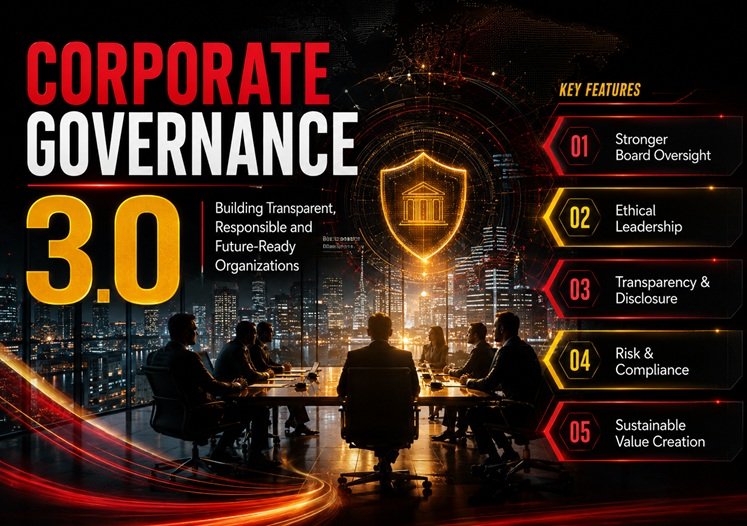
Five Governance Trends That Will Shape Indian Boardrooms by 2030
Several powerful trends are likely to define the next generation of corporate governance in India. First, AI governance committees and digital ethics frameworks will become commonplace. Second, cybersecurity dashboards will become a standing agenda item at every board meeting. Third, ESG metrics will increasingly be linked to executive compensation and long-term incentives.
Fourth, shareholder activism led by institutional investors and proxy advisory firms will continue to reshape board accountability. Finally, skill-based board composition will gradually replace status-based appointments as organisations seek expertise capable of navigating unprecedented complexity. Collectively, these developments represent the transition from governance centred on compliance to governance centred on strategic value creation.
Governance as a Competitive Advantage
India’s economic ambitions over the coming decade will require unprecedented levels of domestic and international investment. Capital today is highly mobile, selective and increasingly governance-sensitive. Investors recognise that strong governance often translates into better capital allocation, stronger crisis management, improved stakeholder trust and enhanced long-term performance.
Companies with robust governance practices are generally better positioned to attract global investors, secure financing at lower cost, withstand economic shocks and preserve corporate reputation during periods of uncertainty. Governance should therefore no longer be viewed merely as a cost of compliance.
It is an investment in institutional credibility. The companies that will lead India’s next phase of growth are unlikely to be those with the longest rulebooks or the most elaborate compliance manuals. They will be those whose boards consistently demonstrate integrity, transparency, accountability, adaptability and strategic foresight.
Corporate Governance 3.0 is therefore not simply about preventing failure. It is about building institutions capable of enduring success.
In the coming decade, competitive advantage will increasingly belong to companies that inspire trust as much as they generate profits. Governance is becoming a strategic asset that shapes investor confidence, organisational resilience and sustainable value creation. As India advances towards becoming one of the world’s leading economic powers, governance will increasingly determine which companies earn the confidence of investors, regulators, employees and society at large.
The boardroom is no longer merely supervising the business. It is helping define its future.
About the Author
Vineet Kumar is an Independent Financial Markets and Corporate Governance Analyst. The Author is also certified as an independent director and advisor and trainer for Fintech and Financial services organizations.
The views expressed are personal.
Copyright@IndiaCSR