

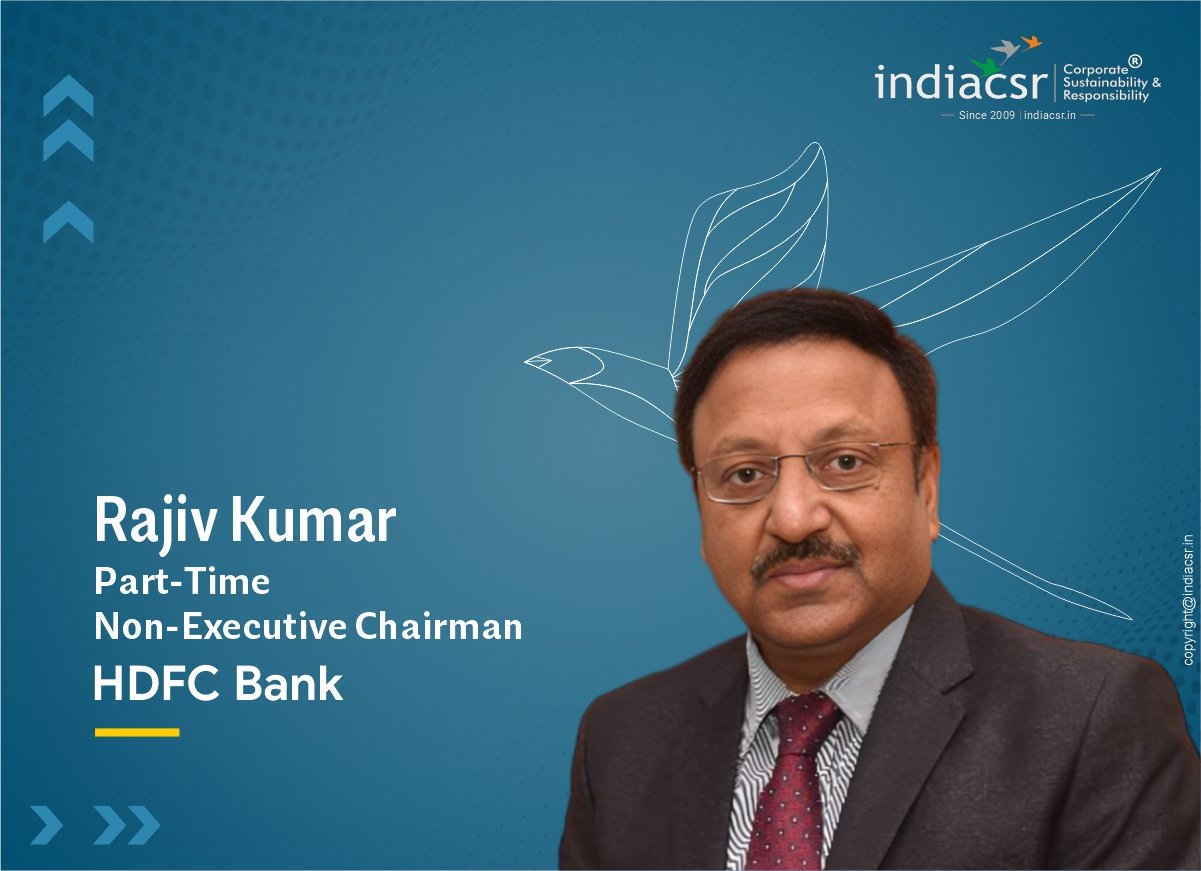



Seasoned Public Policy Leader, Financial Sector Reformer and HDFC Bank’s New Part-time Chairman
Rajiv Kumar, aged 66 years, a distinguished 1984-batch former Indian Administrative Service (IAS) officer, former Chief Election Commissioner and one of India’s most respected public policy reformers, has been appointed as an Additional Independent Director of HDFC Bank Limited and proposed as Part-time Chairman of the Bank. The appointment was approved by the Board of Directors of HDFC Bank at its meeting held on June 29, 2026. His appointment as an Additional Director in the capacity of Independent Director is effective from June 30, 2026 for a period of four years, subject to the approval of the shareholders of the Bank. His appointment as Part-time Chairman has been approved by the Board for a period of three years, subject to approval from the Reserve Bank of India. is a 1984-batch former IAS officer.
Disclosure Made to Stock Exchanges
HDFC Bank made the disclosure to BSE Limited and the National Stock Exchange of India Limited under Regulation 30 of the SEBI Listing Regulations. The disclosure was made through Ref. No. SE/2026-27/60 dated June 29, 2026. The Bank informed the exchanges that the appointment was based on the recommendation of its Governance, Nomination and Remuneration Committee. The disclosure was signed by Ajay Agarwal, Company Secretary and Group Head – Secretarial & Group Oversight of HDFC Bank Limited.

Legal Basis of the Appointment
The appointment has been disclosed under Regulation 30 read with Clause 7 of Paragraph A of Part A of Schedule III of the SEBI (Listing Obligations and Disclosure Requirements) Regulations, 2015. This regulation requires listed companies to disclose material events, including appointment of directors and key managerial personnel, to the stock exchanges. HDFC Bank also referred to SEBI Master Circular No. HO/49/14/14(7)2025-CFD-POD2/I/3762/2026 dated January 30, 2026 for the required disclosure format.
Two-Part Appointment Structure
The Board approved two related but legally distinct appointments for Rajiv Kumar. First, he has been appointed as an Additional Director in the category of Independent Director for four years with effect from June 30, 2026. Second, he has been proposed as Part-time Chairman of HDFC Bank for three years, but this appointment will become effective only from the date approved by the Reserve Bank of India. This distinction is important because the appointment of a chairman of a banking company requires regulatory approval.
Independent Director Appointment Subject to Shareholder Approval
Rajiv Kumar’s appointment as Independent Director is subject to approval by the shareholders of HDFC Bank. As per the disclosure, the Board has approved his appointment, but the appointment must be placed before the members of the Bank. HDFC Bank has also approved the revised notice convening its 32nd Annual General Meeting, scheduled to be held on Wednesday, August 5, 2026, by including resolution or resolutions relating to his appointment.
RBI Approval Required for Part-time Chairmanship
The appointment of Rajiv Kumar as Part-time Chairman of HDFC Bank is subject to the approval of the Reserve Bank of India. Since HDFC Bank is a banking company regulated by the RBI, the appointment of the Chairman is not complete merely by Board approval. The effective date of his appointment as Part-time Chairman will be the date approved by the RBI. His remuneration as Part-time Chairman will also be subject to RBI approval.
Tenure as Independent Director
Kumar has been appointed as an Additional Director in the capacity of Independent Director for a period of four years. His tenure begins from June 30, 2026. As an Independent Director, he will bring an external, objective and governance-focused perspective to the Board. The disclosure also states that he shall not be liable to retire by rotation, which is consistent with the treatment generally applicable to independent directors under company law and listing governance norms.
Tenure as Part-time Chairman
The Board has approved the appointment of Mr. Kumar as Part-time Chairman for a period of three years. However, the starting date of this tenure will depend on the date approved by the Reserve Bank of India. The role of Part-time Chairman in a large private sector bank carries significant governance responsibility. It requires oversight, independence, regulatory understanding and strategic maturity, especially in an institution of HDFC Bank’s size and systemic relevance.
Director Identification Number
Rajiv Kumar’s Director Identification Number is DIN: 08049696. The DIN is a mandatory unique identification number allotted to an individual who intends to be appointed as a director of a company in India. Its disclosure in the stock exchange filing strengthens transparency and ensures that the appointment is traceable under the corporate governance framework.
Confirmation on Debarment
HDFC Bank has confirmed that Rajiv Kumar is not debarred from holding the office of Director by virtue of any order passed by the Securities and Exchange Board of India or any other such authority. This confirmation is an important part of listed company governance disclosures. It assures investors and regulators that the appointee is legally eligible to hold the position of director.
Disclosure of Relationship with Directors
The Bank has also confirmed that Rajiv Kumar is not related to any other Director or Key Managerial Personnel of HDFC Bank. This disclosure is important from the perspective of independence, transparency and avoidance of conflict of interest. For an independent director, absence of relationship with existing directors and key managerial personnel strengthens the perception of objectivity and governance independence.
Board Meeting Details
The Board meeting at which the decision was taken commenced at 7:15 p.m. and ended at 8:10 p.m. on June 29, 2026. The disclosure of the timing of the Board meeting is part of listed company compliance and helps establish the chronology of the decision. The Bank requested the stock exchanges to take the information on record.
Registered Office and Corporate Identity
HDFC Bank Limited is registered with CIN: L65920MH1994PLC080618. The Bank’s registered office is located at HDFC Bank House, Senapati Bapat Marg, Lower Parel West, Mumbai – 400013. The communication also mentioned HDFC Bank Limited, Sandoz House, Shivsagar Estate, Dr. Annie Besant Road, Worli, Mumbai – 400018, along with telephone number 022-66521000, email shareholder.grievances@hdfc.bank.in and website www.hdfc.bank.in.
Rajiv Kumar: A Public Policy Leader of National Standing
Rajiv Kumar, aged 66 years, is a 1984-batch former IAS officer. He is widely regarded as a public policy leader with deep experience in financial services, banking reform, governance, public sector administration and institutional restructuring. His career has covered some of the most critical areas of India’s economic and administrative architecture. His appointment to HDFC Bank brings to the Bank a leader known for reform execution, regulatory understanding and institutional discipline.
Former Finance Secretary of India
Mr. Kumar retired as Finance Secretary of India in February 2020. The position of Finance Secretary is one of the most important administrative roles in the Government of India. It involves high-level coordination across economic policy, public finance, financial services, expenditure, revenue and institutional governance. His elevation to this position reflected his administrative experience, policy capability and trust within the highest levels of government.
Chairman of Public Enterprises Selection Board
After retirement, Mr. Kumar also briefly served as Chairman of the Public Enterprises Selection Board. PESB plays a key role in the selection of top leadership for public sector enterprises. His association with PESB reflects his continued involvement in institutional governance, leadership assessment and public sector management even after his formal retirement from the civil service.
Transformational Role in Financial Services
The most significant phase of Mr. Kumar’s public career was his tenure as Secretary, Department of Financial Services, from 2017 to 2020. He took charge at a time when India’s public sector banking system was under severe stress. Public sector banks were facing high levels of non-performing assets, capital constraints, weak lending confidence and governance concerns. The financial system required decisive action to restore discipline, transparency and trust.
Banking Sector Under Stress
When Mr. Kumar assumed responsibility at the Department of Financial Services, public sector banks were grappling with unrecognised NPAs and capital inadequacy. Many lenders were unable to extend fresh credit due to stressed balance sheets. There were concerns over gold-plating of projects, diversion and recirculation of equity and debt, weak consortium lending practices and governance gaps. The financial system needed a deep clean-up rather than surface-level correction.
NBFC and Micro-Credit Challenges
The period also witnessed stress in the non-banking financial company sector. After demonetisation, NBFCs were struggling to fill micro-credit gaps. Liquidity challenges in the sector created concerns for credit availability, especially for small borrowers, micro enterprises and informal economic segments. Mr. Kumar’s tenure involved policy responses that had to balance financial stability with continued credit access.
Action Against Shell Companies
One of the early decisive actions during Mr. Kumar’s tenure was the freezing of accounts of about 3.38 lakh shell companies. This action came within a fortnight of his joining the Department of Financial Services. It targeted the architecture of black money and illicit financial movement. The move sent a strong signal that financial systems could not be misused for opaque or illegal fund circulation.
Action Against Ponzi Schemes
Mr. Kumar’s tenure also witnessed strong policy action against Ponzi schemes and unregulated deposit schemes. The Banning of Unregulated Deposit Schemes Act, 2019 was passed during this period. The Act aimed to protect citizens from fraudulent deposit-taking activities. It strengthened the legal framework against schemes that misled people and caused financial harm to depositors.
Clean Banking as Reform Philosophy
Kumar’s reform approach was anchored in the idea of clean banking. Clean banking meant transparent recognition of stress, responsible lending, accountable borrowing and stronger governance. It required banks to stop hiding bad loans and instead address them through proper recognition, provisioning and recovery mechanisms. This approach changed the tone of banking reforms during a difficult period.
The 4R Strategy
A major framework associated with his tenure was the “4R strategy” of Recognition, Resolution, Recapitalisation and Reforms. Recognition involved transparent identification of non-performing assets. Resolution involved using mechanisms such as the Insolvency and Bankruptcy Code to resolve stressed loans. Recapitalisation involved strengthening banks with capital support. Reforms involved improving governance, risk management and operational discipline.
Recognition of NPAs
Under Kumar’s policy direction, banks were pushed to recognise stressed assets more transparently. For years, delayed recognition of bad loans had weakened balance sheets and concealed the true level of stress. Recognition was painful but necessary. It helped bring honesty into the system and created a realistic foundation for recovery and reform.
Resolution Through Accountability
Resolution was another crucial part of the reform process. Borrowers were expected to honour repayment obligations, and default could no longer be treated lightly. The Insolvency and Bankruptcy Code became an important framework for enforcing accountability. Mr. Kumar’s approach helped reset the creditor-debtor relationship and made repayment discipline central to India’s banking culture.
Recapitalisation of Public Sector Banks
One of Mr. Kumar’s most important contributions was the unprecedented recapitalisation of public sector banks. Capital infusion exceeding ₹3 lakh crore was undertaken to restore solvency, strengthen balance sheets and revive lending capacity. This was a major intervention at a critical time. It allowed banks to absorb stress, improve capital adequacy and support economic activity.
Reforms in Governance and Risk Management
The reform agenda did not stop at capital infusion. Mr. Kumar emphasised governance reforms, risk management and technology-based monitoring. Specialised monitoring was introduced for large exposures. Fraud checks and IT-based risk scoring replaced weak and informal systems. These reforms were designed to reduce future stress and improve accountability within the banking system.
Public Sector Bank Consolidation
Mr. Kumar spearheaded the consolidation of public sector banks. Under this exercise, 27 public sector banks were merged into 12 stronger entities. This was one of the largest structural reforms in India’s public banking system. The consolidation aimed to create stronger banks with better scale, efficiency, governance and competitiveness.
Building Stronger Banking Institutions
The consolidation of public sector banks was designed to improve operational strength. Larger banks could better manage capital, technology, risk, credit underwriting and customer service. The move also reduced fragmentation in the public banking space. It helped create institutions capable of competing more effectively in a changing financial market.
Rationalisation of Regional Rural Banks
Kumar also supported the rationalisation of Regional Rural Banks into a more efficient one-state-one-RRB structure. Regional Rural Banks play an important role in rural finance, agriculture credit and financial inclusion. Rationalisation was aimed at improving efficiency, governance and service delivery in rural banking.
Mandatory Passport Details for Large Loans
During his tenure, passport details became mandatory for loans of Rs. 50 crore and above. This measure was introduced to prevent large borrowers from fleeing the country before action could be taken in default or fraud cases. It was a practical governance reform that directly addressed public concerns arising from high-profile loan default cases.
Specialised Monitoring for Large Exposures
Specialised monitoring was introduced for loans above Rs. 250 crore. Large exposures carry higher systemic risk and require closer oversight. The use of specialised monitoring helped banks identify stress early, track borrower behaviour and improve credit supervision. This marked a shift from reactive monitoring to preventive risk management.
IT-Based Risk Scoring
IT-based risk scoring was introduced using more than 34 factors. This strengthened the credit monitoring process by making it more data-driven. It reduced reliance on soft signals and subjective assessments. Technology-based risk scoring helped banks detect warning signs and strengthen lending discipline.
Resetting the Creditor-Debtor Relationship
Kumar’s reform message was direct and clear: money must be lent prudently, and debtors must repay. This reset was critical for restoring trust in the financial system. It reminded lenders of their responsibility to assess risk properly and reminded borrowers that public money and depositors’ funds could not be misused.
Strengthening Depositor Protection
Depositor protection was another important area of reform. During this period, deposit insurance coverage was enhanced from Rs. 1 lakh to Rs. 5 lakh. This was a major measure for ordinary depositors. It improved public confidence in the banking system and showed that financial reform was not only about banks but also about citizens.
Financial Inclusion Through Jan Dhan
Kumar also contributed to the expansion of financial inclusion under the Jan Dhan framework. He supported wider access to banking services and promoted credit growth towards retail, agriculture and MSME sectors. His inclusion agenda aimed to bring more citizens and small businesses into the formal financial system.
Supporting MSME and Agriculture Credit
Credit flow to MSMEs and agriculture remained an important priority during his tenure. These sectors are crucial for employment, livelihoods and grassroots economic activity. Mr. Kumar’s approach sought to expand access to credit while maintaining underwriting discipline. This balance was important because reckless credit expansion could create future stress.
Response to NBFC Liquidity Crisis
Following liquidity challenges in the NBFC sector, Rajiv Kumar contributed to policy coordination aimed at stabilising the financial ecosystem. NBFCs play a major role in lending to small borrowers, informal businesses and underserved segments. Stabilising the sector was important for maintaining confidence and credit availability.
EASE Reform Agenda
Kumar’s tenure also witnessed implementation of the Enhanced Access and Service Excellence agenda, known as EASE. The EASE agenda focused on improving customer service, responsible banking, financial inclusion, digital capability, credit delivery and governance in public sector banks. It brought measurable reform indicators into banking operations.
Restructuring of a Public Sector Bank
The disclosure also notes that he contributed to reforms such as the restructuring of a public sector bank. Such restructuring measures are highly sensitive and require coordination among regulators, government, banks and stakeholders. His experience in this area adds to his reputation as a crisis manager and institutional reformer.
Role in Financial Stability Architecture
Kumar has either sat on or chaired several bodies that are central to India’s financial architecture. These include the Central Board of the Reserve Bank of India, the Financial Stability and Development Council and the Financial Sector Regulatory Appointments Search Committee. These roles provided him exposure to financial stability, regulatory appointments and macro-financial governance.
Role in Appointments and Public Institutions
He also served as Secretary of the Appointments Committee of the Cabinet, was associated with the Public Enterprises Selection Board and the Bank Board Bureau, and served on the Boards of State Bank of India and NABARD. These positions show his involvement in institutional leadership, banking governance, rural finance and public sector appointments.
Contribution to RBI Economic Capital Framework
Kumar was associated with an expert committee on the Reserve Bank of India’s economic capital framework. This is a highly technical and significant area of central banking governance. It involves questions of capital, reserves, risk buffers and transfer of surplus. His role in such bodies highlights his understanding of financial institutions at the highest policy level.
Role in NITI Aayog Restructuring Committee
He was also associated with a committee on the restructuring of NITI Aayog. This reflects his broader public policy experience beyond banking and finance. NITI Aayog is a key institution in India’s policy planning and development strategy. His contribution to its restructuring demonstrates his engagement with national governance architecture.
Service as Chief Election Commissioner
Rajiv Kumar also served as the 25th Chief Election Commissioner of India. This role placed him at the centre of India’s democratic process. The office of the Chief Election Commissioner carries enormous constitutional responsibility, requiring neutrality, administrative capacity, public trust and institutional courage.
Record Participation in 2024 General Elections
During the 2024 General Elections to the Lok Sabha, world records were created with participation of around 642 million electors and around 312 million women electors. This massive democratic exercise reflected India’s electoral scale and administrative capability. Mr. Kumar’s role in this process added another major dimension to his public service record.
Administrative Leadership Across Sectors
Kumar’s career stands out because of its diversity. He has worked across banking, financial services, public enterprises, regulatory appointments, rural finance, election management and institutional restructuring. This breadth gives him a rare understanding of how public institutions function and how reforms can be implemented in complex systems.
Reputation as a Reform-Oriented Administrator
Kumar is widely regarded as a reform-oriented administrator. His leadership style has been associated with decisive action, systemic correction and long-term institutional strengthening. He is known for taking difficult decisions during challenging periods. His work in the banking sector demonstrated that reform requires both policy clarity and execution discipline.
Importance of His Appointment for HDFC Bank
His appointment is important for HDFC Bank because the Bank operates in a highly regulated and systemically important sector. HDFC Bank is India’s largest private sector bank and plays a critical role in retail banking, corporate banking, digital banking, payments, deposits and credit delivery. The presence of a leader with Mr. Kumar’s regulatory and governance experience can strengthen Board-level oversight.
Governance Value for a Large Bank
A bank of HDFC Bank’s size requires strong governance architecture. Board leadership must understand risk, compliance, regulatory expectations, customer protection, capital strength and systemic responsibility. Kumar’s experience in financial stability and banking reform makes him well suited to contribute to these areas.
Independent Oversight and Strategic Guidance
As an Independent Director, Kumar is expected to provide independent oversight and strategic guidance. Independent directors are not involved in day-to-day management but play a vital role in governance, risk oversight, accountability and protection of stakeholder interests. His independent status strengthens the governance profile of the Board.
Part-time Chairman Role
As Part-time Chairman, subject to RBI approval, Kumar will hold a leadership position on the Board. The Chairman’s role is crucial in ensuring that Board processes are effective, deliberations are balanced and governance standards remain high. In a banking institution, this role also carries added significance because of regulatory expectations.
Fit with Banking Sector Priorities
India’s banking sector is currently shaped by digital transformation, rising competition, stricter regulation, financial inclusion, cyber risk, credit expansion and customer protection. Kumar’s background in clean banking, risk monitoring, governance and financial inclusion aligns closely with these priorities. His experience can support HDFC Bank’s long-term institutional stability.
Legacy in Public Sector Banking Reform
Kumar’s legacy in public sector banking reform is significant. He helped guide the system through recognition of stress, recapitalisation, consolidation and governance reform. His tenure contributed to a turnaround in public sector banks, with improved asset quality and return to profitability. These achievements remain central to his public profile.
Balance of Inclusion and Discipline
One of Kumar’s key strengths has been his ability to balance inclusion with discipline. He supported financial inclusion, Jan Dhan expansion and credit flow to priority sectors. At the same time, he insisted on prudent lending, proper risk assessment and borrower accountability. This balance is crucial for sustainable banking growth.
A Career Built on Institutional Trust
Kumar’s professional journey reflects institutional trust. He has been entrusted with roles in finance, banking, public enterprises, appointments, central banking, rural finance and elections. Such assignments require credibility, neutrality and administrative capability. His career shows how a civil servant can influence multiple pillars of national governance.
Legal Compliance and Corporate Governance Summary
From a legal and compliance perspective, the appointment has several important elements. It was approved by the Board on June 29, 2026. It was based on the recommendation of the Governance, Nomination and Remuneration Committee. It was disclosed under Regulation 30 of the SEBI Listing Regulations. His Independent Director appointment is effective from June 30, 2026 for four years, subject to shareholder approval. His Part-time Chairman appointment is for three years, subject to RBI approval. He is not liable to retire by rotation. He is not debarred by SEBI or any other authority. He is not related to any Director or Key Managerial Personnel of HDFC Bank.
AGM Resolution and Shareholder Role
The revised notice for the 32nd Annual General Meeting includes resolutions relating to Kumar’s appointment. The AGM is scheduled for Wednesday, August 5, 2026. Shareholder approval will be an important step in confirming his appointment as Independent Director. This reflects the governance principle that directors of listed companies must be accountable to shareholders.
Compliance with Listed Company Disclosure Norms
HDFC Bank’s disclosure follows the format required for appointment-related disclosures. It includes the reason for change, date and term of appointment, brief profile and disclosure of relationship between directors. These details are required to ensure that investors receive timely, complete and material information about Board-level changes.
Importance of RBI Oversight
RBI approval for the Part-time Chairman role is essential because banks are custodians of public deposits and are central to financial stability. The Reserve Bank examines such appointments from the perspective of suitability, governance and regulatory expectations. The requirement of RBI approval reflects the higher standard applicable to banking companies compared with ordinary corporate entities.
No Rotation Clause
The disclosure states that Mr. Kumar shall not be liable to retire by rotation. This means his tenure as Independent Director will be governed by the approved fixed term rather than retirement by rotation at annual general meetings. This is consistent with the governance framework for independent directors and helps protect their independence during their approved tenure.
Independence and Governance Credibility
The declaration that Kumar is not related to any other Director or Key Managerial Personnel supports his independence. Independent directors are expected to exercise judgment without personal or family influence from company insiders. This aspect is especially important in banking, where governance failures can have wider economic consequences.
A New Chapter in a Distinguished Career
Mr. Rajiv Kumar’s appointment to HDFC Bank represents a new chapter in a career defined by public service, financial reform and institutional leadership. After serving the nation through key government and constitutional roles, he now enters the Board leadership framework of a major private sector bank. His experience is expected to add depth to the Bank’s governance and strategic oversight.
(India CSR)



