

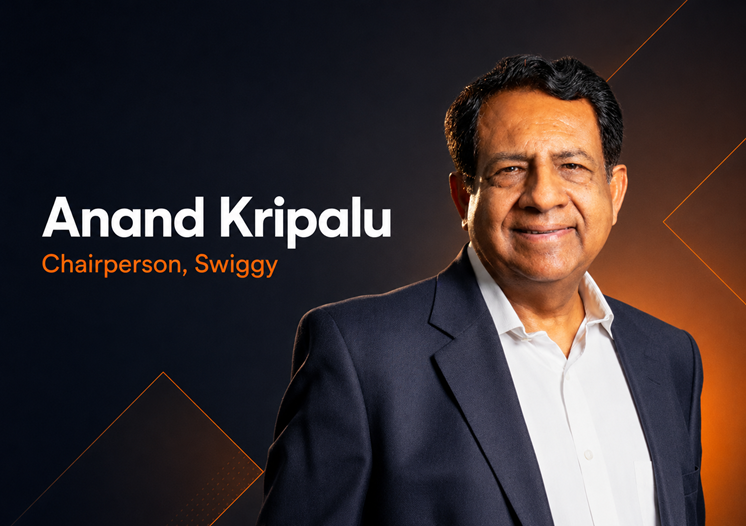


Chairperson Anand Kripalu says Swiggy’s first full year as a listed company strengthened its financial position, operating discipline and long-term growth strategy.
BENGALURU (India CSR): Swiggy Limited is preparing for India’s next phase of digital consumption by combining expansion across food delivery and quick commerce with financial discipline, technology investment, responsible business practices and stronger corporate governance, Chairperson Anand Kripalu has said. In his message to shareholders in Swiggy’s Integrated Annual Report for FY 2025-26, Kripalu described the financial year as an important stage in the company’s evolution. It was Swiggy’s first full year as a listed company and marked the beginning of what he called a more mature chapter in its journey.
According to the Chairperson, Swiggy entered this phase with greater transparency, stronger discipline and a deeper focus on creating sustainable, long-term value for shareholders and other stakeholders. “The progress achieved during the year reaffirms the strength of your Company’s business model and the clarity of its strategy,” Kripalu said in the shareholder communication.
Anand Kripalu is an Independent Director and Chairman of Board since December 4, 2023. He holds a Bachelor’s degree in Technology in Electrical Engineering from the Indian Institute of Technology Madras and a Post Graduate Diploma in Management from the Indian Institute of Management Calcutta. He also holds certification in the Advanced Management Program from The Wharton School, University of Pennsylvania. He is currently the Managing Director and Global Chief Executive Officer at EPL Limited. He is also associated with United Breweries Limited and PGP Glass Private Limited as a director on their respective boards.
Also Read Swiggy Reports No CSR Statutory Spending Obligation in FY 2025-26 Due to Past Losses
India’s Consumption Growth Creates Expansion Opportunity
Kripalu said India entered FY 2025-26 on a relatively strong economic footing despite global uncertainty, geopolitical tensions and uneven growth across major economies. The country’s economic resilience was supported by domestic consumption, services-sector expansion, infrastructure investments, easing inflation and improvements in real incomes, he noted.
Household consumption remained an important component of India’s growth story. Private final consumption expenditure accounted for its highest share of gross domestic product in more than a decade, creating a favourable environment for consumer-facing digital businesses. This economic backdrop is particularly significant for Swiggy because the company operates at the intersection of consumption, technology and logistics.
India’s expanding digital economy is also influencing how consumers discover, purchase and receive products and services. App-led commerce is becoming more widely accepted, while convenience is gradually moving from a premium service to an everyday consumer expectation. Kripalu said India’s retail market remains digitally underpenetrated, providing considerable room for organised online platforms to expand.
Swiggy Builds for India’s Next Consumption Era, Sharpens Focus on Growth, Governance and Profitability
Quick Commerce Remains at an Early Stage
Swiggy believes quick commerce is still in the early stages of development in India, despite its rapid expansion across urban markets. The segment is evolving beyond emergency purchases and limited grocery requirements. It is increasingly becoming a broader convenience platform covering household essentials, personal care products and other everyday consumer needs.
Kripalu said food delivery also retains meaningful headroom as more consumers and meal occasions shift online. Digital adoption is similarly transforming dining out, events and other forms of out-of-home consumption. Reliable fulfilment, wider product choice and easier digital access are reshaping how urban consumers interact with restaurants, retailers and service providers. These developments support Swiggy’s long-term proposition as an integrated platform serving multiple consumption occasions rather than operating as a single-category delivery company.
Swiggy Says It Helped Shape Emerging Categories
Kripalu said Swiggy has not merely participated in newly emerging consumer categories but has also contributed to creating and shaping them. The company began by building its presence in food delivery and subsequently expanded into quick commerce, dining-out services and other convenience-led offerings.
Swiggy’s business strategy has remained centred on addressing everyday consumer requirements through technology-backed delivery and fulfilment systems. Its stated purpose is to improve the quality of life of urban consumers by providing greater convenience. During FY 2025-26, the company sought to translate this purpose into broader progress across its platform businesses.
Food Delivery Deepens Consumer Engagement
Food Delivery continued to deepen engagement by expanding the number of occasions and consumer requirements served through the platform, according to the Chairperson’s statement. The company is seeking to move beyond traditional lunch and dinner ordering occasions by building solutions around a wider range of food consumption needs.
Swiggy’s scale in food delivery also supports the growth of its adjacent businesses. Existing customers, delivery systems, technology infrastructure, restaurant relationships and data capabilities can be used across different parts of the platform.
Kripalu pointed to increasing cross-pollination across Swiggy’s businesses as evidence of the strength of its integrated ecosystem. This cross-platform participation can enable customers who use one Swiggy service to discover and adopt other offerings, strengthening engagement and improving the overall value of the platform.
Quick Commerce Scales in Competitive Market
Swiggy’s Quick Commerce business expanded during FY 2025-26 in what the company described as a large and highly competitive market. The platform strengthened its proposition as a broader provider of everyday convenience. The expansion reflects growing consumer demand for faster access to groceries, household goods and other frequently purchased products.
However, the segment also requires considerable investment in technology, logistics, fulfilment infrastructure, inventory systems and market development. Kripalu said leadership in fast-growing sectors requires staying power, financial prudence, robust governance and consumer confidence. This approach influenced Swiggy’s decisions regarding investment and capital deployment during the year.
Out-of-Home Consumption Achieves Full-Year Profitability
Swiggy’s Out-of-Home Consumption business delivered its first full year of profitability during FY 2025-26, according to the annual report statement. The development indicates that adjacent businesses can become meaningful contributors when effectively integrated with the company’s wider ecosystem.
Swiggy’s out-of-home offering connects users with dining experiences and other consumption occasions outside the home. Its performance is significant because it demonstrates the possibility of building profitable business lines around the company’s core consumer platform. Kripalu said the progress across Food Delivery, Quick Commerce and Out-of-Home Consumption reflected the broad-based development of Swiggy’s operations.
Swiggy Raises Rs. 10,000 Crore Through QIP
Swiggy strengthened its balance sheet by completing a Qualified Institutional Placement worth Rs. 10,000 crore during FY 2025-26. The company also monetised its investment in Rapido, providing additional financial flexibility. Kripalu described the infusion as timely and strategically important. The strengthened financial position is expected to help Swiggy invest in future opportunities, navigate competition and pursue long-term value creation.
The capital can provide the company with greater capacity to invest across technology, logistics, customer experience, platform differentiation and emerging business categories. At the same time, Swiggy’s leadership has emphasised prudent capital allocation as one of its priorities for the next phase.
Technology and Innovation Remain Central
Technology and innovation continue to form an important part of Swiggy’s corporate culture and growth model. The company uses technology to understand changing consumer requirements, improve experiences for partners and make convenience more reliable, accessible and scalable. Kripalu, however, stressed that innovation must be supported by strong execution, organisational learning and accountability.
The Board’s confidence, he said, is based not only on Swiggy’s willingness to experiment but also on the quality of execution behind those experiments. Maintaining a balance between ambition and operational rigour will remain critical as the company increases its scale and expands into new areas.
Public Listing Brings Stronger Governance Focus
Corporate governance has become a major priority for Swiggy following its transition to the public markets. According to Kripalu, the listing has strengthened the company’s commitment to transparency, disclosure quality, independent oversight and stakeholder engagement. Swiggy aims to move beyond simply meeting the formal requirements applicable to a listed company. Its objective is to build institutional credibility and consistently earn stakeholder confidence.
This will be important as the company occupies an increasingly influential position in India’s digital consumption economy and works with a large network of customers, delivery partners, restaurants, merchants and brands.
Swiggy Placed in NSE Sustainability ‘Leader’ Category
Responsible growth is also central to Swiggy’s future strategy. NSE Sustainability Ratings & Analytics has placed Swiggy in the “Leader” category, reflecting the company’s performance across environmental, social and governance parameters, according to Kripalu’s statement.
Swiggy’s sustainability strategy is structured around three areas—Climate, Community and Conscience. The company is pursuing a set of Sustainability Goals for 2030 covering electric mobility, renewable energy, packaging, skills, women’s empowerment, delivery-partner welfare, governance and data privacy.
Swiggy’s 2030 Sustainability Commitments
Among its stated commitments, Swiggy is working towards achieving a 100% electric vehicle delivery fleet. The company also aims to transition to 100% renewable energy in its direct operations and strengthen circular practices related to packaging.
These goals are particularly relevant to a technology and logistics platform whose environmental footprint is influenced by delivery mobility, energy consumption and packaging materials. Swiggy also plans to upskill and engage one million individuals across its value chain by 2030. The target recognises the importance of building capabilities and economic opportunities across the wider platform ecosystem.
Another commitment seeks to empower 100,000 women across Swiggy’s ecosystem. The company has also identified the welfare of delivery partners as an important area of action. Its sustainability roadmap includes measures intended to improve partner welfare alongside stronger governance and data-privacy practices.
Partners Remain Central to Platform Growth
Kripalu acknowledged the contribution of Swiggy’s employees, customers and partners to the company’s development. The platform depends on a large and diverse ecosystem that includes delivery partners, restaurant partners, merchant partners and brand partners. Their collective contribution supports the company’s ability to expand its services and maintain its consumer proposition. Trust across this network will remain important as Swiggy scales its existing businesses and develops new convenience-led offerings.
Profitability and Capital Discipline Among Key Priorities
Swiggy has identified four broad priorities for its next phase: prudent capital allocation, continued technology investment, sharper differentiation and steady progress towards profitability. The company intends to use the business foundation developed over the years to deepen its understanding of customers, strengthen its different operating segments and maintain cost discipline.
While India’s expanding consumption economy offers a large opportunity, Swiggy must also navigate competitive intensity, evolving customer expectations and the capital requirements associated with rapid expansion. The company’s strengthened balance sheet provides room for investment, but management will be expected to demonstrate that growth can progressively translate into sustainable financial performance.
Building an Institution for the Long Term
Kripalu said Swiggy’s future would be shaped by the conviction that guided its development from food delivery into a broader digital convenience platform. “Swiggy’s next chapter will be shaped by the same conviction that has brought us here: to keep building with purpose, serving with care and creating an institution worthy of India’s next consumption era,” he said.
The Chairperson’s statement positions FY 2025-26 as a transition year in which Swiggy combined expansion with greater institutional maturity. As the company moves forward, its ability to balance innovation, competition and capital deployment with governance, sustainability and profitability will determine how effectively it captures the opportunities emerging from India’s next consumption era.
Key Facts
| Particular | Details |
|---|---|
| Company | Swiggy Limited |
| Reporting period | FY 2025-26 |
| Leadership statement | Anand Kripalu, Chairperson |
| Major capital raising | Rs. 10,000 crore through QIP |
| Additional capital action | Monetisation of Rapido investment |
| Profitable business development | Out-of-Home Consumption delivered its first full year of profitability |
| Sustainability rating | ‘Leader’ category by NSE Sustainability Ratings & Analytics |
| Sustainability framework | Climate, Community and Conscience |
| EV commitment | 100% EV delivery fleet by 2030 |
| Renewable-energy commitment | 100% renewable energy in direct operations by 2030 |
| Value-chain target | Upskill and engage one million individuals |
| Women’s empowerment target | Empower 100,000 women across the ecosystem |
| Strategic priorities | Capital discipline, technology, differentiation and profitability |



