

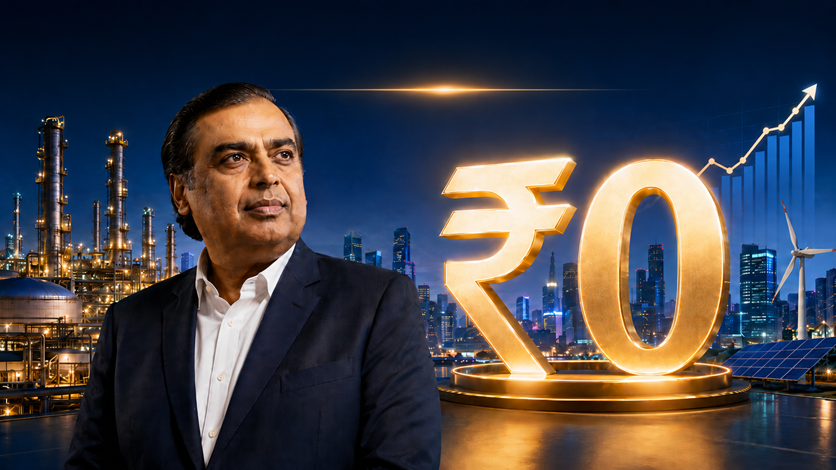


Reliance Chairman and Managing Director drew nil salary as company posted ₹95,754 crore profit and continued heavy capital investment
In the upper echelons of corporate governance, executive compensation is frequently viewed as a barometer for institutional priorities. For Reliance Industries Limited (RIL), India’s largest private-sector enterprise, the financial disclosures contained within its Integrated Annual Report for FY 2025-26 present a striking corporate milestone. At a time when global CEO pay packages are scaling historic heights, RIL Chairman and Managing Director Mukesh D. Ambani has maintained an unprecedented personal fiscal protocol: his total managerial remuneration for the fiscal year was exactly Rs. 0 (Nil).
This marks a prolonged continuation of an intentional strategy that began as an act of solidarity during a global crisis, evolving over nearly two decades into a core tenet of corporate governance. For analytical observers and news media alike, looking beyond the headline number reveals a calculated approach to capital allocation, executive moderation, and institutional legacy.
For employees, investors and public observers, a zero-remuneration disclosure at the top draws attention because pay practices shape perceptions of leadership conduct. RIL had a workforce of 4,19,911 people and reported employee benefits of Rs. 30,318 crore in FY 2025-26. Against that scale, the chairman’s nil remuneration becomes part of a larger debate on leadership, ownership and stakeholder alignment.
The Genesis of Moderation: Trailing the Historical Timeline
To analyze the FY 2025-26 “Nil” remuneration structure objectively, one must trace its roots back over 15 years. Amid a raging debate over corporate compensation levels following the 2008 global financial crisis, Ambani voluntarily capped his annual compensation at Rs. 15 crore in October 2009.
| Fiscal Period | Mukesh Ambani’s Remuneration Status | Operational Context |
| FY 2008-09 to FY 2019-20 | Capped at ₹15 Crore Annually | Personal example of executive moderation |
| FY 2020-21 to FY 2024-25 | ₹0 (Nil) Voluntarily Foregone | Pandemic solidarity transitioned to capital conservation |
| FY 2025-26 | ₹0 (Nil) | Focus on New Energy and Retail hyper-growth |
By consistently drawing zero salary, allowances, perquisites, or commissions over consecutive fiscal terms, Ambani has effectively foregone hundreds of crores in statutory managerial commissions that he is legally entitled to under Indian corporate laws.
The Mathematics of Governance: Foregone Capital vs. Shareholder Yield
Under the Indian Companies Act, 2013, a public limited company’s managerial personnel can collectively draw up to 11% of its net profits, with individual managing directors entitled to up to 5%. Given that Reliance Industries recorded a staggering consolidated net profit of Rs. 95,754 crore for FY 2025-26, Ambani’s legal ceiling for compensation could theoretically sit in the thousands of crores.
By choosing a zero-remuneration model, this capital remains embedded directly within the enterprise. It acts as an internal funding mechanism for the company’s capital expenditure (Capex) cycles. In FY 2025-26 alone, RIL deployed heavy capital to fund its ongoing rollouts in New Energy gigafactories and Jio infrastructure. For public markets, this zero-rupee salary shifts focus entirely toward the value of his equity holding, closely aligning his personal net worth with the performance of retail shareholders.
Company Performance During the Year
Reliance Industries reported growth across key financial indicators during FY 2025-26. Consolidated revenue rose 9.8% year-on-year to Rs. 11,75,919 crore. EBITDA increased 13.4% year-on-year to Rs. 2,07,911 crore. Profit After Tax rose 17.8% to Rs. 95,754 crore.
| Financial Indicator | FY 2025-26 | Year-on-Year Change |
| Consolidated revenue | ₹11,75,919 crore | 9.8% growth |
| EBITDA | ₹2,07,911 crore | 13.4% growth |
| Profit After Tax | ₹95,754 crore | 17.8% growth |
| Cash profit | ₹1,71,258 crore | 16.6% growth |
| Capital expenditure | ₹1,44,271 crore | Higher than ₹1,31,107 crore in FY 2024-25 |
The company’s performance was supported by Digital Services, Retail, Oil-to-Chemicals, Media and Entertainment, and Oil and Gas businesses. The report said capital expenditure was mainly directed towards growth projects in Oil-to-Chemicals and New Energy, along with ongoing initiatives in Digital Services and Retail.
Executive Directors’ Remuneration
While Mukesh Ambani’s remuneration was reported as nil, other executive directors received remuneration during the year. Nikhil R. Meswani received Rs. 25 crore. Hital R. Meswani received Rs. 25 crore. P. M. S. Prasad received Rs. 20.58 crore. Anant M. Ambani received Rs. 12.17 crore after being appointed as Whole-time Director and designated as Executive Director with effect from May 1, 2025.
| Executive Director | Salary, Allowances and Perquisites | Retiral Benefits | Commission | Total Remuneration |
| Mukesh D. Ambani | Nil | Nil | Nil | Nil |
| Nikhil R. Meswani | ₹10 crore | ₹0.44 crore | ₹14.56 crore | ₹25 crore |
| Hital R. Meswani | ₹10 crore | ₹0.44 crore | ₹14.56 crore | ₹25 crore |
| P. M. S. Prasad | ₹20 crore | ₹0.58 crore | Nil | ₹20.58 crore |
| Anant M. Ambani | ₹9.17 crore | ₹0.71 crore | ₹2.29 crore | ₹12.17 crore |
Other Directors Were Paid
The nil remuneration is specific to Mukesh Ambani. Other executive directors received remuneration under the company’s approved framework. Nikhil R. Meswani received Rs. 25 crore. Hital R. Meswani received Rs. 25 crore. P. M. S. Prasad received Rs. 20.58 crore. Anant M. Ambani, who became Whole-time Director and Executive Director from May 1, 2025, received Rs. 12.17 crore.
| Executive Director | Total Remuneration in FY 2025-26 |
| Mukesh D. Ambani | Nil |
| Nikhil R. Meswani | ₹25 crore |
| Hital R. Meswani | ₹25 crore |
| P. M. S. Prasad | ₹20.58 crore |
| Anant M. Ambani | ₹12.17 crore |
This indicates that Reliance continues to operate a performance-linked remuneration structure for its executive leadership. Ambani’s zero pay is therefore a personal remuneration position, not a company-wide cap on executive compensation.
The Contrasting Executive Ecosystem
While the Chairman’s remuneration ledger remains at zero, RIL’s Human Resources, Nomination and Remuneration Committee operates a highly competitive, performance-linked model for its broader executive team. The report highlights that other Whole-Time Directors and key senior management personnel continue to draw market-competitive salaries. This balance ensures that the zero-salary approach remains a personal choice of the promoter rather than an institutional cap that might restrict the company’s ability to attract external executive talent.
You Learn
- Mukesh Ambani’s zero-remuneration statement for FY 2025-26 is more than a public relations narrative; it is a calculated model of corporate governance. In an era where executive compensation is often scrutinized by institutional investors, an individual leading a Fortune 500 entity without drawing from the corporate treasury serves as a notable case study in alignment.
- By linking his financial incentives to long-term equity appreciation rather than fixed salary or performance bonuses, Ambani provides a clear signal to global credit markets and local shareholders: his primary focus remains on execution, cash flow management, and driving the group’s transition into technology, retail, and clean energy.
- From a governance perspective, the disclosure separates promoter-chairman compensation from broader executive pay. It also comes during a period of leadership transition, with Anant Ambani entering an executive role during the year.
Copyright@India CSR®



