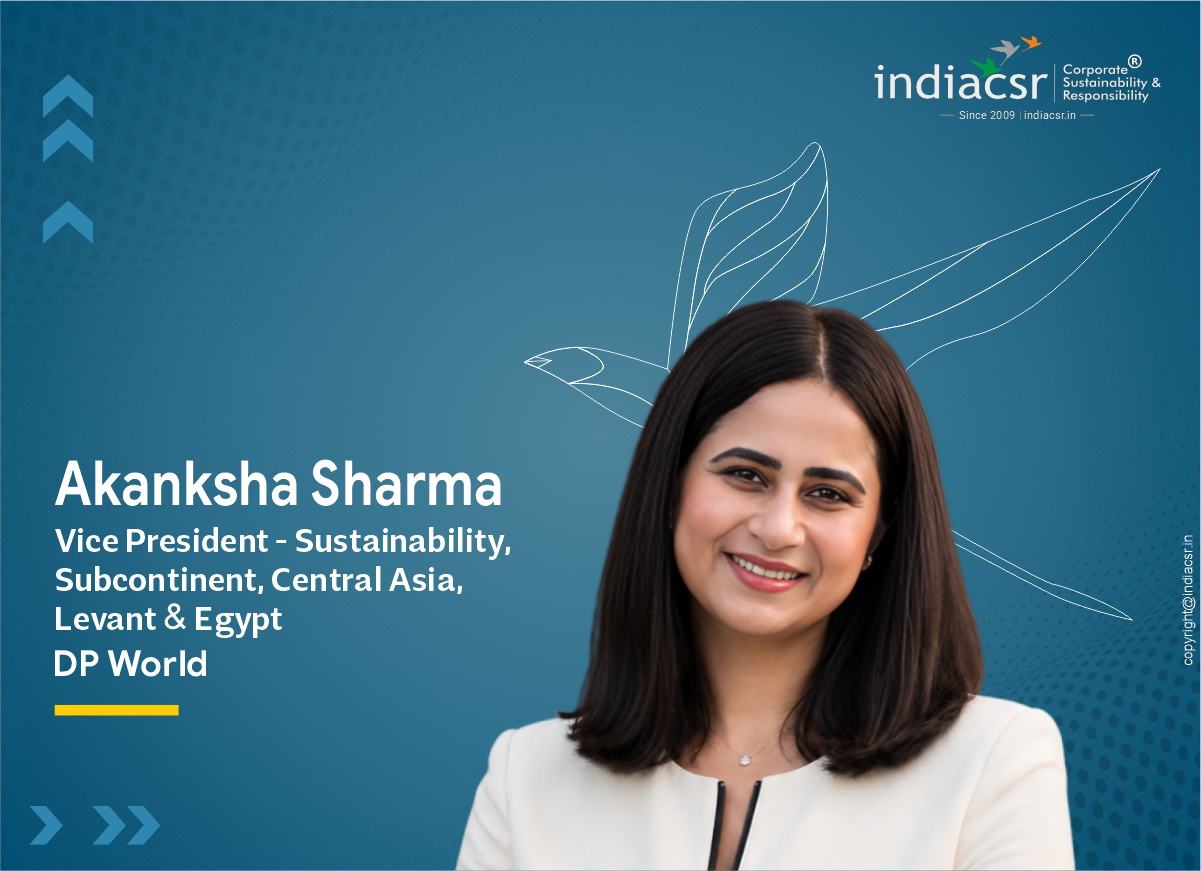



Akanksha Sharma, Vice President – Sustainability, Subcontinent, Central Asia, Levant & Egypt, DP World, explains how low-carbon infrastructure, inclusive communities, and workforce well-being can shape India’s logistics future.
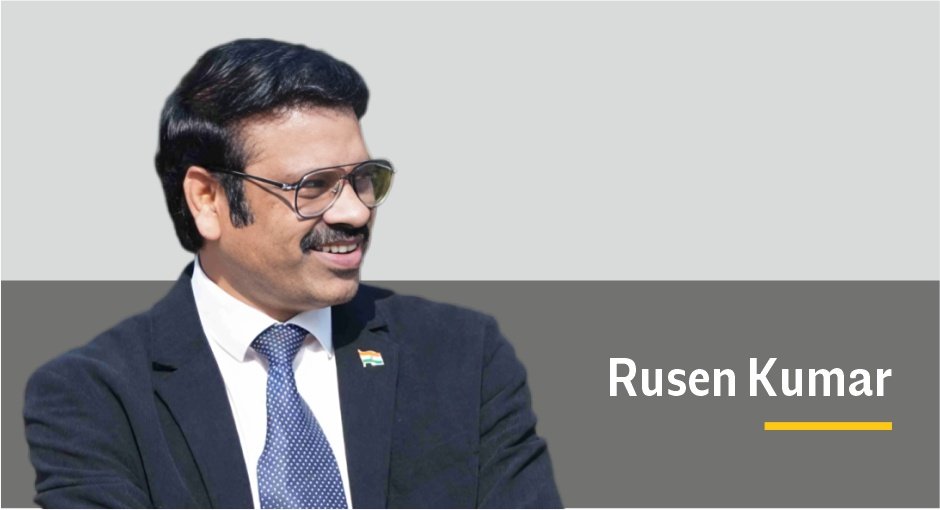
By Rusen Kumar
Sustainability is now central to the future of trade and logistics. As India builds stronger supply chains, the sector must reduce emissions, use cleaner energy, create safer workplaces and ensure that economic growth reaches communities connected to logistics infrastructure. In this exclusive interview with India CSR, Akanksha Sharma, Vice President – Sustainability, Subcontinent, Central Asia, Levant & Egypt, DP World, shares the company’s perspective on responsible leadership and sustainable growth. She discusses renewable energy at port terminals, rail-led logistics, community programmes, mangrove restoration, women’s participation and the wellbeing of truck drivers and frontline workers.
Excerpts of an Interview:
How do you define responsible leadership in today’s sustainability landscape?
Responsible leadership means taking a long-term view, acting with transparency and ensuring that growth creates value for people, communities and the planet. Deloitte’s 2025 C-suite Sustainability Report found that sustainability remains one of the top three priorities for global business leaders, alongside technology adoption and AI. Based on a survey of more than 2,100 C-suite leaders across 27 countries, the report highlights that executives increasingly see sustainability as a driver of revenue, resilience and business value. It also noted continued growth in sustainability investments, particularly in enabling technologies, with 69% reporting a moderate increase and 14% reporting a significant increase. This underlines how sustainability is becoming central to competitiveness and responsible growth.
As a responsible global business, DP World places sustainability at the heart of its strategy and operations, embedding it across its value chain. As ‘we make trade flow,’ we are focused on enabling sustainable trade, strengthening communities and creating long-term value for customers, communities and the planet.
What sustainability priorities are shaping DP World’s India strategy?
DP World has created supply chains that are smarter, resilient and sustainable. We remain focused on reducing CO2 emissions across our operations in India through renewable energy, equipment electrification, digitalization and multimodal logistics solutions. This is aligned with our global commitment to reduce Scope 1 and 2 emissions by 42% by 2030 and achieve net zero across our value chain by 2050.
Through our efforts, we are enabling our customers to meet their Environmental, Social, and Governance (ESG) ambitions while supporting economic growth across the region. For example, our SARAL (Sustainable, Assured, Reliable and Agile Logistics) rail service enables customers to reduce emissions by up to 70% compared to road transport, while our Free Trade Warehousing Zones combine renewable energy, equipment electrification and digital-first operations to help customers build lower-carbon, more resilient supply chains. At our Nhava Sheva terminals in Maharashtra, 11 MW of renewable energy has significantly reduced reliance on conventional power, meeting around 75% of the energy requirements at Nhava Sheva International Container Terminal (NSICT) and 80% at Nhava Sheva India Gateway Terminal (NSIGT). This has helped deliver an estimated 50% reduction in CO₂ emissions across the two terminals.
Combining renewable energy, equipment electrification and digital-first operations helps us demonstrate how sustainable infrastructure can drive both environmental impact and long-term trade competitiveness. Our regional sustainability strategy also places a strong emphasis on community development. We are committed to empowering communities through education, skill development and initiatives that promote socio-economic advancement and gender inclusion, etc.
How can businesses create impact beyond their immediate operations?
A major aspect of building a sustainable business is ensuring that economic growth also contributes to inclusive growth – creating broader social value alongside business success. The greatest impact often comes when organizations use their expertise, infrastructure and partnerships to solve wider societal challenges.
At DP World, we believe trade has the power to create value far beyond the movement of goods. As highlighted in The DP World Effect – an Oxford Economics-backed assessment of DP World’s long-term economic and social contribution across the markets where it operates – investments in logistics and infrastructure can strengthen local economies, expand access to opportunities, create jobs, build skills and improve community resilience, demonstrating that business growth and social progress can advance together. Mundra International Container Terminal (MICT) contributed $128.9 million to India’s GDP in 2024, including $118.8 million within Gujarat. The terminal supported approximately 1,880 jobs nationwide, including 1,240 in Gujarat, while driving economic activity across logistics, transportation, manufacturing, retail and services. The larger impact is reflected through support for employment and livelihood creation, skills development, local business opportunities and investments in community programmes like Swasthya Centre for Drivers, demonstrating how business growth and social progress can advance together.
For instance, our PRAGATI scholarship programme, implemented in partnership with a leading NGO Centre for CSR & Sustainability Excellence (CCSE), supports girls from local communities around our operations in Mundra by helping them continue their education through to Class 12. We believe that investing in education and creating opportunities for young women strengthens not only individual futures but also contributes to more inclusive and resilient communities. Businesses that invest in inclusion, health, education and livelihoods contribute to more stable local economies while ensuring that growth is shared more equitably.
What makes a sustainability programme scalable and long-lasting?
Scalability comes from designing programmes that address genuine local needs, create measurable outcomes and encourage collaboration between businesses, governments, civil society and communities. The most successful sustainability programmes are those that are embedded into the core business. DP World’s ‘Our World, Our Future’ sustainability framework and Ocean Strategy 2024–2030 provide a clear long-term roadmap to actively engage in protecting and restoring the ocean, promoting good stewardship and empowering local communities for a better future.
Measurement and continuous improvement are crucial. Programmes are far more sustainable when local stakeholders are actively involved in their design and implementation. For example, our Mangroves initiative in Ernakulam, implemented in partnership with Plan@Earth and local communities, is restoring and conserving 50 acres of coastal ecosystems through the plantation of 100,000 mangrove saplings over three years. By combining scientific planning, partnerships and community stewardship, the initiative is designed to create lasting environmental and social impact while strengthening the resilience of coastal ecosystems.
Why should vulnerable workforce communities receive greater corporate attention? How can businesses improve the wellbeing of truck drivers, workers, and their families, and why is this important for India’s logistics growth?
India’s logistics growth depends not only on world-class infrastructure and technology, but also on the wellbeing of the people who keep supply chains moving every day. Truck drivers move over 70% of the country’s freight, while frontline workers and their families form the foundation of a resilient logistics ecosystem. Investing in their health, safety and livelihoods is therefore both a social responsibility and a business imperative, contributing to safer roads, higher productivity and stronger communities.
At DP World, our initiatives reflect this holistic approach. DP World flagship Swasthya Kendra spans 7,000 square feet and has been developed as an integrated wellbeing hub designed to serve the trucking community over the coming years. It will provide access to healthcare services, preventive screenings, rest and recovery spaces, sanitation facilities, and assistance in navigating welfare and social security schemes. It is built with a long-term vision to build a network of support that progressively serves trucking communities across India, ensuring those who drive economic growth are supported with dignity, wellbeing, and opportunity. With Mission Disha, we provide preventive healthcare and comprehensive health screenings for heavy vehicle drivers, connecting them to follow-up medical support where required. By aligning our investment with global challenges and local needs, we harness the power of trade to create real, lasting impact in the communities we serve.
What will workforce-focused sustainability look like in India’s logistics sector?
As India continues its logistics transformation, organizations will increasingly need to view workforce wellbeing as an integral part of operational excellence. Investing in people is not separate from business performance – it is one of the strongest foundations for sustainable growth and resilient supply chains. With supply chains becoming smarter and greener, equal emphasis must be placed on creating workplaces that are safer, healthier, more inclusive, and better equipped for the future.
Today, as logistics has become increasingly innovative and data-driven, we believe there has never been a better time for women to build meaningful careers in the industry. DP World initiatives such as UDAAN are helping increase women’s representation in frontline logistics roles through structured training, on-the-job learning and mentorship. We have also created opportunities for women to take on leadership positions, including as Shift Managers in our Express Logistics business, while our Veteran (Lady Officers) Programme brings the leadership experience of former women military officers into the workplace. Complementing these efforts, our six-month MentorHer programme connects women employees with senior leaders to support their professional growth and leadership journey.
Going forward, workforce-focused sustainability will increasingly be built on partnerships that expand access to healthcare, skills development and continuous learning, ensuring the logistics sector remains resilient, inclusive and future-ready.
© Copyright Disclaimer: All rights reserved. No part of this report may be reproduced, republished, distributed or transmitted in any form without prior written permission from India CSR®.