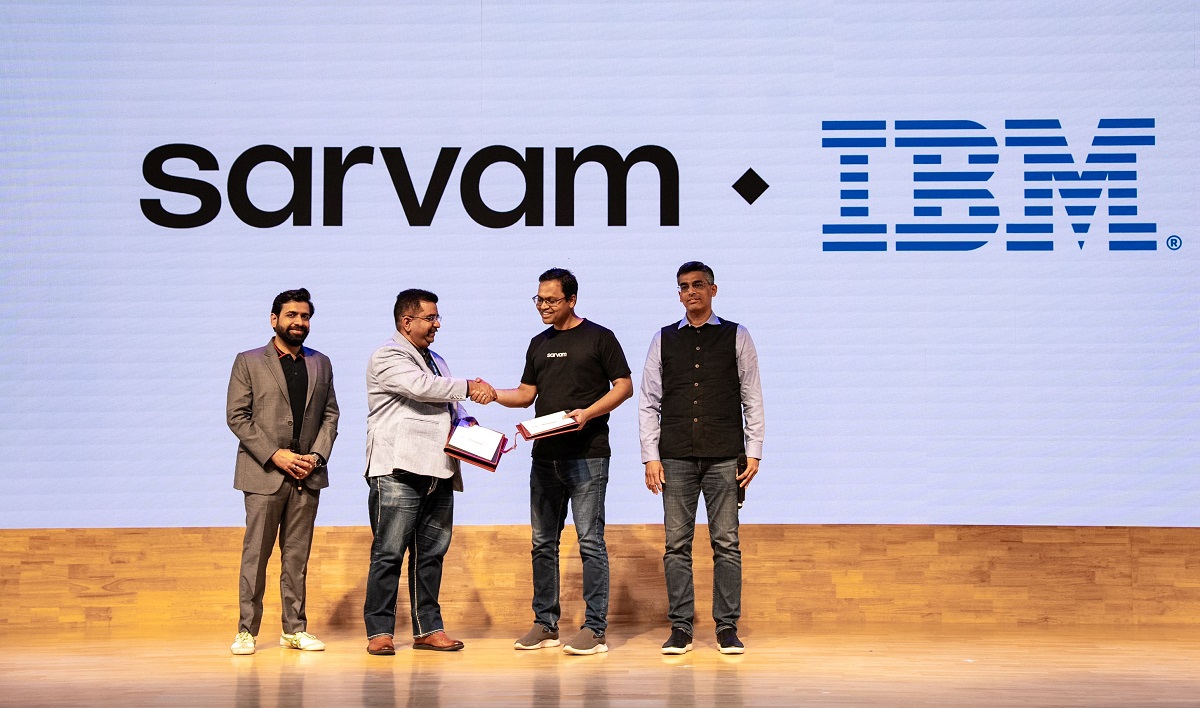



BENGALURU (India CSR): Technology company IBM and Indian artificial intelligence firm Sarvam have announced a collaboration to develop and test full-stack sovereign AI solutions for central and state governments, public sector organisations and regulated enterprises across India.
Announced on July 31, 2026, the collaboration will combine IBM Sovereign Core with Sarvam’s sovereign AI stack to support secure, governed and multilingual artificial intelligence applications aligned with India’s regulatory, operational and data sovereignty requirements.
The two companies will work on innovation pilots, solution accelerators, technical advisory services and knowledge-sharing programmes. The initiative will focus on helping government departments and regulated organisations move AI projects from the experimental stage to production environments.

Sovereign AI Stack
IBM Sovereign Core is described by the company as sovereign-by-design software intended to give organisations control over their data, operations and AI governance.
Sarvam’s technology stack includes reasoning models, language tools and voice-based AI systems developed for Indian use cases. According to the release, its language and voice technologies have been trained in India and are designed to support India-first applications.
The proposed combined offering will target organisations that operate under strict requirements related to security, compliance, data control and public accountability.
Sovereign AI generally refers to systems that allow a country or organisation to retain control over the data, infrastructure, models, operations and governance used to develop and deploy artificial intelligence.
Public Service Uses
IBM and Sarvam said the collaboration will explore AI applications for citizen services, grievance redressal, document processing and administrative workflows.
The systems are expected to support multilingual and voice-enabled government-to-citizen services. Such applications could allow citizens to seek information, access public benefits or register complaints using Indian languages and voice interfaces.
The release, however, did not identify the government departments, public sector organisations or regulated enterprises that may participate in the initial pilots.
It also did not provide details about the expected number of users, project timelines, investment, data hosting arrangements or measurable outcomes.
Lucknow Innovation Hub
The IBM GovTech AI Innovation Center in Lucknow will function as a joint incubation and demonstration hub under the collaboration.
Government departments, enterprises, public sector organisations and industry stakeholders will be able to use the centre to study the technical, operational and governance requirements involved in deploying sovereign AI.
The centre is also expected to demonstrate practical AI applications and help participating organisations examine how pilot projects can be integrated with existing digital systems.
The collaboration places particular emphasis on moving AI solutions beyond demonstrations and into operational use while maintaining institutional control over deployment and governance.
Governance and Control
Sriram Raghavan, General Manager, IBM Software, India and Software Innovation Lab, said sovereign AI involved more than the physical location where an AI system operates.
“Sovereign AI is not simply about where AI runs. It is about giving organizations control over how AI is governed, deployed, and operated. IBM Sovereign Core provides an open, enterprise-grade platform and middleware foundation designed to help governments and regulated enterprises scale AI within environments they trust while addressing governance, security, and compliance requirements. By combining these capabilities with Sarvam’s India-first AI technologies, we aim to help organizations operationalize sovereign AI and accelerate the journey from experimentation to production-scale outcomes,” Raghavan said.
He said IBM Sovereign Core would provide governments and regulated enterprises with an open, enterprise-grade software and middleware foundation for deploying AI in trusted environments.
Raghavan added that combining IBM’s platform with Sarvam’s India-first AI technologies could help organisations move from experimentation to production-scale use while addressing compliance, governance and security requirements.
Language Access
Pratyush Kumar, Co-Founder of Sarvam, said sovereign AI systems needed to operate within the technology infrastructure already used by governments and enterprises.
“Sovereign AI has to run inside the systems governments and enterprises already depend on, and at the scale at which those systems operate,” Kumar said.
He said Sarvam’s models, voice systems and language technologies could operate on IBM’s technology foundation to help citizens access government services or resolve grievances in their own language, including through phone-based interactions.
The collaboration reflects a broader focus on secure AI adoption in public administration and regulated industries. Its practical impact will depend on how the proposed systems address data protection, security testing, accessibility, transparency, public oversight and measurable service-delivery outcomes.