

• India CSR Awards 2026
  • India CSR Leadership Summit
  • Guest Posts
Tuesday, September 1, 2026
India CSR
  • Home
  • Corporate Social Responsibility
    • Art & Culture
    • CSR Leaders
    • Child Rights
    • Culture
    • Education
    • Gender Equality
    • Around the World
    • Skill Development
    • Safety
    • Covid-19
    • Safe Food For All
  • Sustainability
    • Sustainability Dialogues
    • Sustainability Knowledge Series
    • Plastics
    • Sustainable Development Goals
    • ESG
    • Circular Economy
    • BRSR
  • Corporate Governance
    • Diversity & Inclusion
  • Interviews
  • SDGs
    • No Poverty
    • Zero Hunger
    • Good Health & Well-Being
    • Quality Education
    • Gender Equality
    • Clean Water & Sanitation – SDG 6
    • Affordable & Clean Energy
    • Decent Work & Economic Growth
    • Industry, Innovation & Infrastructure
    • Reduced Inequalities
    • Sustainable Cities & Communities
    • Responsible Consumption & Production
    • Climate Action
    • Life Below Water
    • Life on Land
    • Peace, Justice & Strong Institutions
    • Partnerships for the Goals
  • Articles
  • Events
  • हिंदी
  • More
    • Business
    • Finance
    • Environment
    • Economy
    • Health
    • Around the World
    • Social Sector Leaders
    • Social Entrepreneurship
    • Trending News
      • Important Days
        • Festivals
      • Great People
      • Product Review
      • International
      • Sports
      • Entertainment
    • Case Studies
    • Philanthropy
    • Biography
    • Technology
    • Lifestyle
    • Sports
    • Gaming
    • Knowledge
    • Home Improvement
    • Words Power
    • Chief Ministers
No Result
View All Result
  • Home
  • Corporate Social Responsibility
    • Art & Culture
    • CSR Leaders
    • Child Rights
    • Culture
    • Education
    • Gender Equality
    • Around the World
    • Skill Development
    • Safety
    • Covid-19
    • Safe Food For All
  • Sustainability
    • Sustainability Dialogues
    • Sustainability Knowledge Series
    • Plastics
    • Sustainable Development Goals
    • ESG
    • Circular Economy
    • BRSR
  • Corporate Governance
    • Diversity & Inclusion
  • Interviews
  • SDGs
    • No Poverty
    • Zero Hunger
    • Good Health & Well-Being
    • Quality Education
    • Gender Equality
    • Clean Water & Sanitation – SDG 6
    • Affordable & Clean Energy
    • Decent Work & Economic Growth
    • Industry, Innovation & Infrastructure
    • Reduced Inequalities
    • Sustainable Cities & Communities
    • Responsible Consumption & Production
    • Climate Action
    • Life Below Water
    • Life on Land
    • Peace, Justice & Strong Institutions
    • Partnerships for the Goals
  • Articles
  • Events
  • हिंदी
  • More
    • Business
    • Finance
    • Environment
    • Economy
    • Health
    • Around the World
    • Social Sector Leaders
    • Social Entrepreneurship
    • Trending News
      • Important Days
        • Festivals
      • Great People
      • Product Review
      • International
      • Sports
      • Entertainment
    • Case Studies
    • Philanthropy
    • Biography
    • Technology
    • Lifestyle
    • Sports
    • Gaming
    • Knowledge
    • Home Improvement
    • Words Power
    • Chief Ministers
No Result
View All Result
India CSR
No Result
View All Result
Home Interviews

Didi Ki Dukaan is Helping Rural Women Become Independent Entrepreneurs: Vivek Prakash, Sr VP & Head–CSR, Jubilant Ingrevia

When Women Own Enterprises, They Become Economic Decision-Makers in Their Homes and Communities

India CSR by India CSR
September 1, 2026
in Interviews
Reading Time: 7 mins read
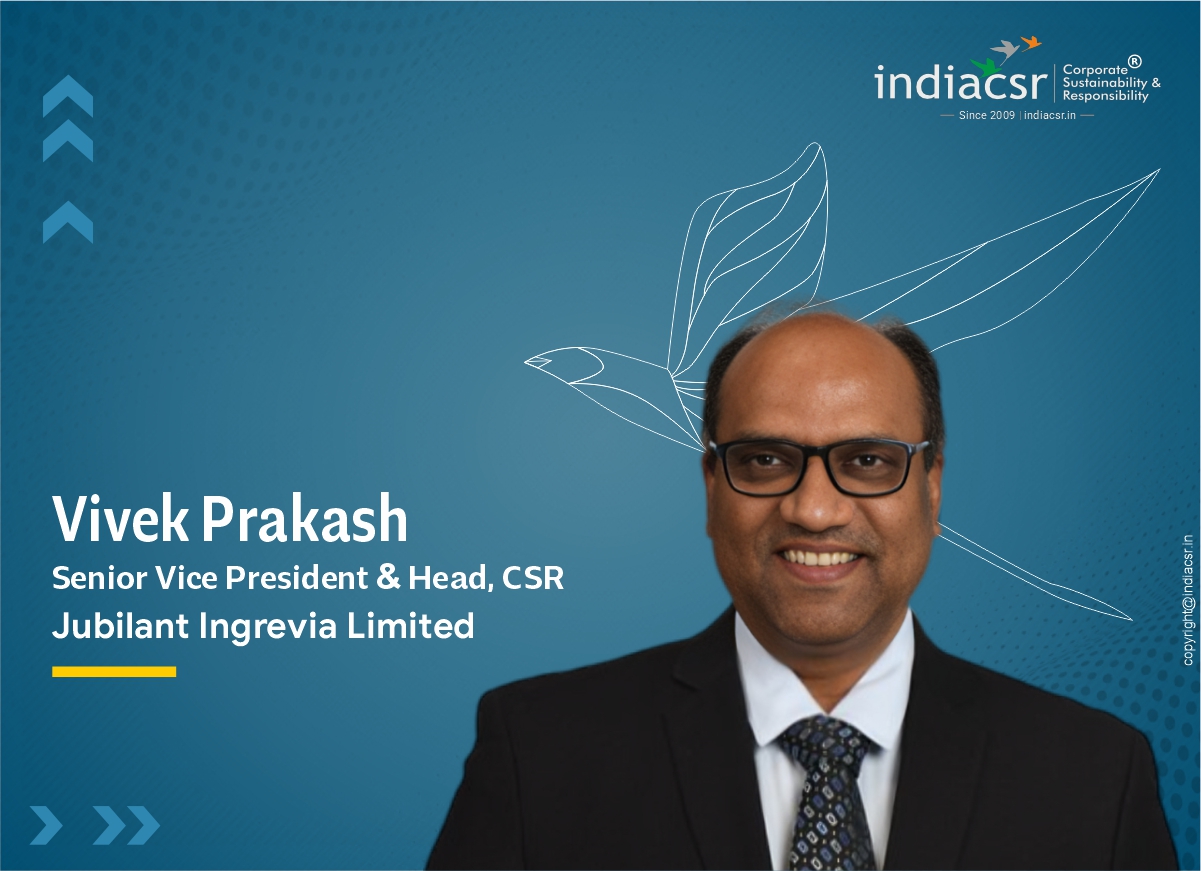
Vivek Prakash, Senior Vice President & Head, CSR at Jubilant Ingrevia Limited

Vivek Prakash, Senior Vice President & Head, CSR at Jubilant Ingrevia Limited

Share Share Share Share
WhatsApp icon
WhatsApp — Join Us
Instant updates & community
Google News icon
Google News — Follow Us
Get our articles in Google News feed
india csr awards
ADVERTISEMENT

With 90 women now operating neighbourhood retail stores and earning average monthly profits of ₹10,000 to ₹15,000, Jubilant Bhartia Foundation’s Didi Ki Dukaan initiative is seeking to strengthen women’s financial independence in rural Uttar Pradesh at Gajraula.
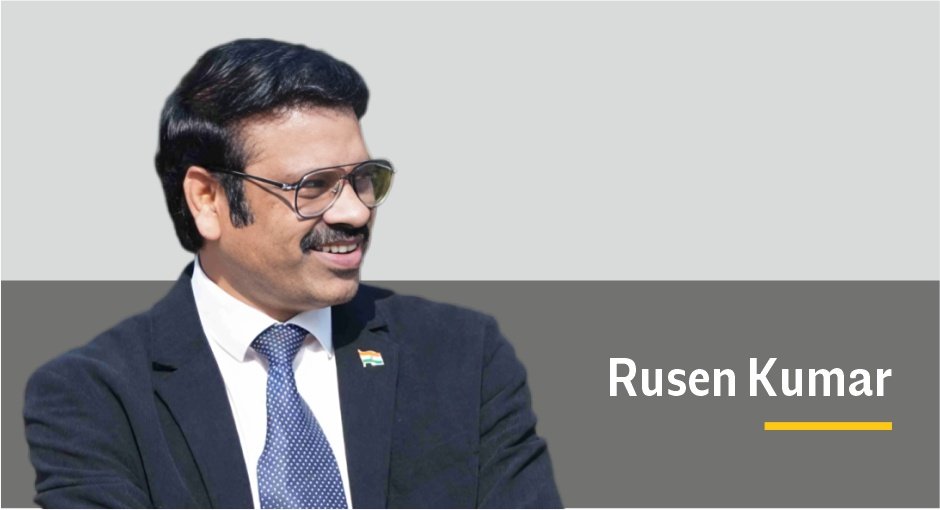
Rusen Kumar Founder and Managing Editor India CSR

By Rusen Kumar

NEW DELHI (India CSR): Women’s livelihood programmes deliver their greatest value when they create lasting ownership, confidence and an independent source of income. In the Gajraula region of Uttar Pradesh, Didi Ki Dukaan (Sister’s Shop), conceptualised by the Jubilant Bhartia Foundation (JBF), is working towards this objective by enabling rural women to establish and run neighbourhood retail stores.

The initiative addresses barriers that often prevent women from moving into entrepreneurship, including limited access to finance, business training, dependable product supplies and markets. According to the Foundation, the programme has supported 90 women to become first-generation retail entrepreneurs. Each participant, referred to as a Didi, is reported to earn an average monthly net profit of Rs. 10,000 to Rs. 15,000.

19th India CSR Leadership Summit 2026
ADVERTISEMENT

In this interview with Rusen Kumar, Editor of India CSR®, Vivek Prakash, Senior Vice President and Head–CSR, Jubilant Ingrevia Limited, explains the thinking behind the initiative, its operating model, the support offered to women entrepreneurs and its next phase of expansion.

What was the thinking behind creating this initiative, and what gap were you trying to address among women in Gajraula?

Under our broader focus on livelihood, our core belief is that true community development occurs when women move from being passive beneficiaries to active economic leaders. In the rural communities surrounding our operations in Gajraula, Uttar Pradesh, we recognized a distinct socio-economic gap. While many rural women possessed the ambition and drive to contribute to their household economies, they faced structural barriers, primarily a lack of financial support, formal business training, reliable source of product supply, and market integration. 

Didi Ki Dukaan was conceptualized by the Jubilant Bhartia Foundation (JBF) to bridge this precise gap. Rather than offering short-term, sub-scale livelihood interventions, we designed a structured pathway for long-term economic self-reliance. By enabling women to establish, own, and independently run neighbourhood retail stores, we are fostering local micro-entrepreneurship that delivers lasting socio-economic resilience.

What makes Didi Ki Dukaan different from conventional women livelihood or self-help group programmes? How does the initiative enable women to transition from beneficiaries to first-generation entrepreneurs?

The fundamental differentiator of Didi Ki Dukaan lies in its sharp focus on true micro-enterprise ownership and commercial viability, moving far beyond traditional income supplementation or basic skill-building models. Didi Ki Dukaan functions as an active, end-to-end business incubator that guides rural women through a complete socio-economic transformation. 

The transition from passive beneficiaries to confident first-generation entrepreneurs begins with a rigorous screening process where the Jubilant Bhartia Foundation (JBF) identifies candidates based on their entrepreneurial drive, socio-economic need, and crucial family support. Once selected, JBF provides comprehensive capacity-building, assists directly in setting up physical storefronts, and establishes crucial supply chain linkages to ensure business readiness from day one. Rather than stepping away post-launch, JBF maintains an active lifecycle role, delivering ongoing mentoring, digital financial literacy, and proactive problem-solving to help these women navigate daily retail challenges.

This sustained operational handholding ensures that first-time business owners build the resilience, capability, and confidence needed to become permanent economic decision-makers within their households and communities.

“Didi Ki Dukaan is helping rural women move from beneficiaries to business owners.” — Vivek Prakash

What has been the most significant outcome and impact created by Didi Ki Dukaan in terms of income, financial independence, and decision-making within the household?

The impact of Didi Ki Dukaan is reflected both in tangible economic metrics and profound social transformation across the community. The initiative has already transformed 90 women in the Gajraula region into first-generation retail entrepreneurs.. This provides a sustainable, independent baseline income that significantly strengthens their household economies.

Beyond the financial numbers, this economic autonomy has directly enhanced their value within the family. Our Didis now exercise an active voice in critical household choices, directing their earnings toward higher quality education for their children, better healthcare, improved family nutrition, and long-term savings. In doing so, these store owners have evolved into visible role models who actively demonstrate the power of female financial independence to the broader community.

Beyond providing the initial support to set up a store, what kind of handholding do the Didis receive? How does JBF help them develop the skills and confidence required to run a sustainable business?

Establishing a store is only the starting point of the entrepreneurial journey, as long-term business viability requires sustained operational support. The Jubilant Bhartia Foundation functions as a dedicated incubator across the entire lifecycle of the enterprise rather than stepping away post-launch. We deliver structured capacity-building modules covering essential retail skills, including inventory management, basic bookkeeping, profit margin calculations, and digital payment adoption.

“A woman’s own enterprise strengthens her income, confidence and voice at home.” — Vivek Prakash

Additionally, JBF facilitates direct linkages with local supply chains and distributors to ensure consistent stock and competitive sourcing prices. Our field teams maintain continuous on-ground engagement through regular follow-up meetings, working directly with the Didis to solve real-time operational challenges such as credit management and customer relations. This ongoing handholding systematically builds both the business acumen and self-confidence necessary for these women to run thriving, independent enterprises

What have been some of the biggest challenges faced by these women while starting and running their businesses, and how has the programme helped them overcome these barriers?

The primary obstacles these women faced at the outset stemmed from deeply entrenched socio-cultural norms, mobility limitations, and initial lack of formal business exposure or financial literacy. For many, taking the initial step into commercial entrepreneurship required navigating hesitation both from their immediate families and the wider community.

We address these barriers through a dual strategy of grassroots mobilization and structured risk mitigation. From the screening phase, JBF engages families directly to foster shared alignment and position the store as a collective household asset. Simultaneously, our end-to-end incubation framework minimizes early operational risks through continuous training and mentoring. As these stores become operational and consistently generate Rs. 10,000 to Rs. 15,000 in monthly income, initial family scepticism naturally evolves into strong household support, creating a positive shift in community perceptions surrounding women’s leadership

The stores cater to everyday needs within their own neighbourhoods. How important is this community-centric approach in making the businesses sustainable while also creating value for the local community?

A hyper-local, community-centric model is central to both the commercial viability of the stores and the social value generated for the village. By establishing retail outlets directly within the neighbourhoods where the entrepreneurs reside, the initiative provides residents, especially women, with convenient access to essential daily groceries, hygiene products, and household items without the need to travel long distances to central markets.

From a business standpoint, operating within a familiar environment significantly reduces transportation costs and operational overheads for the Didis, while allowing them to build a loyal customer base grounded in existing social trust. This localized model ensures that economic capital continues to circulate within the village, establishing a self-sustaining cycle of micro-economic development and community trust.

“Sustained handholding can turn a first-time retailer into a confident entrepreneur.” — Vivek Prakash

What are the next areas of evolution for the programme? Do you see potential to take the model beyond Gajraula or replicate it in other communities?

The Didi Ki Dukaan framework has conclusively demonstrated that with structured incubation and supply chain support, rural women can build viable, scalable micro-enterprises. Building on our current footprint of 90 active entrepreneurs in the Gajraula region, JBF is preparing to incubate 40 additional Didi Ki Dukaan stores in the upcoming phase to further expand our community-led retail network.

Moving forward, the strategic evolution of the program will focus on deepening digital enablement—incorporating digital financial tools and stock tracking while expanding product assortments and forging direct linkages with FMCG distributors. Given its lean, high-impact architecture, the core principles of ownership, structured handholding, and community-based enterprise are highly replicable across other industrial belts and rural catchments nationwide.


© Copyright Disclaimer: All rights reserved. No part of this report may be reproduced, republished, distributed or transmitted in any form without prior written permission from India CSR®.

Read more interviews.
Tags: CSR of Jubilant Ingrevia LimitedDidi Ki DukaanJubilant IngreviaVivek Prakash
India CSR Image 1 India CSR Image 2

CSR, Sustainability, and ESG success stories hindustan zinc
ADVERTISEMENT
India CSR

India CSR

India CSR® is the largest media on CSR and sustainability offering diverse content across multisectoral issues on business responsibility. It covers Sustainable Development, Corporate Social Responsibility (CSR), Sustainability, and related issues in India. Founded in 2009, the organisation aspires to become a globally admired media that offers valuable information to its readers through responsible reporting.

Related Posts

India CSR
Interviews

Responsible Business Must Turn Research into Real Impact: Prof Bob Doherty

Akanksha Sharma, Vice President – Sustainability, Subcontinent, Central Asia, Levant and; Egypt DP World
Interviews

DP World’s Sustainability Strategy: Building Greener, Inclusive Logistics in India

Dr. V.K. Raju
Interviews

Every Premature Baby Deserves the Right to Sight: Dr. V.K. Raju, Chairman, Goutami Eye Institute & Founder, Eye Foundation of America

India CSR Interview with George Muthoot George, Deputy Managing Director of Muthoot Finance
Interviews

Muthoot Finance CSR Is About Empowerment, Not Dependency: George Muthoot George

Hardeep S. Brar - BMW Group India CEO
Interviews

Skills Are the Starting Line, Jobs Are the Finish Line: BMW Group India CEO Hardeep S. Brar

Dr. Vikas Garg, Chairman, Ebix Group
Interviews

CSR: Compliance Gives You a Floor, But Purpose Gives You a Legacy: Dr. Vikas Garg, Chairman, Ebix Group

Load More
bba
ADVERTISEMENT

Interviews

Vivek Prakash, Senior Vice President & Head, CSR at Jubilant Ingrevia Limited
Interviews

Didi Ki Dukaan is Helping Rural Women Become Independent Entrepreneurs: Vivek Prakash, Sr VP & Head–CSR, Jubilant Ingrevia

by India CSR

A hyper-local, community-centric model is central to both the commercial viability of the stores and the social value generated for...

Read moreDetails
India CSR

Responsible Business Must Turn Research into Real Impact: Prof Bob Doherty

Akanksha Sharma, Vice President – Sustainability, Subcontinent, Central Asia, Levant and; Egypt DP World

DP World’s Sustainability Strategy: Building Greener, Inclusive Logistics in India

Dr. V.K. Raju

Every Premature Baby Deserves the Right to Sight: Dr. V.K. Raju, Chairman, Goutami Eye Institute & Founder, Eye Foundation of America

Load More
Ad 1 Ad 2 Ad 3 Ad 4 Ad 5 Ad 6
ADVERTISEMENT

CSR UPDATES

TREVOC Strengthens CSR With Recognition for Site Personnel and Safety Practices

Bannari Amman Sugars Spends Rs 4.28 Cr on CSR in FY 2025-26

Rachana Infrastructure Spends Rs. 9 Lakh on CSR in FY2025-26, Exceeds Mandatory Obligation

Shivam Chemicals Reports Nil CSR Expenditure for Second Straight Year; FY2025-26 Revenue Rises 30%

IGC Industries Reports No CSR Spending Obligation for FY2025-26 Amid ₹2.93 Crore Net Loss

CSR: Zinc Football Academy Brings Rural Youth Together, Begins Half Marathon Countdown

STEM Learning STEM Learning STEM Learning
ADVERTISEMENT
Facebook Twitter Youtube LinkedIn Instagram
India CSR Logo

India CSR is the largest tech-led platform for information on CSR and sustainability in India offering diverse content across multisectoral issues. It covers Sustainable Development, Corporate Social Responsibility (CSR), Sustainability, and related issues in India. Founded in 2009, the organisation aspires to become a globally admired media that offers valuable information to its readers through responsible reporting. To enjoy the premium services, we invite you to partner with us.

Follow us on social media:

Subscribe to Our Newsletter

Don't miss out on the latest updates in corporate social responsibility. Subscribe to our newsletter at indiacsr.in and be part of the positive change.
Please enable JavaScript in your browser to complete this form.
Loading

  • About India CSR
  • Team
  • India CSR Awards 2026
  • India CSR Leadership Summit
  • Partnership
  • Guest Posts
  • Services
  • ESG Professional Network
  • Content Writing Services
  • Business Information
  • Contact
  • Privacy Policy
  • Terms of Use
  • Donate

Copyright © 2026 - India CSR | All Rights Reserved

No Result
View All Result
  • Home
  • Corporate Social Responsibility
    • Art & Culture
    • CSR Leaders
    • Child Rights
    • Culture
    • Education
    • Gender Equality
    • Around the World
    • Skill Development
    • Safety
    • Covid-19
    • Safe Food For All
  • Sustainability
    • Sustainability Dialogues
    • Sustainability Knowledge Series
    • Plastics
    • Sustainable Development Goals
    • ESG
    • Circular Economy
    • BRSR
  • Corporate Governance
    • Diversity & Inclusion
  • Interviews
  • SDGs
    • No Poverty
    • Zero Hunger
    • Good Health & Well-Being
    • Quality Education
    • Gender Equality
    • Clean Water & Sanitation – SDG 6
    • Affordable & Clean Energy
    • Decent Work & Economic Growth
    • Industry, Innovation & Infrastructure
    • Reduced Inequalities
    • Sustainable Cities & Communities
    • Responsible Consumption & Production
    • Climate Action
    • Life Below Water
    • Life on Land
    • Peace, Justice & Strong Institutions
    • Partnerships for the Goals
  • Articles
  • Events
  • हिंदी
  • More
    • Business
    • Finance
    • Environment
    • Economy
    • Health
    • Around the World
    • Social Sector Leaders
    • Social Entrepreneurship
    • Trending News
      • Important Days
      • Great People
      • Product Review
      • International
      • Sports
      • Entertainment
    • Case Studies
    • Philanthropy
    • Biography
    • Technology
    • Lifestyle
    • Sports
    • Gaming
    • Knowledge
    • Home Improvement
    • Words Power
    • Chief Ministers

Copyright © 2026 - India CSR | All Rights Reserved

This website uses cookies. By continuing to use this website you are giving consent to cookies being used. Visit our Privacy and Cookie Policy.

