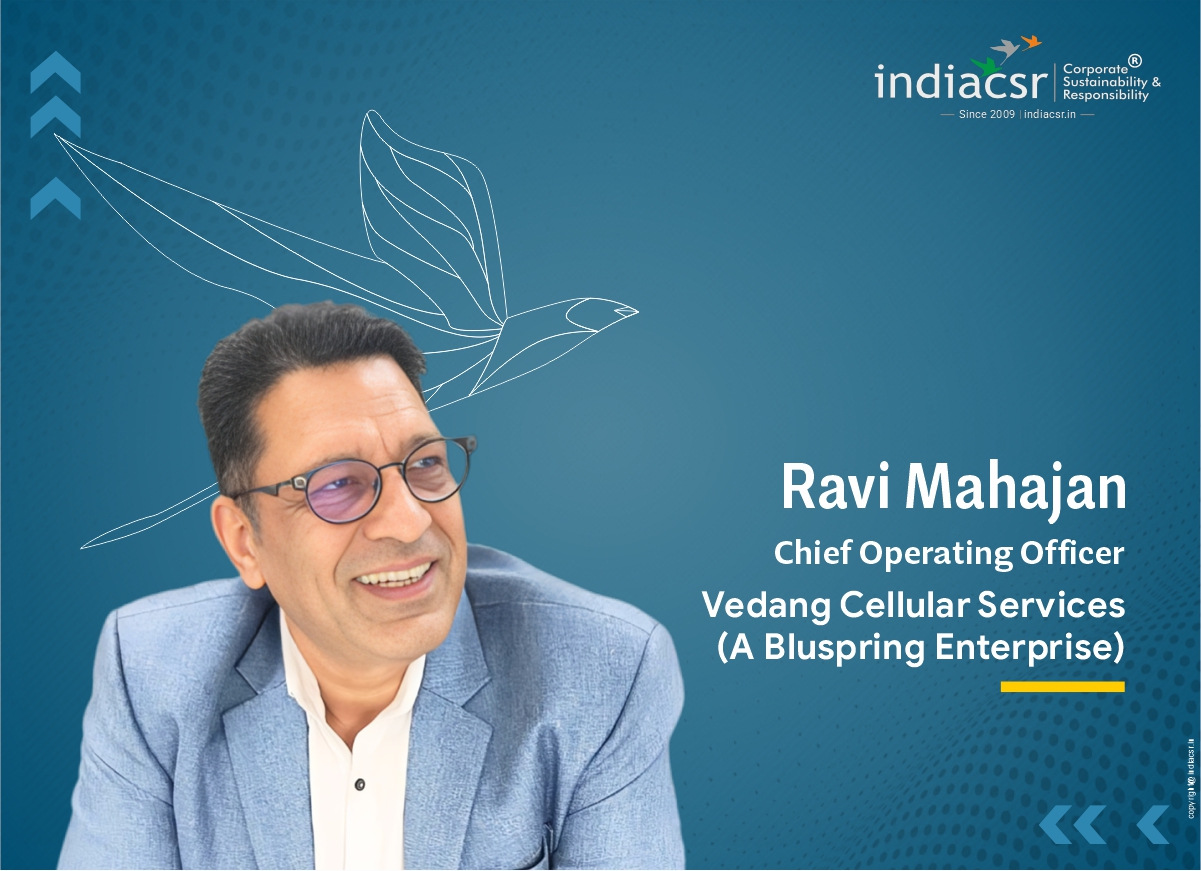


Ravi Mahajan of Vedang Cellular Services discusses solar energy, battery storage, AI and IoT in building efficient and resilient telecom infrastructure.
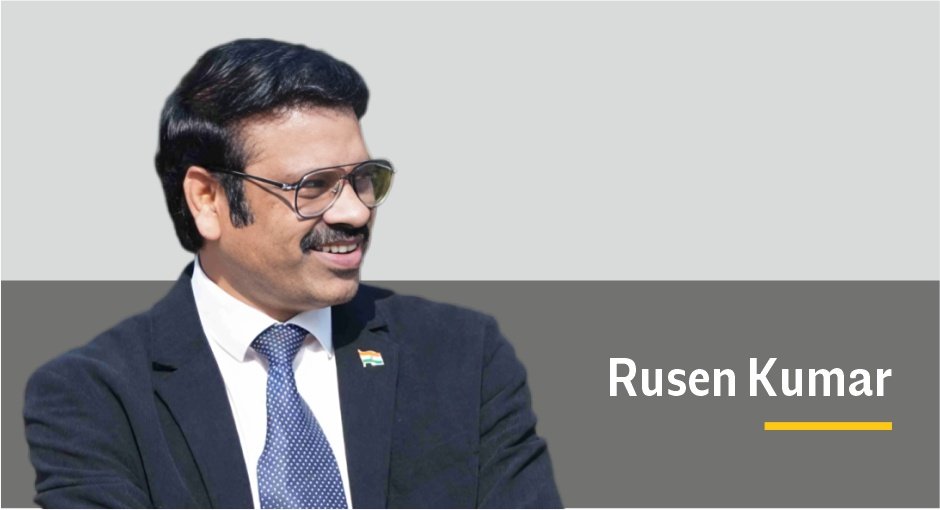
By Rusen Kumar
NEW DELHI (India CSR): In this exclusive interview, Rusen Kumar, Managing Editor, India CSR, speaks with Ravi Mahajan, Chief Operating Officer, Vedang Cellular Services, about the shift from diesel-dependent telecom infrastructure to cleaner, technology-driven energy systems.
Mahajan explains how solar power, battery storage and intelligent energy management are helping telecom operators reduce diesel consumption while maintaining reliable network availability. He discusses the growing use of hybrid solar-battery systems at remote and challenging sites, where conventional energy supply can be costly and unreliable.
The conversation also examines how AI, IoT, remote monitoring and predictive maintenance are improving energy efficiency, equipment performance and operational visibility across telecom networks. Mahajan highlights Vedang’s approach to renewable energy integration and its association with Bluspring’s integrated ecosystem. He also discusses the importance of measuring outcomes through diesel displacement, carbon emissions, total cost of ownership, network uptime and SLA performance.
Q1. How is the industry balancing uninterrupted network availability with the imperative to reduce energy consumption and environmental impact?
For telecom infrastructure, network availability will always remain non-negotiable. What is changing is the way the industry approaches the energy required to deliver that uptime. Traditionally, diesel provided a dependable backup option, particularly in areas with unreliable grid connectivity. Today, advances in solar, battery storage and intelligent energy management are enabling operators to reduce that dependence without compromising network performance.
Well-designed hybrid solar-battery systems can strengthen site resilience by diversifying energy sources and reducing exposure to fuel availability and logistics. This is driving an important shift in the industry; sustainability is increasingly being viewed not only as an environmental priority, but also as an opportunity to improve operational efficiency and resilience. At Vedang, this thinking is becoming integral to how we assess and manage telecom sites.
Q2. Where does renewable energy fit into Vedang’s approach, and what practical changes are you seeing at the site level?
Renewable energy is now built into our fundamental operational model. Solar integration is now part of how we commission and operate sites — being deployed across geographies ranging from high-altitude northern locations to coastal environments in the south. At the site level, the most significant change is the transition from diesel-primary to hybrid configurations, with solar and battery storage doing the heavy lifting and diesel available only as a genuine last resort. Diesel consumption seems to be dropping significantly on well-designed installations. Energy performance is now part of our commissioning checklist, and routine site visits include energy audits that surface inefficiencies in cooling and load management that were previously invisible.
Q3. How can solar and battery storage reduce dependence on conventional energy while improving resilience at remote telecom sites?
Remote sites are where the energy problem is most acute and where renewables make the strongest case. The true cost of diesel at a tower is never just the per-litre price. It includes logistics, supply risk, and the SLA penalty when a network goes down waiting for a technician. Solar-plus-storage removes much of that dependency. Battery systems have no moving parts, require no manual restart, and are unaffected by supply chain disruptions. Sites that previously went dark when a fuel delivery was delayed are now largely insulated from that risk. When you combine cleaner generation with the energy audits we conduct during deployment, the gains in cost and reliability compound meaningfully over time.
Q4. How are AI, IoT and remote monitoring helping Vedang improve energy efficiency, predictive maintenance and network performance?
Managing infrastructure across 22 circles and 70 geographies requires strong digital visibility and the ability to act on information quickly. AI-enabled energy monitoring allows us to track parameters such as generator run-hours, battery state of charge, solar output and load behaviour in real time, helping teams identify anomalies and intervene before they develop into larger operational issues.
The larger opportunity lies in moving from reactive to predictive maintenance. Early indicators of equipment inefficiency, for example, can trigger preventive intervention rather than an emergency site visit after a failure. IoT-enabled sensors continuously strengthen this visibility, while our Network Operating Centre provides a central layer for monitoring and response. As 5G networks become denser and infrastructure requirements more complex, this kind of data-led operational intelligence will increasingly become fundamental to efficient network management.
Q5. How does being part of Bluspring’s integrated ecosystem strengthen Vedang’s approach to sustainable telecom operations?
Telecom infrastructure today sits at the intersection of connectivity, energy, technology and asset management. Being part of Bluspring’s integrated ecosystem enables Vedang to approach these requirements more holistically, bringing together capabilities across solar deployment, energy operations, lifecycle management and network performance.
For clients, particularly those looking at long-term managed services, this creates the opportunity for greater integration and accountability across the infrastructure lifecycle rather than addressing each requirement in isolation. It also gives us a broader platform to develop and deploy capabilities such as AI-led energy management and IoT-based monitoring within an integrated infrastructure environment. This becomes increasingly relevant as telecom operators look to improve network performance while simultaneously advancing their sustainability goals.
Q6. What metrics should the industry track to demonstrate meaningful impact from green initiatives?
Sustainability commitments are easy to make but measuring them honestly is harder, and that is where the industry needs to focus.
A few metrics that actually matter:
- Absolute diesel displacement, measured in litres, to demonstrate the tangible reduction in fossil-fuel dependence
- Carbon emissions per tower per year, measured consistently to track improvement over time
- Total cost of ownership, comparing renewable and conventional energy systems across the full asset lifecycle rather than only upfront capex
- Network uptime and SLA performance across solar-integrated and conventional sites to understand the relationship between sustainability and operational resilience
That last one often gets overlooked. If green infrastructure also delivers better network reliability — and our experience suggests it does — that is a powerful and honest case to make. The industry has the data. It just needs to use it more rigorously.
Copyright@India CSR®