



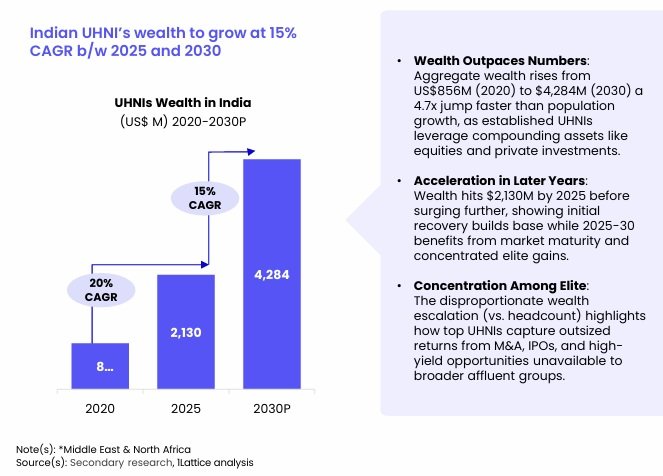
India’s ultra-rich families may see their combined wealth nearly double from around Rs. 201 lakh crore in 2025 to about Rs. 404 lakh crore by 2030, based on the report’s projection and approximate rupee conversion.
India’s family offices are moving from quiet wealth-preservation structures to powerful investment institutions. Once limited to managing family wealth, succession and philanthropy, they are now participating actively in public markets, private equity, venture capital, private credit, real estate, global assets, impact investing and technology-led opportunities. The Indian Family Offices Report ’26 by The Economic Times and 1Lattice estimates that India has more than 300 family offices managing assets exceeding US$30 billion, around Rs. 2.83 lakh crore. Globally, family offices manage more than US$6 trillion, around Rs. 566 lakh crore, showing that India is still at an early but fast-growing stage of this wealth-management evolution.
This growth is being driven by rising entrepreneurship, founder-led liquidity events, startup wealth creation, deeper capital markets and an upcoming intergenerational wealth transfer estimated at US$1.3–1.5 trillion, around Rs. 122.72–141.60 lakh crore. The result is a new class of Indian private capital that is patient, professional and increasingly strategic.

Indian UHNI Wealth Projected to Nearly Double by 2030
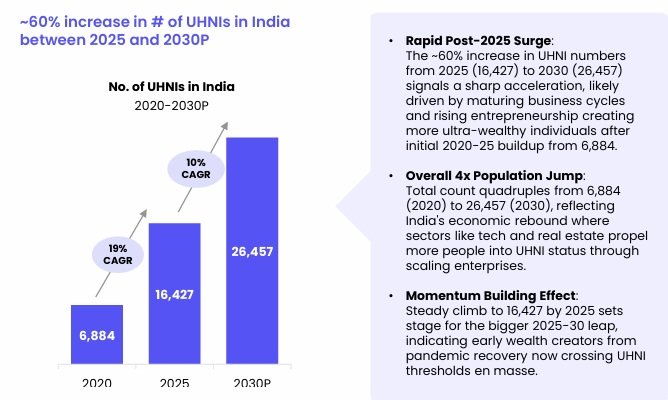
The report projects that India’s UHNI population will rise from 16,427 in 2025 to 26,457 by 2030, an increase of around 61% over five years. Compared with 6,884 UHNIs in 2020, the 2030 projection represents nearly a four-fold rise over a decade. The report’s UHNI wealth trend also shows strong expansion, rising from 2,130 in 2025 to 4,284 by 2030P, with an estimated 15% CAGR. Interpreted as US$2.13 trillion to US$4.28 trillion, this would translate editorially to around Rs. 201.07 lakh crore in 2025 and around Rs. 404.03 lakh crore by 2030. However, because the report’s chart carries a unit-label inconsistency, this should be presented as an indicative estimate, not as an independently confirmed rupee value.

Table 1: India’s Wealth Creation and Family Office Growth
| Indicator | Earlier Figure | Latest / Projected Figure | Growth / Signal |
| UHNIs in India | 6,884 in 2020 | 26,457 by 2030 | Around 284% growth |
| UHNIs in India | 16,427 in 2025 | 26,457 by 2030 | Around 61% growth |
| UHNI Wealth Trend | 2,130 in 2025 | 4,284 by 2030P | Around 101% growth |
| Estimated UHNI Wealth CAGR | 2025 | 2030 | Around 15% CAGR |
| Family offices in India | 300+ | US$30 billion, around Rs. 2.83 lakh crore AUM | Rising capital pool |
| Wealth transfer ahead | — | US$1.3–1.5 trillion, around Rs. 122.72–141.60 lakh crore | Major succession moment |

Family Offices Are Becoming Professional Capital Platforms
The report identifies a clear shift in how Indian family offices operate. Earlier, many were founder-led, relationship-driven and focused on opportunistic deals. Since 2016, the sector has moved toward professionalisation, with CIOs, COOs, investment committees, documented investment policies and manager-selection frameworks. Since 2023, a more platform-led model has emerged, marked by co-investment clubs, shared diligence, secondaries platforms, specialist service providers and next-generation education.
This evolution matters because family offices are no longer only protecting wealth. They are increasingly shaping enterprise creation. Many families bring operating experience, sector knowledge and founder networks that make them valuable capital partners for startups and growth businesses.
Only 20% of Indian Family Offices Have Formal Succession Plans.
Types of Family Offices in India
Indian family offices generally operate through four models. Single-family offices serve one wealthy family and usually suit families with US$100 million or more, around Rs. 944 crore, in net worth. Multi-family offices serve several families through shared advisory, reporting and succession services, often for families with US$25 million to US$100 million, around Rs. 236 crore to Rs. 944 crore. Virtual family offices use outsourced experts and cloud-based collaboration. Embedded family offices operate within a family-owned business structure. Each model reflects a different stage of wealth maturity. As Indian wealth grows, more families are expected to move from informal wealth management to dedicated family office structures.
Indian family offices are becoming strategic institutions that protect legacy, deploy risk capital, support startups, enable global diversification and build purpose-led portfolios.
Why Families Are Setting Up Family Offices
The key reason is control. A family office brings investments, succession, tax planning, philanthropy, governance and lifestyle management under one coordinated platform. It offers privacy, faster decision-making and long-term alignment with family values. Family offices also reduce dependence on product-led wealth advice. Instead of being pushed into standard financial products, families can create customised strategies across asset classes, geographies and generations. For families with global holdings, the family office also helps manage FEMA, RBI, SEBI, tax treaties, KYC and cross-border investment requirements.
Asset Allocation: From Preservation to Growth
Indian family offices continue to hold traditional assets, but the portfolio mix is changing. Public equity remains the largest allocation, with an average portfolio share of around 40%. PE/VC accounts for about 20%, while real estate and debt each account for around 15%. Alternatives account for 8%, while luxury and passion assets account for about 2%. PE/VC has delivered the highest reported return trend at around 25%, followed by public equities at 16%, luxury assets at 10%, private credit at 9%, and real estate and alternatives at around 8%.
Table 2: Average Portfolio Allocation and Return Trend
| Asset Class | Average Allocation | Reported Return Trend |
| Public Equity | 40% | 16% |
| PE / VC | 20% | 25% |
| Real Estate | 15% | 8% |
| Debt | 15% | Stable allocation |
| Alternatives | 8% | 8% |
| Luxury / Passion Assets | 2% | 10% |
| Private Credit | Rising separate allocation | 9% |
This shows a balanced but growth-oriented approach. Public equities provide liquidity and transparency, while private markets offer higher alpha potential. Real estate and debt provide stability, while alternatives and passion assets add diversification.
Public Markets and Megatrend Investing
Family offices allocate around 15–25% to listed equities, largely for long-term capital appreciation. Technology is the most preferred public equity sector, with 43% allocation preference. Healthcare follows at 31%, BFSI at 28%, FMCG at 26%, energy and renewables at 15%, and industrials at 12%. This reflects a move toward megatrend investing. Families are increasingly looking at artificial intelligence, healthcare, green energy, precision manufacturing, SaaS, logistics and enterprise software. The mindset is shifting from merely safeguarding wealth to actively compounding it.
India Now Has 300-Plus Family Offices Managing Over Rs. 2.83 Lakh Crore.
Private Markets and Startup Capital
Private markets are central to the new family office strategy. Indian family offices allocate around 20–25% to private investments through PE, VC, venture debt, SPVs and co-investments. The report says India saw around US$36.8 billion, around Rs. 3.47 lakh crore, in PE-VC deals in 2025. Private debt grew from US$9.3 billion, around Rs. 87,792 crore, in 2024 to US$12.4 billion, around Rs. 1.17 lakh crore, in 2025. India’s startup ecosystem remains a major attraction. The country had 157,700 DPIIT-recognised startups as of December 2024, 121 unicorns by mid-2025 and a combined unicorn valuation of about US$0.4 trillion, around Rs. 37.76 lakh crore.
Table 3: Private Market and Startup Growth
| Indicator | Earlier Figure | Latest Figure | Growth / Signal |
| PE-VC Investments | US$22 billion, around Rs. 2.08 lakh crore in 2024 | US$34 billion, around Rs. 3.21 lakh crore in 2025 | Around 55% growth |
| PE-VC Deal Activity | — | US$36.8 billion, around Rs. 3.47 lakh crore in 2025 | Strong capital flow |
| Private Debt | US$9.3 billion, around Rs. 87,792 crore in 2024 | US$12.4 billion, around Rs. 1.17 lakh crore in 2025 | Around 33% growth |
| Recognised Startups | — | 157,700 as of Dec. 2024 | Deep startup pipeline |
| Unicorns | — | 121 by mid-2025 | Strong venture opportunity |
| Family Office Deal Participation | 122 deals in 2021 | 76 deals in 2025 | More selective investing |
Family offices are not just passive LPs. Many are co-investing directly with VC and PE funds, using SPVs for targeted exposure and participating in secondaries for faster liquidity.
Mumbai, Delhi-NCR and Bengaluru Account for 70% of India’s Family Offices.
Private Credit, Real Estate and Alternatives
Private credit is becoming attractive because it offers steady yields with lower volatility than equity. Direct lending can deliver 12–16% returns, while distressed debt opportunities may offer 18–25% returns. India’s private credit AUM remains only around 0.6% of GDP, compared with 3.8% in the US, suggesting significant room for growth. Real estate remains a core allocation. Institutional real estate investment rose from US$5.4 billion, around Rs. 50,976 crore, in 2023 to US$10.4 billion, around Rs. 98,176 crore, in 2025, marking around 93% growth over two years.
Table 4: Real Estate and Alternatives Growth
| Indicator | Earlier Figure | Latest Figure | Growth / Signal |
| Institutional Real Estate Investment | US$5.4 billion, around Rs. 50,976 crore in 2023 | US$10.4 billion, around Rs. 98,176 crore in 2025 | Around 93% growth |
| Real Estate Investment | US$8.9 billion, around Rs. 84,016 crore in 2024 | US$10.4 billion, around Rs. 98,176 crore in 2025 | Around 17% growth |
| FO Real Estate Involvement | Current base | Next 5 years | Around 15% CAGR |
| Hedge Fund AUM via Cat III AIFs | — | US$27 billion, around Rs. 2.55 lakh crore by Sept. 2025 | Rising allocation |
| Crypto Allocation | — | 2–5% of assets | Cautious exposure |
Family offices are increasingly looking at REITs, Grade-A income assets, warehousing, offices and commercial real estate in Tier 1 cities. Hedge funds routed through Category III AIFs are also gaining traction. Crypto remains limited, generally at 2–5% of assets.
Indian Family Offices Allocate Up to 25% of Portfolios to Private Investments.
Capital Is Not the Constraint, Bandwidth Is
The report highlights that the biggest challenge for Indian family offices is not lack of capital but lack of bandwidth. Most offices operate with lean teams of five to ten people while managing investment sourcing, due diligence, treasury, tax, compliance, governance, philanthropy and reporting. Talent retention is another problem. Family offices often cannot compete with PE and VC firms on compensation, carry and career progression. This creates continuity risks.
Data and reporting remain weak. Many portfolios include PMS, AIFs, LP stakes, private investments, real estate SPVs and loans. Yet reporting often depends on PDFs, Excel sheets and fragmented manager statements. This slows decision-making and increases risk.
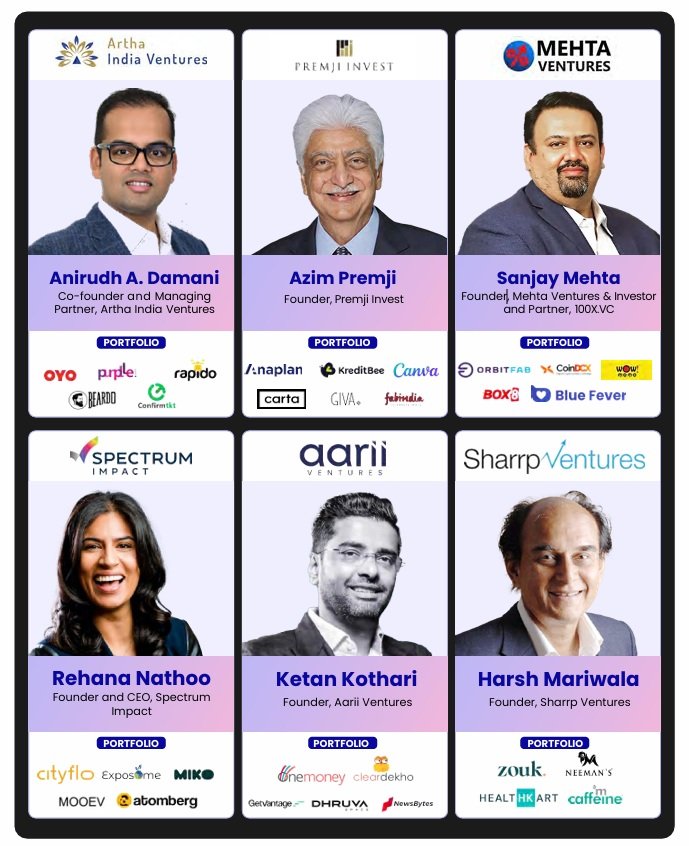
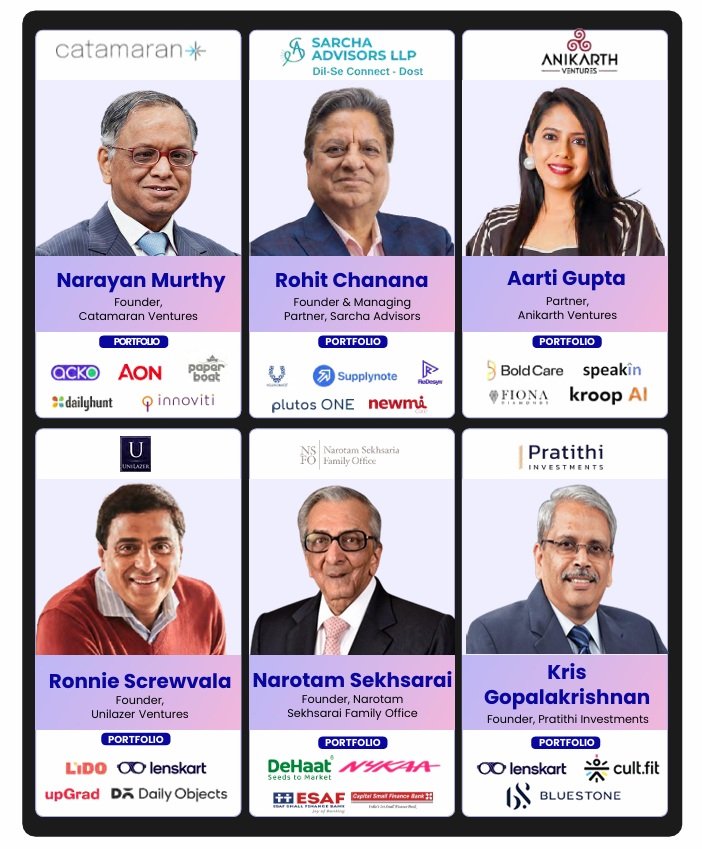
Most active family offices
Succession Is India’s Biggest Family Capital Test
India is expected to witness an intergenerational wealth transfer of US$1.3–1.5 trillion, around Rs. 122.72–141.60 lakh crore, over the next decade. Yet the report says only around 20% of Indian family offices have formal succession plans, around 95% lack family constitutions, and only around 60% maintain formal governance frameworks.
Table 5: Succession and Governance Gaps
| Indicator | Current Situation | Implication |
| Formal succession plans | Around 20% of Indian family offices | Large governance gap |
| Family constitutions | Around 95% lack them | High dispute risk |
| Formal governance frameworks | Around 60% maintain them | Professionalisation incomplete |
| Conflicting vision | 62% | Top succession challenge |
| Unclear roles | 47% | Role clarity needed |
| Capability gaps | 41% | Next-gen education critical |
| Wealth transfer ahead | US$1.3–1.5 trillion, around Rs. 122.72–141.60 lakh crore | Major succession moment |
The generational shift is also changing investment priorities. Older generations often prefer real estate, debt and listed equities. Younger members are more interested in startups, ESG, digital assets, climate solutions and philanthropy.
Cross-Border Investing and GIFT City
Indian family offices are increasing global exposure for diversification, currency protection and access to global sectors. LRS outflows rose from US$27 billion, around Rs. 2.55 lakh crore, in FY23 to US$32 billion, around Rs. 3.02 lakh crore, in FY24, before moderating to US$30 billion, around Rs. 2.83 lakh crore, in FY25. ODI rose from around US$17 billion, around Rs. 1.60 lakh crore, in FY24 to US$28 billion, around Rs. 2.64 lakh crore, in FY25, showing strong globalisation of Indian capital.
Table 6: Cross-Border Investment Growth
| Indicator | Earlier Figure | Latest Figure | Growth / Trend |
| LRS Outflows | US$27 billion, around Rs. 2.55 lakh crore in FY23 | US$32 billion, around Rs. 3.02 lakh crore in FY24 | Around 19% growth |
| LRS Outflows | US$32 billion in FY24 | US$30 billion, around Rs. 2.83 lakh crore in FY25 | Slight moderation |
| ODI | US$17 billion, around Rs. 1.60 lakh crore in FY24 | US$28 billion, around Rs. 2.64 lakh crore in FY25 | Around 65% growth |
| ODI FY26 | — | US$20.5 billion, around Rs. 1.94 lakh crore up to Dec. 2025 | Strong momentum |
| Overseas equity and debt investments | — | US$1.7 billion, around Rs. 16,048 crore | 8% of FY26 LRS outflow |
GIFT City is emerging as India’s onshore-offshore gateway. It has more than 25 family office structures, about 500 financial institutions and a target of US$1 trillion, around Rs. 94.40 lakh crore, in AUM over the next eight to ten years.
PE-VC Investments in India Rose 55% to Around Rs. 3.21 Lakh Crore in 2025.
Table 7: GIFT City and Fund Ecosystem
| Indicator | Figure | Growth Signal |
| Family office structures in GIFT City | 25+ as of 2025 | Rising adoption |
| Financial institutions | Around 500 | Expanding financial hub |
| Target AUM | US$1 trillion, around Rs. 94.40 lakh crore | Long-term scale opportunity |
| GIFT IFSC fund commitments | US$22.1 billion, around Rs. 2.09 lakh crore by mid-2025 | Strong ecosystem |
| Amount raised | US$10.5 billion, around Rs. 99,120 crore | Active mobilisation |
| Amount invested | US$11.3 billion, around Rs. 1.07 lakh crore | Strong deployment |
Impact Investing and Purpose-Led Capital
Impact investing is becoming a bridge between wealth, legacy and social responsibility. India’s impact investment market attracted nearly US$5 billion, around Rs. 47,200 crore, in 2025. Climate tech led with US$2.94 billion, around Rs. 27,754 crore, followed by financial inclusion at US$841 million, around Rs. 7,939 crore, healthcare at US$565 million, around Rs. 5,334 crore, and tech for development at US$537 million, around Rs. 5,069 crore.
The report projects India’s impact investing market to grow from about US$3 billion, around Rs. 28,320 crore, in 2025 to US$9 billion, around Rs. 84,960 crore, by 2030, implying 3x growth and 25% CAGR.
Table 8: Impact Investing Growth
| Indicator | Earlier Figure | Projected / Latest Figure | Growth |
| India Impact Investing Market | US$3 billion, around Rs. 28,320 crore in 2025 | US$9 billion, around Rs. 84,960 crore by 2030 | 3X growth |
| Impact Investing CAGR | 2025 | 2030 | Around 25% CAGR |
| Climate Tech | — | US$2.94 billion, around Rs. 27,754 crore in 2025 | Largest segment |
| Financial Inclusion | — | US$841 million, around Rs. 7,939 crore in 2025 | Strong social finance flow |
| Healthcare Opportunity | — | US$372 billion, around Rs. 35.12 lakh crore by 2030 | Major SDG-linked sector |
| Global impact investment | — | US$715 billion, around Rs. 67.50 lakh crore | FOs account for about 5% |
Next-generation family members are especially interested in ESG, climate, healthcare, education, financial inclusion and community-linked philanthropy. For them, legacy is not only about wealth preservation but also about social value creation.
Real Estate Investment Nearly Doubled to Around Rs. 98,176 Crore in Two Years.
Technology, AI and Tokenisation
Technology adoption remains a major gap. Fewer than 45% of Indian family offices have clear technology strategies, fewer than 30% use advanced portfolio tools and less than 10% actively use generative AI. However, around 50% are piloting AI for research, risk analytics, due diligence and decision-making. Indian tech startups secured around US$10.5 billion, around Rs. 99,120 crore, in funding in 2025, making India one of the world’s top technology investment hubs.
Table 9: Technology and Tokenisation Growth
| Indicator | Earlier Figure | Latest / Projected Figure | Growth / Signal |
| India Tokenisation Market | US$122 million, around Rs. 1,152 crore in 2025 | US$222 million, around Rs. 2,096 crore by 2032 | Around 82% growth |
| Tokenisation CAGR | 2025 | 2032 | Around 8.9% CAGR |
| Tech Startup Funding | — | US$10.5 billion, around Rs. 99,120 crore in 2025 | India among top tech hubs |
| Family Offices Using GenAI | Below 10% | Around 50% piloting AI | Rapid adoption potential |
| FOs with tech strategy | Below 45% | — | Digital transformation gap |
| FOs using advanced portfolio tools | Below 30% | — | Reporting upgrade needed |
Tokenisation can unlock liquidity in assets such as real estate, private equity, art and collectibles. For family offices, it may also support smoother intergenerational transfer.
Impact Investing Market in India May Triple to Around Rs. 84,960 Crore by 2030.
Opportunities in Emerging Cities and Sectors
Family offices are increasingly looking beyond Mumbai, Delhi-NCR and Bengaluru. Tier 2 and Tier 3 cities now account for 10–15% of new family offices, supported by regional entrepreneurship and the fact that 45% of DPIIT-recognised startups come from these cities. Fintech, D2C, healthtech, agritech, industrial corridors, warehousing, data centres and manufacturing clusters are emerging as attractive areas. India’s urban infrastructure demand is projected at around US$2.5 trillion, around Rs. 236 lakh crore, by 2050, creating long-term opportunities for patient capital.
Road Ahead
India’s family office ecosystem is moving from informal wealth management to institutional capital stewardship. The next phase will depend on four priorities: professionalisation, succession, diversification and purpose. Professionalisation will require stronger CIO teams, investment committees, independent advisors, standardised reporting and better governance. Succession will require family constitutions, role clarity, dispute-resolution mechanisms and next-gen education. Diversification will require greater exposure to private credit, secondaries, real assets, global markets, technology and GIFT City structures. Purpose will require measurable impact investing, ESG integration, climate finance, healthcare access and financial inclusion.
Note: The original report presents most financial figures in US dollars. Rupee equivalents in brackets are approximate editorial conversions based on an exchange rate of around Rs. 94.4 per US$1 on 27 June 2026. Values are rounded for reader’s convenience.
Read the full report.