


• India CSR Awards 2026
  • India CSR Leadership Summit
  • Guest Posts
Tuesday, September 22, 2026
India CSR
  • Home
  • Corporate Social Responsibility
    • Art & Culture
    • CSR Leaders
    • Child Rights
    • Culture
    • Education
    • Gender Equality
    • Around the World
    • Skill Development
    • Safety
    • Covid-19
    • Safe Food For All
  • Sustainability
    • Sustainability Dialogues
    • Sustainability Knowledge Series
    • Plastics
    • Sustainable Development Goals
    • ESG
    • Circular Economy
    • BRSR
  • Corporate Governance
    • Diversity & Inclusion
  • Interviews
  • SDGs
    • No Poverty
    • Zero Hunger
    • Good Health & Well-Being
    • Quality Education
    • Gender Equality
    • Clean Water & Sanitation – SDG 6
    • Affordable & Clean Energy
    • Decent Work & Economic Growth
    • Industry, Innovation & Infrastructure
    • Reduced Inequalities
    • Sustainable Cities & Communities
    • Responsible Consumption & Production
    • Climate Action
    • Life Below Water
    • Life on Land
    • Peace, Justice & Strong Institutions
    • Partnerships for the Goals
  • Articles
  • Events
  • हिंदी
  • More
    • Business
    • Finance
    • Environment
    • Economy
    • Health
    • Around the World
    • Social Sector Leaders
    • Social Entrepreneurship
    • Trending News
      • Important Days
        • Festivals
      • Great People
      • Product Review
      • International
      • Sports
      • Entertainment
    • Case Studies
    • Philanthropy
    • Biography
    • Technology
    • Lifestyle
    • Sports
    • Gaming
    • Knowledge
    • Home Improvement
    • Words Power
    • Chief Ministers
No Result
View All Result
  • Home
  • Corporate Social Responsibility
    • Art & Culture
    • CSR Leaders
    • Child Rights
    • Culture
    • Education
    • Gender Equality
    • Around the World
    • Skill Development
    • Safety
    • Covid-19
    • Safe Food For All
  • Sustainability
    • Sustainability Dialogues
    • Sustainability Knowledge Series
    • Plastics
    • Sustainable Development Goals
    • ESG
    • Circular Economy
    • BRSR
  • Corporate Governance
    • Diversity & Inclusion
  • Interviews
  • SDGs
    • No Poverty
    • Zero Hunger
    • Good Health & Well-Being
    • Quality Education
    • Gender Equality
    • Clean Water & Sanitation – SDG 6
    • Affordable & Clean Energy
    • Decent Work & Economic Growth
    • Industry, Innovation & Infrastructure
    • Reduced Inequalities
    • Sustainable Cities & Communities
    • Responsible Consumption & Production
    • Climate Action
    • Life Below Water
    • Life on Land
    • Peace, Justice & Strong Institutions
    • Partnerships for the Goals
  • Articles
  • Events
  • हिंदी
  • More
    • Business
    • Finance
    • Environment
    • Economy
    • Health
    • Around the World
    • Social Sector Leaders
    • Social Entrepreneurship
    • Trending News
      • Important Days
        • Festivals
      • Great People
      • Product Review
      • International
      • Sports
      • Entertainment
    • Case Studies
    • Philanthropy
    • Biography
    • Technology
    • Lifestyle
    • Sports
    • Gaming
    • Knowledge
    • Home Improvement
    • Words Power
    • Chief Ministers
No Result
View All Result
India CSR
No Result
View All Result
Home Business

Seedance 2.5 for Multilingual Public-Interest Video: A Practical Editorial Workflow

India CSR by India CSR
August 27, 2026
in Business
Reading Time: 7 mins read
India CSR
Share Share Share Share
WhatsApp icon
WhatsApp — Join Us
Instant updates & community
Google News icon
Google News — Follow Us
Get our articles in Google News feed
india csr awards
ADVERTISEMENT

Public-interest information often needs to travel across languages.

A municipality may need to explain a transport change. A university may be communicating enrollment updates. A nonprofit might need versions of the same public-awareness message for Arabic, Amazigh, French, English, or other audiences.

Translation is only part of the job.

19th India CSR Leadership Summit 2026
ADVERTISEMENT

Dates, addresses, fees, eligibility rules, maps, and safety instructions must remain accurate in every version. A message that works as a written notice may also become confusing when compressed into a short video.

That makes multilingual public-interest video a useful case for AI-assisted production—but only if the technology helps with presentation rather than becoming a new source of facts.

Start With One Verified Master Brief

Suppose a public-interest team needs to explain a change to a city transport service.

The master brief might contain the effective date, affected routes, verified stop locations, service hours, accessibility information, and the official source for further details.

That document remains authoritative.

Editors first decide what needs narration, what belongs on screen, and which information requires a verified map or graphic. Each language version can then be translated and reviewed before video production begins.

This separation matters. Translating and generating at the same time makes it harder to identify where an error entered the workflow.

Track Meaning Across Languages

A multilingual workflow should preserve claims, not simply sentences.

The same fact may need different wording in Arabic, Amazigh, French, or English while keeping the underlying meaning unchanged.

A simple editorial record can help:

Master claimLanguage versionReview
Service begins 15 SeptemberArabic / Amazigh / French / EnglishLanguage + subject review
Route 4 moves to Central StationArabic / Amazigh / French / EnglishLanguage + transport review
New hours begin at 06:00Arabic / Amazigh / French / EnglishLanguage + fact check

This gives editors something concrete to compare when narration length, terminology, or sentence structure changes between languages.

The goal is not identical wording. It is consistent meaning.

Review should also cover writing direction, line breaks, numeral formatting, date and time conventions, pronunciation, terminology, and caption safe areas. Arabic layouts may require right-to-left composition, while Amazigh versions should follow the approved script and terminology standard for the intended audience.

Where Seedance 2.5 Fits

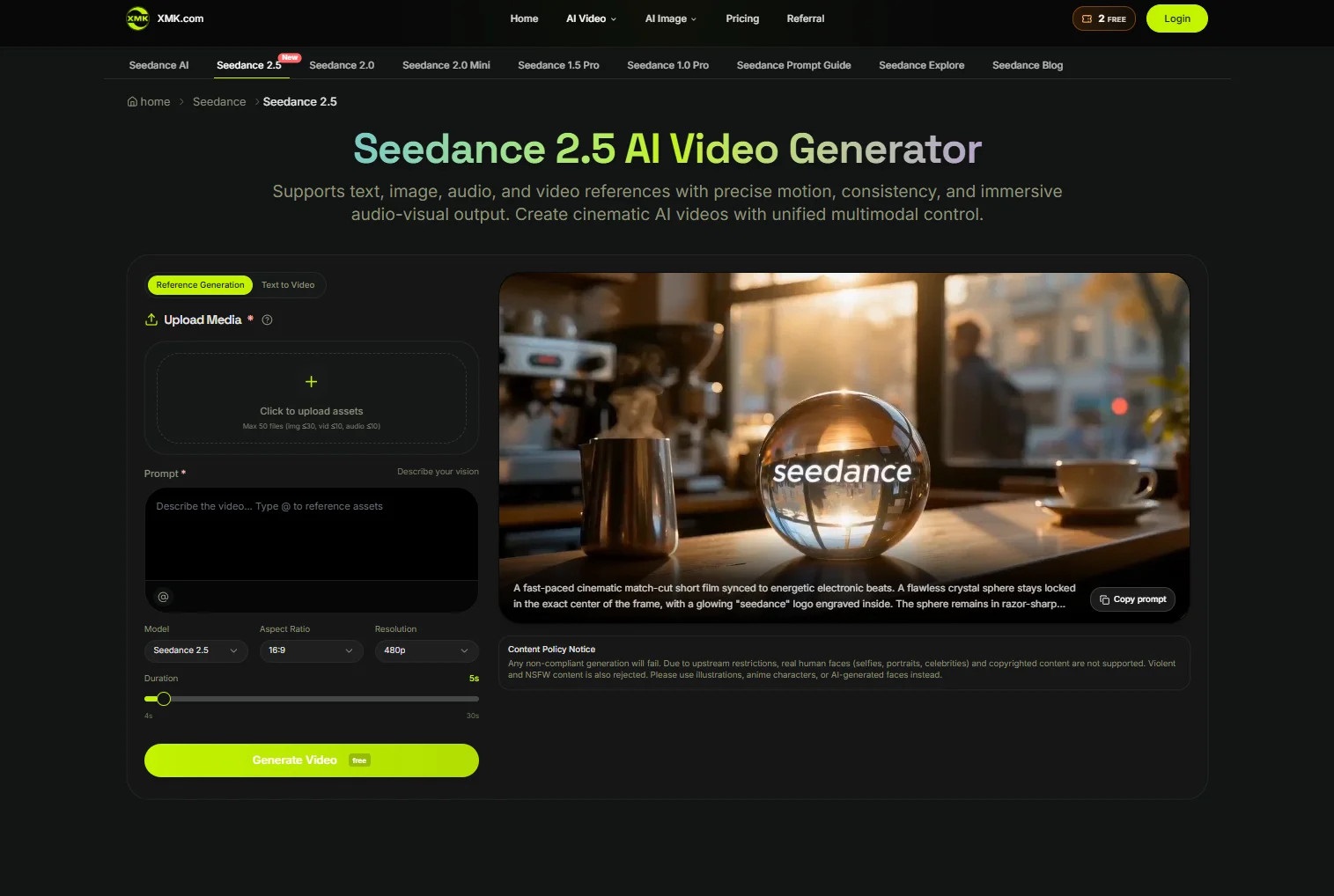
Once the master brief and language versions are approved, Seedance 2.5 ai can be considered for visual prototyping.

XMK describes Seedance 2.5 as accepting text alongside image, video, and audio references, with generation of up to 30 seconds and post-generation editing options.

For a multilingual team, the useful question is not whether AI can create the public message by itself. It is whether a visual draft can expose presentation problems early.

Perhaps a timeline moves too quickly. A French narration may need more time than the original draft allows. An Arabic version may require a different text layout. A diagram may need to remain on screen longer.

Those are production questions that can be explored before the final briefing is assembled.

Keep Facts Outside the Generative Layer

Reference inputs can guide a draft, but they do not guarantee factual fidelity.

A model may redraw a map, alter a number, distort text, change a logo, or modify the proportions of a chart even when the original asset was supplied as a reference.

For precise information, use the original verified material.

Briefing elementAuthoritative source
Dates and timesApproved master brief
AddressesOfficial record
Numbers and feesVerified document or dataset
Maps and routesTrusted geographic source
Translated wordingReviewed language version
Contact informationOfficial organisation record
Generated imagerySupporting context only

Where exact visual fidelity matters, verified maps, charts, text, logos, and information panels should be composited into the final video with conventional editing tools rather than recreated by the model.

A generated map that moves a route or a generated number that changes a fee is not a cosmetic error. In public-interest communication, it can change the meaning of the message.

One Structure Does Not Mean Identical Versions

A multilingual briefing can share the same editorial structure without forcing every language into exactly the same timing or layout.

A basic sequence might introduce the issue, explain what is changing, show the affected area, present the effective date, and direct viewers to an official source.

But narration length and reading speed vary between languages.

Arabic may require different spacing and right-to-left composition. Amazigh content may require an approved Tifinagh, Arabic, or Latin-script convention depending on the intended audience and institutional standard. French and English versions may also need different line breaks to remain readable on smaller screens.

Each version should therefore be reviewed as its own publication.

The final test is straightforward:

Would someone relying only on this language version receive the same verified information?

If not, the version is not ready.

Separate Prototyping From Publishing

The seedance 2.5 ai video also presents local re-draw as a way to target elements such as a product, background, or subject.

This may help refine a non-factual part of an internal prototype, but the complete clip should be reviewed again because nearby motion, composition, lighting, or other details may also change.

Factual maps, numbers, text, or documentary material should remain outside generative editing.

A practical workflow can stay simple:

  1. Verify — Create one authoritative master brief.
  2. Translate — Produce and review each language version.
  3. Prototype — Test the visual structure with approved, non-sensitive material.
  4. Assemble — Add verified maps, numbers, text, logos, and contact information using conventional editing.
  5. Review — Check each version for factual accuracy, language quality, accessibility, and visual clarity.
  6. Publish — Direct viewers to the authoritative source where appropriate.

Each final version should also be checked for captions, readable contrast, narration clarity, screen-reader-compatible accompanying text, and an accessible transcript where appropriate.

Sensitive Material Needs a Separate Decision

Public-interest organisations may hold material that should not be uploaded to an external AI service.

Confidential case records, health or financial information, private addresses, images of children or vulnerable participants, and unpublished internal material should not be treated as safe merely because names have been removed.

Removing a name or account number does not automatically make a document appropriate for external AI processing.

Teams still need to consider internal policy, consent, legal obligations, platform rules, and whether they have permission to upload the material at all.

When permission is unclear, teams can test an internal layout with generic components and clearly labelled placeholder data. All placeholder information should be removed and replaced with verified material before publication.

Platform eligibility is a separate question. XMK’s current product information states restrictions around real human faces, celebrity content, and copyrighted material. Organisations should therefore verify both their rights to use an asset and whether the selected service accepts that type of material before uploading it.

Clarity Before Automation

Multilingual public-interest communication is not successful simply because the same message can be produced faster in several languages.

Each version still needs to preserve the same verified facts, respect the audience’s language and context, and make clear what is factual and what is illustrative.

That includes details that are easy to overlook: writing direction, terminology, pronunciation, captions, dates, numerals, accessibility, and the script expected by the intended audience.

AI video can help test presentation. It should not become the authority for the message.

Automate presentation where useful; keep facts, translation, accessibility, and accountability under editorial control.


csr education cybernetyx
ADVERTISEMENT
India CSR Image 1 India CSR Image 2

CSR, Sustainability, and ESG success stories hindustan zinc
ADVERTISEMENT
India CSR

India CSR

India CSR® is the largest media on CSR and sustainability offering diverse content across multisectoral issues on business responsibility. It covers Sustainable Development, Corporate Social Responsibility (CSR), Sustainability, and related issues in India. Founded in 2009, the organisation aspires to become a globally admired media that offers valuable information to its readers through responsible reporting.

Related Posts

How Indian Wellness Brands Are Combining Ayurveda With Responsible Sourcing
Business

How Indian Wellness Brands Are Combining Ayurveda With Responsible Sourcing

India CSR
Business

Smart Investment Strategies for Agricultural Planting Equipment

India CSR
Business

Kishangarh’s Premier Italian Marble Dealer Vardhman Sagar Marbles Launches Exclusive B2B Program for Indian Architects

India CSR
Business

केश किंग ने पेश किया ‘स्कैल्प फर्स्ट’; पुरुषों और महिलाओं के लिए ऑयली और ड्राई स्कैल्प की जरूरतों के अनुरूप विशेष रेंज

Optimized by JPEGmini 3.18.32.260205554-TBTBLNP 0x10b5fc3a
Business

Indian Gen Z Places Greater Emphasis on Quality, Trust and Financial Independence: Study

Optimized by JPEGmini 3.18.32.260205554-TBTBLNP 0x10b5fc3a
Business

AutomationEdge Launched Assist-Edge at Global Fintech Fest 2026, Redefining How Enterprises Build and Scale Automation

Load More
csr education cybernetyx
ADVERTISEMENT
bba
ADVERTISEMENT

Interviews

India CSR
Interviews

Interview: Ravi Mahajan on India’s Shift from Diesel to Solar-Powered Telecom Towers

by India CSR

Ravi Mahajan of Vedang Cellular Services discusses solar energy, battery storage, AI and IoT in building efficient and resilient telecom...

Read moreDetails
Sanjay Hande, Head Of Manufacturing And Technology Management, Bosch India @india csr

Giving Becomes Participation, and Participation Creates a Deeper Connection: Sanjay Hande, Bosch India

Vivek Prakash, Senior Vice President & Head, CSR at Jubilant Ingrevia Limited

Didi Ki Dukaan is Helping Rural Women Become Independent Entrepreneurs: Vivek Prakash, Sr VP & Head–CSR, Jubilant Ingrevia

India CSR

Responsible Business Must Turn Research into Real Impact: Prof Bob Doherty

Load More
Ad 1 Ad 2 Ad 3 Ad 4 Ad 5 Ad 6
ADVERTISEMENT

CSR UPDATES

CSR: Nayara Energy Commits ₹2 Crore for Free Dialysis and Palliative Care in Kochi

Nita M. Ambani’s message to Indian athletes for the Asian Games: This is your moment, make it count

Indus Towers CSR Positively Impacts 33.88 Million Lives

From Potential to Progress: The Maashal Fellowship Story of GreenBreathe Innovations

Bata India Spends Rs 6.89 Cr on CSR in FY 2025-26, Supports Education, Health and Environment

BASF India Transfers Rs 8.86 Cr to Unspent CSR Account for Ongoing Projects in FY 2025-26

STEM Learning STEM Learning STEM Learning
ADVERTISEMENT
Facebook Twitter Youtube LinkedIn Instagram
India CSR Logo

India CSR® is the largest tech-led platform for information on CSR and sustainability in India offering diverse content across multisectoral issues. It covers Sustainable Development, Corporate Social Responsibility (CSR), Sustainability, and related issues in India. Founded in 2009, the organisation aspires to become a globally admired media that offers valuable information to its readers through responsible reporting. To enjoy the premium services, we invite you to partner with us.

Follow us on social media:

Subscribe to Our Newsletter

Don't miss out on the latest updates in corporate social responsibility. Subscribe to our newsletter at indiacsr.in and be part of the positive change.
Please enable JavaScript in your browser to complete this form.
Loading

  • About India CSR®
  • Team
  • India CSR® Awards 2026
  • India CSR® Leadership Summit
  • Partnership
  • Guest Posts
  • Services
  • ESG Professional Network
  • Content Writing Services
  • Business Information
  • Contact
  • Privacy Policy
  • Terms of Use
  • Donate

Copyright © 2026 - India CSR® | All Rights Reserved

No Result
View All Result
  • Home
  • Corporate Social Responsibility
    • Art & Culture
    • CSR Leaders
    • Child Rights
    • Culture
    • Education
    • Gender Equality
    • Around the World
    • Skill Development
    • Safety
    • Covid-19
    • Safe Food For All
  • Sustainability
    • Sustainability Dialogues
    • Sustainability Knowledge Series
    • Plastics
    • Sustainable Development Goals
    • ESG
    • Circular Economy
    • BRSR
  • Corporate Governance
    • Diversity & Inclusion
  • Interviews
  • SDGs
    • No Poverty
    • Zero Hunger
    • Good Health & Well-Being
    • Quality Education
    • Gender Equality
    • Clean Water & Sanitation – SDG 6
    • Affordable & Clean Energy
    • Decent Work & Economic Growth
    • Industry, Innovation & Infrastructure
    • Reduced Inequalities
    • Sustainable Cities & Communities
    • Responsible Consumption & Production
    • Climate Action
    • Life Below Water
    • Life on Land
    • Peace, Justice & Strong Institutions
    • Partnerships for the Goals
  • Articles
  • Events
  • हिंदी
  • More
    • Business
    • Finance
    • Environment
    • Economy
    • Health
    • Around the World
    • Social Sector Leaders
    • Social Entrepreneurship
    • Trending News
      • Important Days
      • Great People
      • Product Review
      • International
      • Sports
      • Entertainment
    • Case Studies
    • Philanthropy
    • Biography
    • Technology
    • Lifestyle
    • Sports
    • Gaming
    • Knowledge
    • Home Improvement
    • Words Power
    • Chief Ministers

Copyright © 2026 - India CSR® | All Rights Reserved

This website uses cookies. By continuing to use this website you are giving consent to cookies being used. Visit our Privacy and Cookie Policy.
