

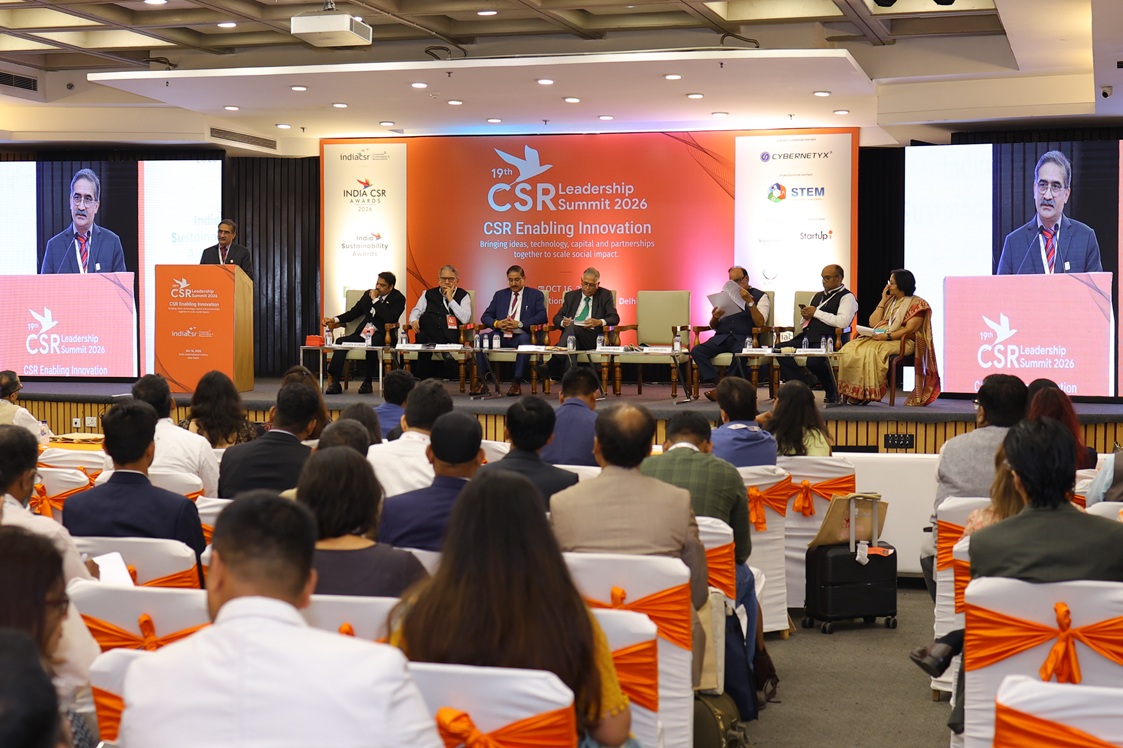


At the 19th India CSR Summit 2026, HPCL’s Chief General Manager–CSR, Public Relations and Corporate Communications outlined a framework centred on institutional strength, community ownership, transparent evaluation and long-term ecosystem building.
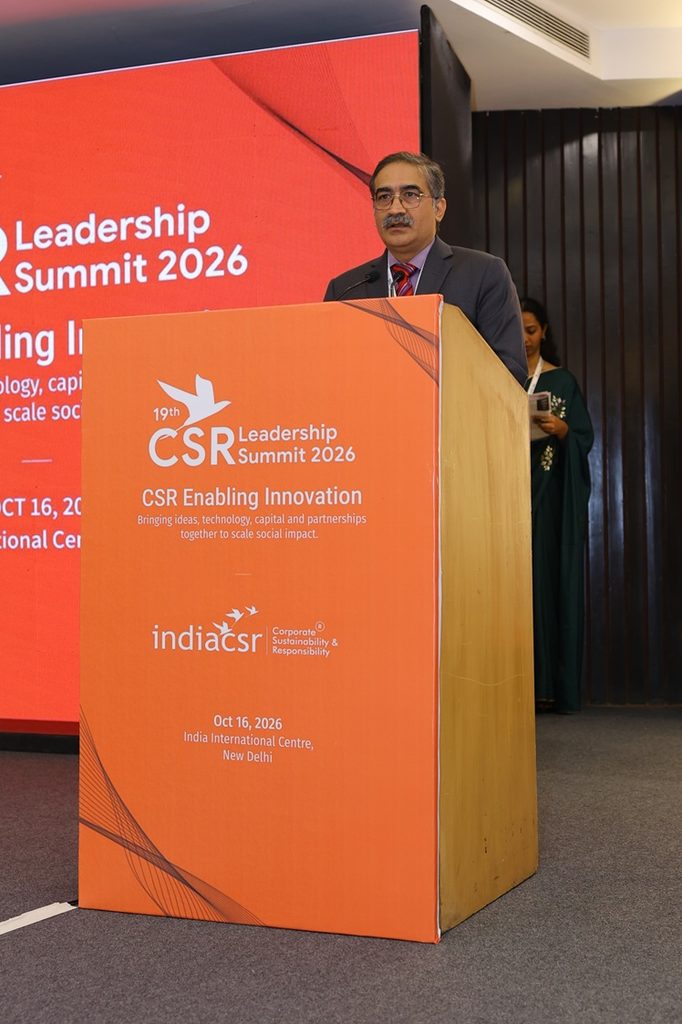
NEW DELHI (India CSR): CSR projects should be designed to become sustainable beyond the period of corporate funding, Anupam Tiwari, Chief General Manager–CSR, Public Relations and Corporate Communications, Hindustan Petroleum Corporation Limited, said at the 19th India CSR Summit 2026. Delivering a special address at the India International Centre on October 16, Tiwari outlined the lessons HPCL has drawn from its social-development interventions across skilling, livelihoods, water, education and community infrastructure. The summit was organised by India CSR under the theme, “CSR Enabling Innovation – Bringing Ideas, Technology, Capital and Partnerships Together to Scale Social Impact.” Tiwari’s central argument was that corporate support must create institutions, capabilities and local systems rather than permanent dependence. The objective, he said, is not simply to fund an activity but to help a programme continue, improve and serve communities after the initial sponsor reduces or ends its direct involvement.
Revenue Replaces Dependency
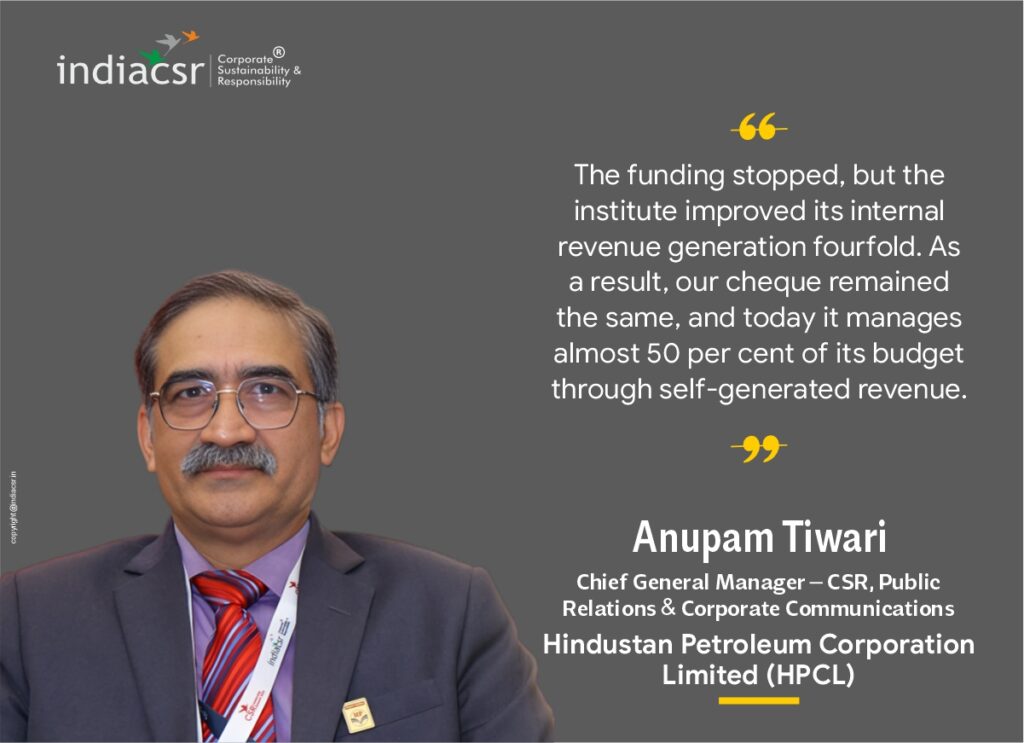
Tiwari cited HPCL’s skill-development institute in Visakhapatnam as an example of how an organisation can respond when external funding declines. The institute was initially supported through funding from different companies and institutions. When some of that funding stopped, the conventional response might have been for the principal sponsor to increase its contribution and fill the gap. Instead, the institute strengthened its internal revenue-generation model. According to Tiwari, the institution increased its internal revenue fourfold, allowing HPCL’s financial contribution to remain at the same level. Today, he said, the institute generates nearly 50 per cent of its own budget through the facilities and systems developed over time. “The funding stopped and they improved their internal revenue generation fourfold, so that our cheque remained the same,” Tiwari said. The example demonstrates that programme sustainability can be strengthened when institutions develop an independent economic base alongside grant support.
Anupam Tiwari says sustainable CSR requires community ownership, outcomes-based evaluation, transparent reporting and planned exits.
Ownership Sustains Funding
Funding can initiate a community project, but ownership is what enables it to continue, Tiwari said. He noted that CSR programmes can lose momentum because of changing priorities, reduced financial support or declining stakeholder engagement. To address this risk, HPCL seeks to involve local communities and company officers in projects implemented near its locations and installations. In water-body rejuvenation, recharge work and similar interventions, villagers are encouraged to become stakeholders in planning, maintenance and use. This involvement, he said, creates a sense of ownership that can help protect assets and sustain outcomes. “Ownership sustains what funding starts,” Tiwari said. The principle is particularly relevant for rural infrastructure, where long-term benefits depend on how communities maintain, govern and use facilities after construction is completed. The approach moves CSR away from a donor-beneficiary model towards a shared-responsibility framework involving companies, implementation partners and local residents.
Livelihoods Define Success
CSR interventions in skilling must be judged by whether they lead to viable livelihoods, not only by the number of certificates issued, Tiwari said. Training programmes often begin with considerable visibility and enthusiasm, but their purpose can be diluted if participants do not obtain employment, build market-relevant capabilities or improve their incomes. HPCL has partnered with CII to train transgender persons who are now employed, he said, pointing to the importance of linking inclusion with economic sustainability. The objective, he argued, must be to empower people in a manner that helps them sustain themselves through the skills they acquire. “One thing is taking initiative and second is not just to empower them, but to empower them in such a way that their livelihood sustainability is there,” Tiwari said. This distinction is important for CSR reporting. A training programme may produce immediate outputs, but its real value lies in long-term employment, self-employment, income security and dignity.
Partnerships Multiply Reach
Tiwari described partnerships as essential to the scale and continuity of social-impact work. He referred to HPCL’s Super 50 programme in Jammu and Kashmir as an example of a multi-stakeholder model. In the programme, HPCL works as the funder, the Indian Army provides space and infrastructure, and an implementing organisation serves as a knowledge partner. Each participant contributes a different capability, reducing the burden on any single organisation while improving the programme’s ability to function over time. “Partnerships multiply reach,” Tiwari said. The model illustrates how CSR programmes can benefit when corporations, public institutions, community bodies and specialist organisations combine their respective strengths. Corporate entities may provide funding, project-management systems and strategic direction; government institutions can facilitate infrastructure and scale; and implementing partners can bring local knowledge and subject expertise. Such collaboration can make programmes more resilient, especially in complex geographies or underserved communities.
Scrutiny Enables Learning
Every CSR project requires scrutiny, not as a fault-finding exercise but as a way to understand weaknesses and improve systems, Tiwari said. Monitoring, evaluation and periodic review can help programme teams identify where implementation is falling short, whether resources are being used effectively and what adjustments are needed. He said scrutiny should strengthen projects by making them more sustainable and broad-based over time. This approach requires organisations to be open to findings that may challenge assumptions or reveal gaps. In many cases, development programmes operate in dynamic environments where community needs, market conditions and institutional capacities change. A project that performed well in its initial phase may require redesign as circumstances evolve. Tiwari’s remarks suggested that CSR teams should make evaluation an integral part of programme management, rather than a reporting requirement at the end of a funding cycle. Learning, he said, is central to sustaining social investments over the long term.
Outcomes Guide Decisions
HPCL plans and assesses projects through an outcome-based approach, Tiwari said. He called for a shift from outputs to outcomes, explaining that activity counts alone cannot establish whether a programme has created enduring change. In its skill-development interventions, the company tracks placement rates, cost per trainee and the share of self-generated revenue, he said. These indicators help determine whether training is resulting in jobs and whether the institution is gradually strengthening its own financial viability. The framework also creates a basis for comparing performance across time and taking corrective action where required. “We not only train the students, we track the placement rates, cost per trainee and share of self-generated revenue,” Tiwari said. Outcome measurement is especially important in projects that seek to improve livelihoods, employability, health or education, because these areas require evidence of change beyond immediate participation. It can help CSR teams allocate resources more effectively and understand where deeper support may be necessary.
Independent Reviews Matter
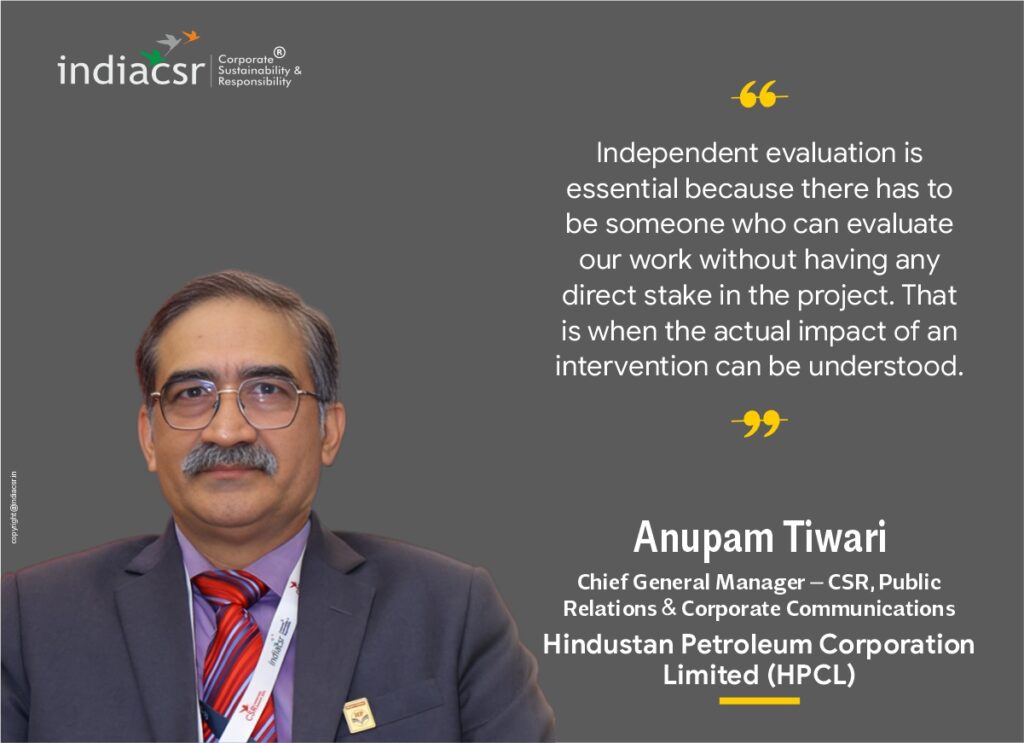
Independent evaluation is necessary for a credible understanding of social impact, Tiwari said. An external evaluator can review a programme without being directly responsible for its design, funding or implementation, bringing a degree of distance to the assessment. “There has to be somebody who sees our work, evaluates our work and who has no skin in the game,” he said. This independence can help distinguish between reported activity and verified results. It can also identify unintended effects, implementation gaps or operational risks that internal teams may overlook. Independent evaluations are particularly valuable for large, multi-year initiatives involving several stakeholders and substantial investment. They can assess whether the programme has reached its intended beneficiaries, whether outcomes are attributable to the intervention and whether benefits are likely to endure. Tiwari’s remarks reinforce the growing emphasis within CSR on evidence, transparency and third-party assurance. For companies, credible review mechanisms can improve decision-making while strengthening the trust of communities, partners and other stakeholders.
Transparency Builds Trust
Transparency is another core requirement for sustainable CSR, according to Tiwari. Organisations need to be clear about what they are doing, where their programmes are succeeding and where there remains scope for improvement. Transparent reporting can create accountability within a company and build confidence among communities, implementing agencies, regulators and the public. It also encourages programme teams to confront difficulties early rather than allowing them to remain unaddressed. Tiwari said transparency helps organisations understand their position and identify areas requiring further work. This is significant in a sector where impact claims can sometimes focus heavily on visible achievements while overlooking the complexities of implementation. Clear reporting on objectives, expenditure, partnerships, indicators and results can help stakeholders judge whether projects are achieving their stated purpose. It can also make learning transferable, enabling other organisations to adapt successful models or avoid challenges already encountered by others. Transparency, therefore, is not merely a compliance obligation but an operational discipline.
Dips Reveal Learning
CSR reporting should acknowledge setbacks as well as achievements, Tiwari said. “Report the dips, not just the peaks,” he urged, noting that neither life nor markets move in a linear direction. Development projects can face unexpected challenges: community participation may take longer than anticipated, equipment may require repair, a training partner may struggle, or external conditions may affect outcomes. Reporting only successes can create an incomplete understanding of a programme and prevent institutions from learning from their weaker phases. Tiwari said that when a dip occurs, it should be appreciated, recorded and addressed. This approach requires a culture in which organisations can discuss difficulties without treating every setback as failure. Honest reporting can lead to stronger programme design because it reveals where additional resources, technical support or community engagement may be needed. For CSR practitioners, acknowledging challenges can be as important as celebrating progress, particularly in multi-year programmes intended to deliver durable impact.
Durability Needs Planning
The durability of physical assets must be considered from the beginning of a CSR project, Tiwari said. Water ATMs, water-recharge structures, community facilities and other infrastructure require maintenance if they are to remain useful after inauguration. HPCL seeks to support maintenance for an initial period and then transfer responsibility to an agency capable of continuing the work after the annual maintenance contract concludes. This process requires clarity about who will own the asset, how operating costs will be met and whether local institutions have the capacity to manage it. Too often, infrastructure is treated as the final outcome rather than the beginning of a longer operating cycle. Tiwari’s comments highlighted the importance of building maintenance, governance and financing provisions into project design. A water facility, training centre or health asset becomes sustainable not only because it is constructed well, but because people and institutions have the ability to operate, repair and govern it after external support is reduced.
Ecosystems Outlast Projects
Tiwari said HPCL’s broader learning is to build an ecosystem rather than execute an isolated project. This means looking at the interconnected needs of communities, including skills, education, health, infrastructure, livelihoods and institutional capacity. A single intervention may address one need, but its impact can remain limited if surrounding barriers are not considered. For example, skill training is more effective when linked to employers; education is stronger when children have supportive facilities; and community infrastructure lasts longer when local governance and maintenance arrangements exist. “Build an ecosystem, not just a project,” Tiwari said. The approach is particularly relevant in regions experiencing rapid industrial or economic change, where corporate investment can transform local demand for jobs, housing, education, health services and public infrastructure. By viewing CSR within this wider context, companies can better align their social investments with community needs and development opportunities created by their business presence.
Pachpadra Shapes Futures
HPCL’s refinery investment at Pachpadra in Rajasthan provides an example of this ecosystem approach, Tiwari said. The refinery project represents an investment of nearly ₹80,000 crore and has changed the profile of an area that was previously identified largely with desert terrain. Such a major industrial investment brings business opportunities and infrastructure, but it also creates new expectations from nearby communities. HPCL is setting up a dedicated skill centre in the region, with trades selected to match jobs that can be absorbed by the refinery and its contractors. This alignment seeks to connect training directly with employment opportunities created by the industrial ecosystem. Tiwari described the programme as a way to ensure that local communities can participate in the economic changes taking place around them. The model illustrates how corporate CSR can be linked with local capability development, helping people access jobs and livelihood opportunities associated with large-scale infrastructure and industrial projects.
Education Anchors Growth
Beyond short-term skills courses, HPCL is setting up a government polytechnic at Balotra with its own investment, Tiwari said. The institution will be handed over to the All India Council for Technical Education for operation, reflecting a division of roles between corporate investment and educational expertise. HPCL is also establishing a school and hospital in the Pachpadra region, according to the address. These interventions seek to create a wider foundation for community development in an area undergoing industrial transformation. Tiwari stressed that companies are not necessarily experts in running educational institutions and therefore need capable institutions to manage them. This recognition is important in CSR: investment in infrastructure must be accompanied by appropriate governance and professional operation. HPCL has also partnered with the Ministry of Tribal Affairs to upgrade Eklavya Model Residential Schools across Rajasthan, with a focus on tribal students. Together, these initiatives reflect an effort to connect industrial development with education, health and skills.
Exit Plans Matter
Projects should be designed with an exit strategy from the first day, Tiwari said, while cautioning that companies should not rush their withdrawal before a programme is ready. “We need to design the exit on day one,” he said. An exit strategy can clarify how a programme will transition from corporate support to local ownership, government management, revenue generation or another sustainable model. Without such planning, projects may face uncertainty when funding ends. However, Tiwari emphasised that each programme requires a realistic assessment of when it can function independently. Some initiatives may need longer support because of the complexity of their context or the time required to build local capacity. The decision to exit should therefore be based on evaluation rather than a fixed timetable. A well-designed transition can ensure that investments continue to serve communities, while allowing CSR funds to be redirected towards new needs and underserved locations.
Future Funding Freed
Tiwari concluded that sustainable projects allow companies to use their resources more effectively over time. When an institution begins generating revenue, a community takes responsibility for an asset, or a government system assumes management of a facility, the original CSR investment can continue delivering value without requiring the same level of recurring funding. This gives corporate foundations and CSR teams the ability to direct new resources towards other pressing challenges. He urged organisations to invest in assets, capabilities and ecosystems; measure outcomes honestly; and publish findings transparently. The ultimate test, he said, is whether a project can keep moving after the company exits. “After we exit, the project should move on,” Tiwari said. His address placed sustainability at the centre of CSR strategy—not as an additional feature, but as the standard against which programme design, partnerships, evaluation and long-term impact should be judged.
Also Read More on India CSR Summit and Awards
IIC Director K. N. Shrivastava Calls for CSR-Led R&D, Inclusive Innovation at India CSR Summit
Value Beyond Business: LT Foods’ Monika Chawla Jaggia Addresses India CSR Summit
LT Foods Awarded ‘Certificate of Honour’ at India CSR Awards for Sustainability Report 2024–25
Shallu Jindal Named India CSR Person of the Year 2026 – India CSR
HOPE Foundation Wins India CSR Award for Integrated Cradle-to-Career Model – India CSR