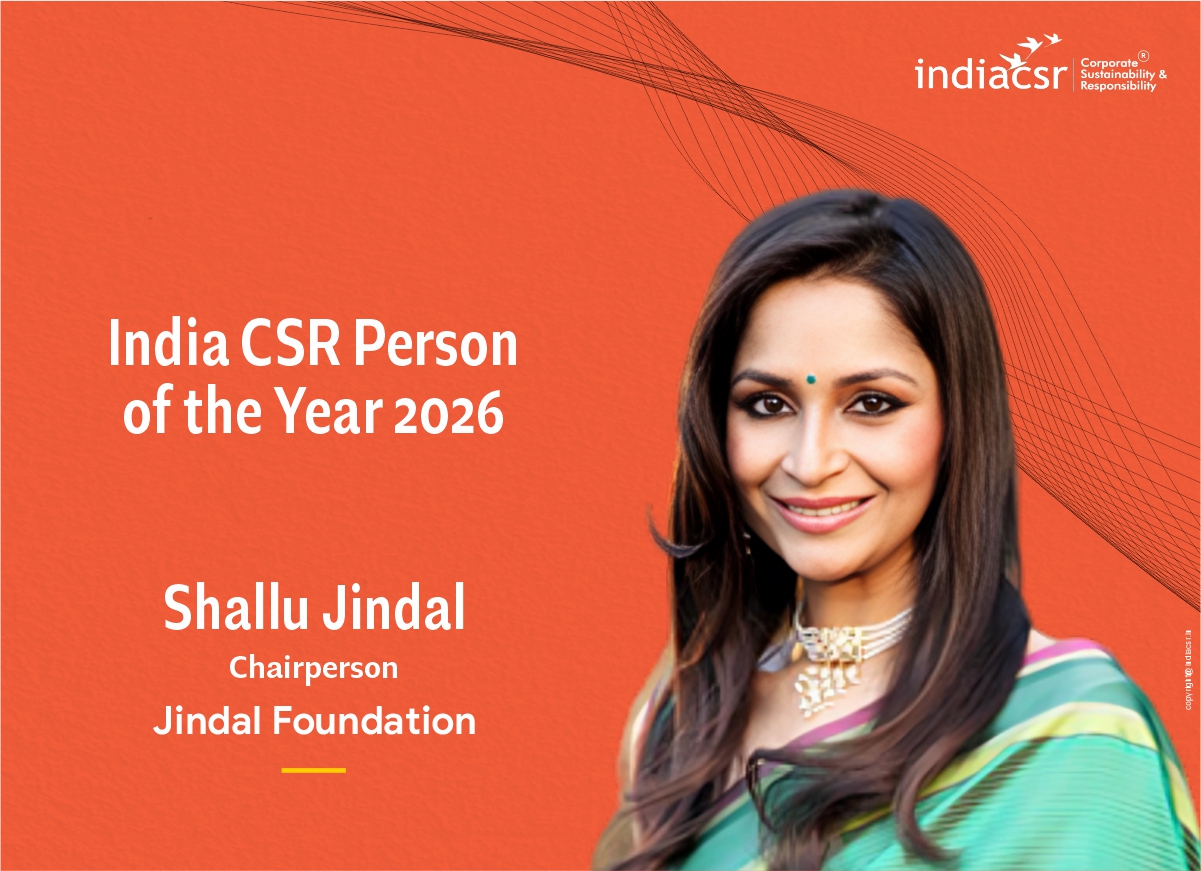


The Jindal Foundation Chairperson was recognised at the India CSR Summit & Awards 2026 for #HerKadam, an integrated initiative supporting women, girls and children across underserved communities.
NEW DELHI (India CSR): Smt. Shallu Jindal, Chairperson of Jindal Foundation, has been named India CSR Person of the Year at the 19th India CSR Leadership Summit & Awards 2026 in New Delhi. The recognition acknowledges her leadership in advancing women’s health, maternal care, nutrition and economic empowerment through community-led development programmes. Under her leadership, Jindal Foundation has built #HerKadam as an integrated social-impact initiative focused on women, adolescent girls, mothers, children and vulnerable families. The Foundation says the initiative operates across more than 2,300 underserved villages in Odisha, Chhattisgarh, Jharkhand and Haryana. The award recognised the effort to combine mobile healthcare, nutrition support, health awareness, institutional partnerships and community participation. It also reflects the importance of women-centred CSR programmes that address health and nutrition challenges across different stages of life rather than through isolated interventions.
“We congratulate Smt. Shallu Jindal on being named CSR Person of the Year. Her leadership through #HerKadam demonstrates how sustained, integrated action in women’s health, nutrition and empowerment can create meaningful change across communities,” says Rusen Kumar, Founder and Editor, India CSR.
HerKadam Expands Reach
The #HerKadam initiative is designed as a continuum of support, linking adolescent health, maternal and infant care, child nutrition, elderly care and livelihood-related interventions. Jindal Foundation says the programme has reached more than nine lakh adolescent girls through anaemia screening, treatment, counselling and health awareness activities. The initiative seeks to address anaemia, menstrual-health awareness and related barriers that can affect the education, well-being and confidence of young girls. The Foundation has used mobile and doorstep-delivery models in remote and rural areas where access to static health facilities may be limited. These efforts are supported through programmes such as Kishori Express, which uses mobile health services and digital diagnostic tools. The approach is intended to take services closer to communities, reducing travel barriers and enabling follow-up support. The Foundation says its work is aligned with wider public-health priorities, including Anaemia Mukt Bharat.
***
Maternal Care Strengthened
Maternal and child health form another major part of the #HerKadam framework. Jindal Foundation reports that its Vatsalya programme has provided antenatal and postnatal care to more than 8.9 lakh expectant and new mothers. The programme works to support pregnancy registration, health monitoring, counselling, institutional delivery and infant-care practices through coordination with local health systems. In rural and tribal communities, such support can be important where women face long distances, limited information and socio-cultural barriers to accessing timely care. The Foundation’s nomination material states that its interventions are designed to complement existing Community Health Centres, Primary Health Centres, Anganwadi centres and other government systems rather than create parallel structures. This approach allows community-level workers, healthcare providers and public institutions to participate in monitoring and service delivery. The objective is to strengthen health-seeking behaviour among families while improving continuity of care for mothers and infants.
***
Nutrition Outcomes Reported
Child nutrition is addressed through the Foundation’s Chiranjeevi programme, which works with families and the Integrated Child Development Services network to identify, monitor and support children facing severe acute malnutrition. According to Jindal Foundation, more than 90 per cent of identified severely malnourished children supported through the programme have progressed towards a healthy nutritional status. The Foundation says the model combines growth monitoring, nutritional counselling, caregiver participation and convergence with Anganwadi and health systems. More broadly, #HerKadam and associated programmes have delivered over 12 million instances of health and nutrition support, according to the Foundation. Its SNEH programme supports vulnerable households with essential nutrition and healthcare safety nets, while Swasti Express provides mobile geriatric care, including physiotherapy and chronic-care support, for elderly residents in remote locations. Together, these interventions seek to create a life-stage approach that responds to the different health needs of girls, women, children and senior citizens.
***
Community Systems Built
A defining feature of the Foundation’s reported approach is its focus on community participation and local capacity. Village-level health workers, referred to as Swasthya Sanginies, support health awareness, screenings, nutrition tracking and counselling. Local women’s self-help groups are also associated with menstrual-hygiene initiatives, including the manufacture and distribution of sanitary napkins. The Foundation says this model helps shift communities from being passive beneficiaries to active participants in health and nutrition programmes. Community needs assessments, village mapping, focus-group discussions and local consultations are used to identify gaps and shape programme delivery. The model also seeks to promote sustainability by strengthening local health committees, training grassroots workers and connecting mobile services with existing public-health infrastructure. Such convergence is important because long-term outcomes depend on whether knowledge, behaviour and service access remain in place after an individual intervention has ended. The Foundation’s wider programmes also cover education, livelihoods, skill development, environment, sports, infrastructure and social inclusion.
***
Summit Celebrates Leadership
The 19th India CSR Leadership Summit 2026, organised by India CSR® at the India International Centre, New Delhi, on 16 October 2026, brought together corporate leaders, CSR professionals, social-sector organisations, academic institutions and policy stakeholders to explore how innovation can scale social impact. Held under the theme, “CSR Enabling Innovation – Bringing ideas, technology, capital and partnerships together to scale social impact,” the Summit featured discussions on skilling, livelihoods, education, entrepreneurship, inclusion and sustainable development. With participation from more than 250 corporates, the platform strengthened dialogue on building measurable, collaborative and community-centred CSR interventions across India.
Also Read More on India CSR Summit and Awards
IIC Director K. N. Shrivastava Calls for CSR-Led R&D, Inclusive Innovation at India CSR Summit
Value Beyond Business: LT Foods’ Monika Chawla Jaggia Addresses India CSR Summit
HOPE Foundation Wins India CSR Award for Integrated Cradle-to-Career Model – India CSR
LT Foods Awarded ‘Certificate of Honour’ at India CSR Awards for Sustainability Report 2024–25