
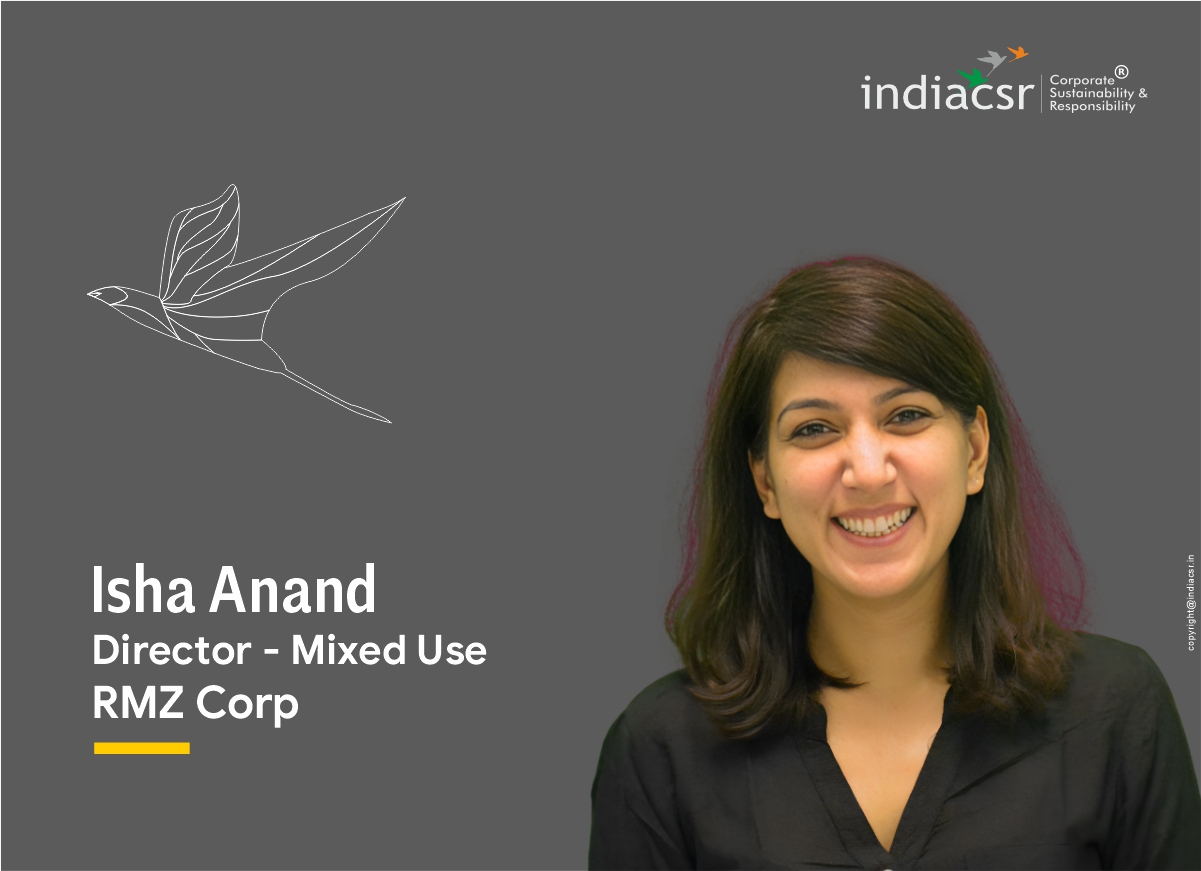



Isha Anand of RMZ, discusses ESG-led value creation, net-zero goals, climate resilience, water circularity and future-ready real estate in India.
An architect and sustainability advocate with over 25 years of experience in hospitality and retail development, Isha Anand leads spatial design and integration efforts as Director – Mixed Use at RMZ Corp. In this conversation with Rusen Kumar, Editor, India CSR, she explains how ESG is reshaping real estate from a compliance-led exercise into a driver of asset performance, occupier demand, investor confidence and long-term value creation.
From renewable energy, water circularity and waste reduction to embodied carbon, climate-risk planning and wellness-focused workplaces, Anand outlines what it will take to build truly future-ready real estate assets in India.
Excerpts of an interview:
Q. ESG in real estate is often seen as compliance driven. How is this perception changing, and what does ESG-led value creation actually look like today?
Isha Anand: The perception of ESG as a compliance requirement is rapidly evolving into a strategic value driver. Today, ESG is directly linked to asset performance, occupier demand, and capital access. At RMZ, we see ESG-led value creation through three lenses – operational efficiency, risk mitigation, and premium asset positioning. For instance, energy-efficient buildings reduce operating costs, while wellness-certified environments enhance occupier productivity and retention. At the same time, strong ESG credentials are increasingly influencing investor decisions, especially among global institutional capital.
ESG has moved from being a reporting requirement to becoming a core business strategy that influences how assets are designed, financed, operated, and valued. It is fundamentally shaping how real estate is designed, financed, and operated.
“The perception of ESG as a compliance requirement is rapidly evolving into a strategic value driver.”
***
Q. RMZ has achieved high levels of green certification across its portfolio – what lies beyond certifications in your sustainability journey?
Isha Anand: Certifications like LEED and WELL are important benchmarks, but they are only the starting point. The next phase is about real-time performance and measurable impact. At RMZ, a significant proportion of our portfolio is green certified, but our focus is on how these buildings perform daily – how much energy they consume, how efficiently water is used, and how they contribute to occupant well-being.
We are investing in digital infrastructure and data-driven ESG management systems that allow us to monitor and optimise performance continuously. The shift is from “designing green buildings” to operating high-performing assets that continuously adapt through data-driven operations.
***
Q. With a significant portion of your energy coming from renewables, what are the next big challenges in achieving net-zero across commercial real estate?
Isha Anand: Renewable energy addresses operational emissions, but achieving net zero requires tackling emissions across the entire asset lifecycle, and we’ve made strong progress with a large share of our energy already coming from clean sources. However, the next frontier lies in addressing Scope 3 emissions and embodiedcarbon – which includes emissions from construction materials, tenant operations, and the broader supply chain.
Achieving net-zero will require industry-wide collaboration, innovation in low-carbon materials like green cement, and deeper integration of lifecycle assessments into design decisions. It is a complex transition, but also a significant opportunity to redefine how we build and operate real estate.
***
Climate risk is now a core part of our investment framework, not an afterthought.
Q. How are you integrating climate risk – such as flooding, heat stress, or regulatory changes – into your investment and development decisions?
Isha Anand: Climate risk is now a core part of our investment framework, not an afterthought. We integrate scenario-based risk assessments across the lifecycle of our assets – from site selection to design and operations. For example, we conduct detailed flood risk modelling, heat resilience planning, and climate scenario analysis aligned with global frameworks. These insights directly inform design interventions such as elevation strategies, drainage systems, and material choices. This approach ensures that our assets are not only sustainable but also resilient and future-proof, which is critical for long-term value creation.
***
Q. Water stress is becoming a critical urban challenge. How is RMZ rethinking water management across its developments?
Isha Anand: Water stewardship is a priority, especially in urban India where water scarcity is intensifying. At RMZ, we follow a closed-loop water management approach – where water is treated, recycled, and reused within the asset. We have implemented 100% on-site recycling of grey and blackwater, along with rainwater harvesting and efficient plumbing systems to reduce freshwater dependency. The goal is to create assets that are not just efficient but developments that contribute positively to the urban water balance.
Water stewardship is a priority, especially in urban India where water scarcity is intensifying.
***
Q. Circularity is gaining prominence in ESG conversations. How are you embedding waste reduction and material reuse into both construction and operations?
Isha Anand: We believe circularity begins at the design stage rather than at the point where waste is generated. Circularity is embedded across our asset lifecycle – from construction to operations. During construction, we use modular and precast techniques to reduce material wastage, and we increasingly rely on life cycle assessments to select low-impact materials.
On the operational side, we are moving towards zero waste to landfill, supported by segregation, recycling, and partnerships with specialized waste management organisations. Our long-term vision is to build assets that operate within a circular economy framework, minimizing resource extraction and maximising reuse.
***
Q. From an occupier perspective, how important are sustainability and wellness features in influencing leasing decisions today?
Isha Anand: Sustainability and wellness have become central to occupier decision-making, especially among global corporations and GCCs. Today’s occupiers are looking for spaces that align with their own ESG commitments while also enhancing employee experience. Features such as energy-efficient environments, indoor air quality, biophilic design, and wellness certifications are no longer differentiators – they are expectations.
At RMZ, we design spaces that go beyond functionality to create experiential, human-centric workplaces, which in turn drives higher occupancy and long-term tenant retention. Increasingly, workplace quality is becoming a talent attraction and retention strategy for occupiers.
***
Q. How do you see ESG influencing capital flows in real estate, especially with global investors becoming more sustainability-focused?
Isha Anand: ESG is playing a decisive role in shaping capital flows. Global investors today are prioritising assets that demonstrate strong sustainability credentials, transparency, and long-term resilience. At RMZ, our ESG framework is aligned with global standards and integrated into our investment lifecycle – from due diligence to asset management.
This not only enhances investor confidence but also enables access to patient, long-term capital that is aligned with sustainable growth. ESG is effectively becoming an increasingly important factor in attracting long-term institutional capital.
***
Q. RMZ NXT focuses on industrial and logistics assets – how does the ESG playbook differ for this segment compared to commercial office spaces?
Isha Anand: While the core ESG principles remain consistent, the application differs across asset classes. In industrial and logistics, the focus is more on energy optimization, land use efficiency, and supply chain sustainability. For RMZ NXT, this includes solar-ready infrastructure, green building certifications, and efficient warehouse design that reduces operational emissions. As e-commerce and manufacturing scale up, ESG in logistics will play a critical role in reducing the overall carbon footprint of supply chains.
***
Q. Looking ahead, what will define a truly ‘future-ready’ real estate asset in India over the next decade from an ESG standpoint?
Isha Anand: A future-ready asset will be net-zero aligned, climate-resilient, digitally enabled, and human-centric. It will integrate sustainability across every layer – from low-carbon construction and renewable energy to water circularity and biodiversity. It will also leverage technology for real-time performance monitoring and continuous optimization.
Most importantly, it will create environments that enhance well-being, inclusivity, and community engagement. The future of real estate lies in creating resilient, low-carbon places that support business performance, strengthen communities, and improve quality of life.
© Copyright Disclaimer: All rights reserved. No part of this report may be reproduced, republished, distributed or transmitted in any form without prior written permission from India CSR®.
Read more interviews.