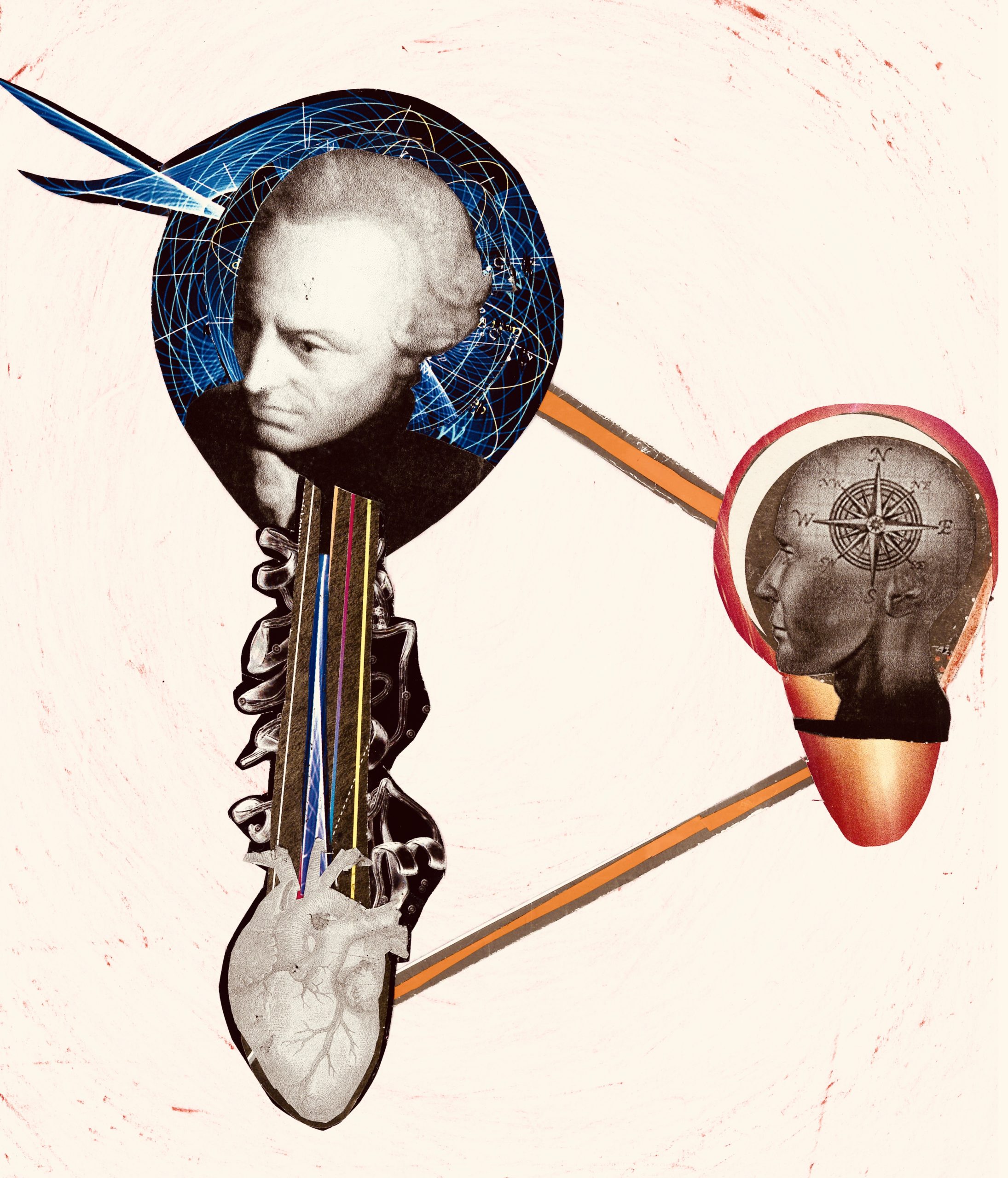



The Supreme Court decided on June 15 that the Civil Rights Act of 1964 protects gay and transgender workers from workplace discrimination. Discrimination ‘because of sex’ is unlawful. But what is it that makes discrimination morally wrong? It is useful to examine this from a Kantian standpoint because Immanuel Kant lays the foundation for recognizing the inherent dignity of every individual – and discrimination is indeed an affront to human dignity.
Kant’s moral philosophy – or deontology (‘deon’ referring to duty) – maintains that what makes an act right is that it is done for the sake of the moral law. Consequences, intended or otherwise, are irrelevant in determining the moral worth of an action. What matters is whether the action is motivated by duty, which is to say, respect for the moral law.
Kant offered several formulations of the moral law which he described as a categorical imperative, as opposed to a hypothetical imperative. A hypothetical imperative says “If you want to accomplish x… then you must do y.” A categorical imperative on the other hand says, “Do x!” Your ends, aims or desires are irrelevant. That is what makes it categorical: it is not conditional upon anything. It commands us all the same irrespective of empirical or psychological contingencies.

Two formulations of the categorical imperative are particularly important. The first is the principle of human dignity and it says, never treat another rational being merely as a means but always as an end-in-themselves. In other words, treat every human being as possessing intrinsic value and never simply as a means to your own ends. From this standpoint, slavery is wrong precisely because it reduces the human being to a mere object, a thing, an instrument for satisfying another’s interests and fails to recognize their infinite and intrinsic worth as an end-in-themselves.
The second formulation of the categorical imperative is the principle of universalizability. It tells us to act only on those maxims that we can universalize. In other words, ask yourself if the action I am about to take can be rationally universalized – could I rationally, self-consistently will that everyone act in the same way as I am about to? Suppose I want to break a contract and renege on my promise: could I rationally will that everyone act on the maxim, renege on your promise when it suits you? The answer is no. I cannot rationally universalize the maxim, break your contract whenever it suits you, because in that case the entire institution of making contracts would collapse. No one would enter into a contract if there was not a reasonable expectation that it would be honored. When I renege on an agreement what I am actually doing is making an exception of myself – I am saying that everyone else should abide by their agreements but the same rule does not apply to me.
In fact, it is fair to say that the capital sin from a Kantian standpoint is precisely making an exception of myself, failing to recognize that the same rules apply to me as they do to anyone else. Discrimination therefore violates the very core of Kantian moral theory. When I discriminate against another person or group, I am saying that they do not count as much as I do. Discrimination is always morally wrong from a Kantian standpoint because it means that I allow myself to count more than the other does: the same rules do not apply to us equally. But morality requires that no one, and no group, counts more than any other. The rules apply to us all equally and no one is permitted to make an exception of themselves or the group to which they happen to belong.
There is another aspect to the deontological critique of discrimination. Kant famously writes in the Conclusion to his Critique of Practical Reason (1788): “Two things fill the mind with ever new and increasing admiration and reverence… The starry heavens above me and the moral law within me.” What is so wonderful about the moral law? There is something about it which gives humanity a touch of the divine and the reason has to do with autonomy.
To say that we are capable of acting on the basis of the moral law is to say that we are capable of autonomy – that is, literally, self-lawgiving. If we are able to give the law to ourselves then we are truly free. There is no freedom without autonomy. Freedom is not being able to do whatever you want. It is being able to act on a law that you legislate to yourself.
The alternative to autonomy is heteronomy. I may be physically free but if I live my life satisfying every base inclination then I am not really free at all. In that case, I am heteronomous – ruled by an other. I am still being ruled by an other, even if that other is my own inclinations and desires. As Martin Luther King observed, “An individual has not started living until he can rise above the narrow confines of his individualistic concerns to the broader concerns of all humanity.” Freedom is being able to govern yourself through a kind of self-legislation.
Kant admits that we may never know whether anyone ever truly acted solely out of respect for the moral law: “One need not be an enemy of virtue but only a cool observer… to become doubtful at certain moments… whether any true virtue is to be found in the world.” We can say of any act that it was partially motivated by self-interest or inclination. But if it is impossible to act on the basis of the moral law then freedom is also impossible. When we act on the basis of self-interest or inclination we are not acting with true freedom. Although we cannot know that any act consistent with duty was motivated solely by the moral law, neither can we know that it was not. And not only are we permitted to think that moral freedom is indeed possible, in fact we have to assume it is possible for morality to make any sense at all.
We cannot arrive at any theoretical knowledge pertaining to freedom, according to Kant, because our knowledge is limited to the world of phenomena, or appearances. To the extent that our knowledge is bound by phenomena, nothing in the world including ourselves is free – as Kant observed: “[If] I were only a part of the world of sense [all my actions] would be assumed to conform wholly to the natural law of desires and inclinations, i.e., to the heteronomy of nature.” But it is also because our knowledge is limited that we are allowed to think of ourselves as free; and indeed, for the sake of morality we have to. We do not know what we are in ourselves, so to speak: “Even as to himself, the human being cannot claim to cognize what he is in himself…” – for we cannot know things in themselves, or the world as noumena. And since we cannot know, it is possible that we are free as noumenal beings.
What then is morally wrong with discrimination from a Kantian standpoint? When we discriminate against persons what we are effectively doing is saying this person or group of people lack moral worth. We have moral worth because we have the capacity for autonomy or freedom. That is why one is to be treated always as an end-in-itself, because we are rational agents capable of acting on the basis of a law that reason itself legislates. When I am prejudiced against someone I am, consciously or not, denying their capacity for moral freedom.
But we have also seen that Kant denies that we can have any such knowledge about others or even ourselves. Therefore, when I deny another’s capacity for autonomy I am assuming a knowledge I do not possess. I have to assume that all rational beings are capable of freedom, and as such they possess infinite worth. Discrimination is morally wrong then because it is based on a false premise – namely, that I can truly know the other.
Kant teaches that we have to acknowledge the limits of human knowledge. When I recognize that the other as a noumenal being eludes me I have to admit that I can no more deny their freedom then I can deny my own. And if they are free then they possess infinite self-worth and must be treated as end-in-themselves and never simply as a means.
From a Kantian standpoint discrimination based on race – or religion, or gender – is fundamentally wrong. It is wrong, first of all, because it is dehumanizing, a denial of human dignity. When I racially discriminate, I am denying the person’s intrinsic self-worth, I am, in fact, denying their very right to exist, whether I know it or not. The moral law demands that I treat every individual as a free person equal to everyone else. If the moral law grants each of us a kind of infinite worth, it does not grant someone greater worth than anyone else.
As Patrick Linden, a professor of philosophy at New York University, said to me in an email, it is “more consonant with Kant’s ethics to disregard group membership – black, white, sex, tribe, etc. – and focus on the person as a source of freedom and value. To treat a person on the basis of their essential humanity rather than according to other categories they may be members of. That is what we want to be the universal law. This is why Kant is usually seen as morally opposed to affirmative action whatever its expedience may be. It also contradicts traditionalist understandings of workplace gender segregation.”
Discrimination is morally egregious when we use it to justify treating another human being as anything less than a human being, as anything less than a person possessed with inherent dignity, and immeasurable intrinsic value. Each one of us is an end-in-itself, a citizen within a “kingdom of ends,” as Kant put it. When I discriminate, I do not treat that person any longer as an end-in-themselves – I identify them with some group of which they are a member and allow that to define who and what they are. What I have invariably overlooked is their humanity: when I respect their humanity, I treat them with dignity, because I know they have the capacity for moral freedom and therefore infinite worth.
Sam Ben-Meir is a professor of philosophy and world religions at Mercy College in New York City.