

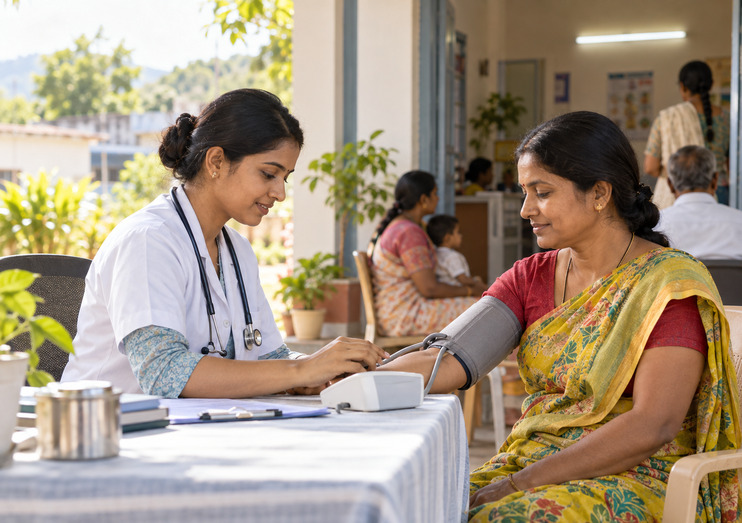



Preventive healthcare can strengthen long-term health outcomes through early detection, continuity of care and data-led follow-up.

By Abhisek Halder
As corporate India looks to make its CSR spending more strategic, healthcare is becoming one of the clearest tests of whether social investment can deliver lasting value. Over the last five fiscal years, Indian enterprises contributed more than Rs. 1.4 lakh crore to development-focused CSR, with healthcare receiving the largest share. This level of commitment reflects both the urgency of the sector and the growing expectation that businesses can help solve public challenges at scale.
But the next phase of impact will depend on more than the scale of investment. It will depend on where that effort is made and how early it reaches people. In India, where delayed diagnosis, uneven access to care and high out-of-pocket costs continue to shape health outcomes, the strongest social return often comes from intervening earlier, not later. This is where corporate healthcare investment needs a strategic reset. Treatment, recovery, and crisis response will always remain critical areas for CSR support. But if the objective is to create a deeper and more durable impact, there is a case for moving further upstream – towards the point at which disease can still be prevented, detected earlier or managed before it becomes more complex and costly.

Prevention offers the clearest path to impact
India’s healthcare challenge is not only about access to treatment. It is also about how late treatment often begins. Out-of-pocket expenditure still accounts for nearly half of the country’s total health spending, placing millions of families under severe financial strain when conditions go undetected or unmanaged for too long. By the time care begins, the human cost is often higher and the financial burden much harder to absorb.
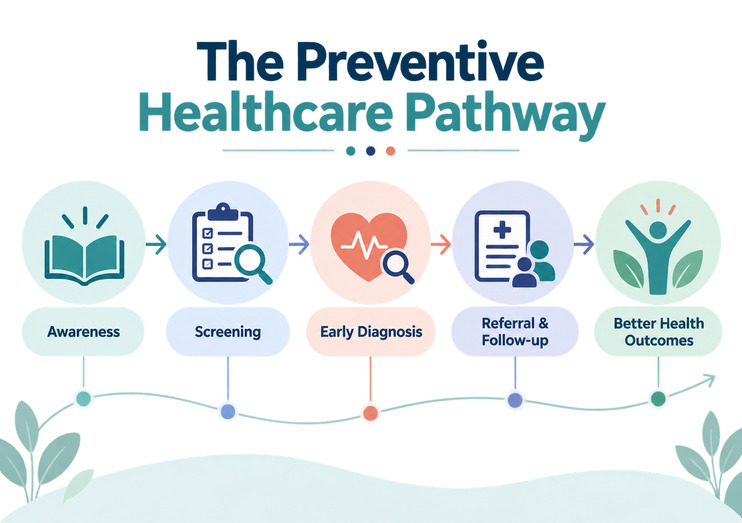
This is where prevention changes the equation. Screening, vaccination, early diagnosis, regular monitoring, and timely follow-up may not attract the same visibility as hospital support or emergency care, but they often do far more to reduce suffering over time. They help catch risk earlier, lower pressure on families and health systems, and create the kind of long-term value these investments are meant to deliver.
The case is especially clear in women’s health. NFHS-5 data show that around two-thirds of children and more than half of women of reproductive age in India suffer from anemia. Cervical cancer presents an equally urgent challenge. India accounts for more than 65% of regional cervical cancer deaths, yet screening coverage among women aged 30 to 49 remains just around 2%. These figures do not point to a lack of medical knowledge. They point to an opportunity to reach people early enough.
Preventive interventions should therefore be treated as core health infrastructure, not peripheral support. Regular screening programs, community diagnostics, and primary immunization can do more than improve access in the moment; they can change outcomes altogether. Pairing routine screening with HPV vaccination, for example, is not simply sound public health practice. It is a practical way to reduce future disease burden while improving present-day care.
Companies can accelerate the shift to prevention
Corporate India has a distinct advantage here. Businesses bring operational discipline, digital capability, supply-chain visibility, and the ability to design systems that scale. When those strengths are combined with the on-ground reach of NGOs and the legitimacy of public institutions, healthcare programs can become more continuous, more measurable, and more effective.
The opportunity now is to move beyond the intervention itself. Too much healthcare support still stops at the point of delivery. A camp is funded, medicines are distributed and the effort ends there. That may create immediate relief, but it rarely creates continuity. The more important question is what happens next: who was identified as being at risk, who was referred, who received follow-up care and where patients dropped off.
That requires a different model, one built around patient tracking, referral management, follow-up, medicine planning, and performance measurement over time. In other words, it requires exactly the kind of structured execution many companies are well placed to support. The opportunity is not to make social investment more corporate; it is to use corporate capabilities to make health programs more connected, accountable and outcome-oriented.
Prevention becomes more powerful when it is guided by data
One of the biggest opportunities in preventive healthcare is the ability to use data and analytics to shift from episodic support to sustained intervention. Historically, many health programmes operated with limited visibility into who was screened, who needed follow-up and where unmet needs were greatest, making outcomes harder to measure and sustain.
Today, that visibility is improving. Data analytics can help identify emerging disease patterns and underserved populations earlier, while digital registries make it easier to track referrals and follow-up care. Better planning can also improve the reliability of medicines and diagnostics where they are needed most. These same insights can help direct employee volunteering towards outreach, awareness, and trust-building in underserved communities.
The value of data lies not just in better measurement, but in enabling interventions that are more timely, targeted, and effective. In an anemia mitigation program supported by ZS and Shrimad Rajchandra Love and Care, nearly 3.6 lakh people were screened, around two-thirds underwent repeat screenings, and close to four in five treated beneficiaries saw improvements in hemoglobin levels. More than 11,000 people moved out of anemia. These results demonstrate how preventive health programs can achieve meaningful scale when outreach, execution and follow-through are built into their design.
More broadly, the opportunity for corporate health investment is not simply to fund individual interventions, but to build systems that deliver stronger and more durable outcomes. The organizations that lead in this space will measure success not only by the support provided after a crisis emerges, but by their ability to reduce the likelihood of that crisis occurring in the first place. That is what it means to treat corporate healthcare as a strategic lever for change rather than a yearly line item.
If CSR is meant to create lasting social value, preventive healthcare should not sit at the edge of the agenda. It should help define where it goes next.
Author: Abhisek Halder, Office Managing Principal – Bengaluru & India ESG Lead, ZS.
ZS is a management consulting and technology firm that partners with companies to improve life and how we live it. We transform ideas into impact by bringing together data, science, technology and human ingenuity to deliver better outcomes for all.
© Copyright Disclaimer: All rights reserved. No part of this report may be reproduced, republished, distributed or transmitted in any form without prior written permission from India CSR®
Also Read: Vulnerable Patients Need Timely, Dignified and Affordable Healthcare – India CSR



