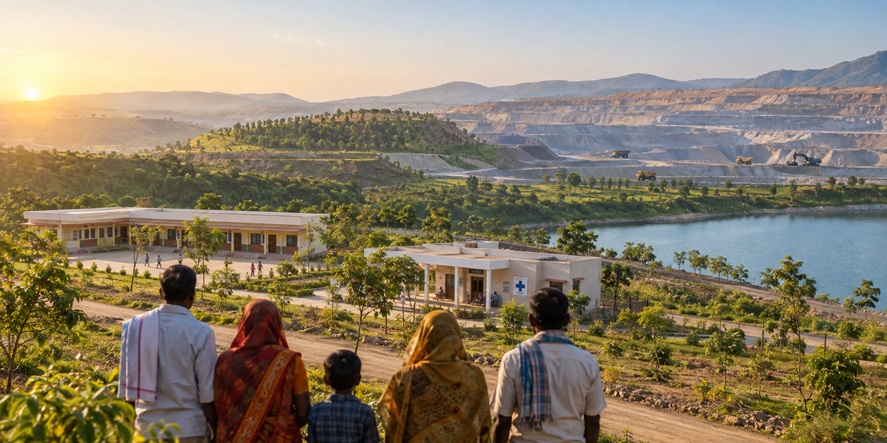



How District Mineral Foundations (DMF) are converting mining revenues into local development
By Rusen Kumar
Mining has long been central to India’s industrial expansion. Coal, iron ore, bauxite, limestone and other minerals power electricity generation, infrastructure, manufacturing and millions of livelihoods across the value chain. But the benefits of extraction have not always been distributed evenly. Communities located near mines often live with the immediate consequences: land acquisition and displacement, pressure on water sources, dust and air pollution, health risks, disrupted agriculture and a gradual erosion of traditional livelihoods. The Pradhan Mantri Khanij Kshetra Kalyan Yojana, or PMKKKY, was designed to address this imbalance by ensuring that a share of mineral wealth is reinvested where mining has its deepest social and environmental footprint.
Launched on 17 September 2015, PMKKKY provides the national framework through which District Mineral Foundations, commonly called DMFs, finance welfare and development works in mining-affected districts. The principle is simple but important: mineral resources belong to the nation, and communities bearing the cost of their extraction should receive a fair and visible share of the gains. A decade after its launch, the programme has grown into one of India’s largest district-level mechanisms for directing resource revenues towards local public goods.

A statutory framework for local development
DMFs draw their authority from the Mines and Minerals Development and Regulation Act, 1957. The 2015 amendment to the Act introduced the provision for every mining-affected district to establish a District Mineral Foundation as a non-profit trust. These trusts operate under the jurisdiction of the respective State Governments, which frame their own DMF rules while incorporating the PMKKKY framework. The funds are collected and deployed at the district level, allowing decisions to respond to the particular needs of mine-affected villages and settlements.
DMFs have been established in 656 districts across 23 States.
The scale of this institutional architecture is substantial. DMFs have been established in 656 districts across 23 States. Their resources come from statutory contributions made by mining lease holders in addition to royalty paid on mineral extraction. For leases or prospecting licence-cum-mining leases granted on or after 12 January 2015, the contribution is 10 per cent of royalty. For leases granted before that date, it is 30 per cent of royalty. This creates a direct fiscal link between extraction and the development needs of affected communities.
From compensation to long term capability
PMKKKY is not conceived merely as a compensation fund. Its stated objectives are broader: to implement welfare and development projects in mining-affected areas; to minimise the adverse environmental, health and socio-economic impacts of mining during and after operations; and to secure long-term, sustainable livelihoods for affected people. This wider purpose matters because the consequences of mining are often intergenerational. A road, a water scheme or a health facility can provide immediate relief, but lasting progress depends equally on human capability, environmental restoration and local economic resilience.
The revised guidelines issued in January 2024 sharpen this planning framework. They help align DMF expenditure with local priorities while complementing the programmes of State and Central governments. The test for a successful DMF should therefore not be the amount spent alone. It should be whether the funding reaches the most affected populations, builds durable public assets, closes basic-service gaps and creates livelihood options that remain viable even after mining activity declines or ceases.
Priority sectors reflect everyday needs
The PMKKKY utilisation framework gives a clear spending hierarchy. At least 70 per cent of available funds must go to high-priority sectors, including drinking water supply, environmental preservation and pollution control, healthcare, education, welfare of women and children, support for the aged and persons with disabilities, skill development, livelihood generation, sanitation, housing, agriculture and animal husbandry. The remaining amount, up to 30 per cent, may support other priority sectors such as physical infrastructure, irrigation, energy, watershed development and measures that improve environmental quality.
This allocation recognises that mine-affected districts require more than one type of intervention. Safe water and primary healthcare respond to immediate vulnerabilities. Schools, hostels, scholarships and digital learning can widen opportunity for children. Skill training, producer groups, agriculture support and enterprise promotion can help families diversify income beyond casual mining-linked work. Environmental investments can mitigate dust, restore water systems and strengthen ecological security. In practical terms, PMKKKY offers an opportunity to connect infrastructure with human development rather than treating them as separate agendas.
More than 4.70 lakh projects, with a sanctioned value exceeding Rs 1 lakh crore, have been approved under the DMF-PMKKKY framework.
Progress at a national scale
Official data available as of July 2026 shows the growing reach of this district-led model. More than 4.70 lakh projects, with a sanctioned value exceeding Rs 1 lakh crore, have been approved under the DMF-PMKKKY framework. Of these, more than 2.92 lakh projects have been completed. A further 78,809 works are under execution, supported by committed funds of more than Rs 30,512 crore. The numbers indicate both a significant investment pipeline and the importance of sound project selection, execution and monitoring at district level.
| Project status | Number of projects | Amount Rs crore |
| Sanctioned | 4,70,020 | 1,09,938 |
| Completed | 2,92,156 | 49,973 |
| Ongoing | 78,809 | 30,512 committed |
Tribal rights and local participation
The social context of mining makes implementation especially sensitive. Mining operations are concentrated in many remote and historically underserved regions, including areas with substantial Scheduled Tribe populations. The framework therefore requires State Governments, while framing rules, to take account of constitutional provisions governing Scheduled and Tribal Areas, the Panchayats Extension to Scheduled Areas Act, 1996, and the Forest Rights Act, 2006. These safeguards are central to the legitimacy of development planning in places where land, forests and water are inseparable from identity, culture and livelihood.
For DMFs, meaningful participation is more than a procedural requirement. Gram Sabhas, panchayats, women’s groups, youth, forest-dwelling communities and other affected residents can help identify the gaps that official data may overlook. They can also make projects more relevant: a drinking-water asset must work through summer; a health intervention must reach scattered hamlets; a skills programme must be tied to real employment or enterprise opportunities. When community voices are built into planning, grievance redressal and social audit, DMF funds are better placed to deliver outcomes rather than isolated assets.
The governance challenge
The large project pipeline also underlines a governance challenge. A sanctioned work is not the same as a completed work, and a completed work is not automatically an effective one. District administrations, DMF governing bodies and implementing agencies need strong systems for baseline assessment, project appraisal, procurement, quality control, geo-tagged tracking, public disclosure and outcome measurement. Convergence with health, education, rural development, water and livelihoods departments can prevent duplication and help DMF funds fill critical gaps rather than finance parallel structures.
Transparency should be treated as a development tool, not simply a compliance exercise. Publicly accessible information on project selection, allocations, progress, beneficiaries and maintenance responsibilities can build trust. It can also help civil society, researchers and communities identify what works. The most useful measures will go beyond counting buildings or equipment. They will examine whether school attendance improved, whether households have reliable water, whether health referrals have become quicker, whether women gained income opportunities and whether environmental risks have reduced.
A pathway to a just transition
India’s demand for minerals will remain important as the country builds infrastructure, expands manufacturing and develops clean-energy supply chains. This makes the question of equitable mining more urgent, not less. PMKKKY and DMFs offer a practical vehicle for linking national growth with local wellbeing. They can enable a form of development in which mining districts are not left behind once the mineral leaves the ground, but receive stronger services, restored environments and a more diversified economic base.
The next phase of the programme should focus on quality, equity and durability. High-impact plans will prioritise the most affected habitations, protect the rights of tribal and vulnerable communities, invest in reliable services and livelihoods, and openly track results. They will also plan for the life cycle of mines, including closure and the future of local employment. If these principles guide implementation, DMF-PMKKKY can become more than a fund for works. It can become a durable social compact between the nation, its mineral economy and the communities whose land sustains it.
Conclusion
PMKKKY represents an important public-policy commitment: those who live with the costs of mining must be partners in its benefits. With more than four lakh sanctioned projects and resources running into over Rs 1 lakh crore, the programme has already created a formidable platform for local development. Its enduring success will depend on whether this financial scale translates into better health, education, water security, environmental quality and dignified livelihoods for mining-affected people. A fairer deal for mining districts is not only a matter of welfare. It is essential to making India’s resource-led growth more inclusive, accountable and sustainable.
What is Pradhan Mantri Khanij Kshetra Kalyan Yojana (PMKKKY)?
Pradhan Mantri Khanij Kshetra Kalyan Yojana (PMKKKY) is a programme launched on 17 September 2015 to provide for the welfare of areas and people affected by mining related operations. PMKKKY is implemented by the District Mineral Foundations (DMFs) of the respective districts using the funds accruing to the DMF from miners. (Khanij means Mineral and Kshetra means area or field in Hindi. Kalyan stands for welfare and Yojana stands for a Plan or project)
District Mineral Foundation (DMF) is a trust set up under Mines and Minerals (Development & Regulation) Amendment Act, (MMDRA) 2015 as a non-profit body in those districts affected by the mining works to work for the interest and benefit of persons and areas affected by mining related operations, in such manner as prescribed by the relevant State Government.
What is the Objective
Mining related operations largely affect less developed and very remote areas of the country, and vulnerable sections of the population, especially Scheduled Tribes. Therefore, it is especially necessary that special care and attention is devoted, in an organized and structured manner so as to ensure that these areas and affected persons are benefitted by the mineral wealth in their regions and are empowered to improve their standard of living. It is with this objective that DMF and PMKKKY were launched by the Government. The overall objectives of PMKKKY scheme are:
- to implement various developmental and welfare projects/programs in mining affected areas. These projects/ programs will be complementing the existing ongoing schemes/projects of State and Central Government;
- to minimize/mitigate the adverse impacts, during and after mining, on the environment, health and socio-economics of people in mining districts; and
- to ensure long-term sustainable livelihoods for the affected people in mining areas.
The Central Government has issued a directive on 16 September 2015 to the State Governments, under Section 20A of the MMDR Act, 1957, laying down the guidelines for implementation of PMKKKY and directing the States to incorporate the same in the Rules framed by them for the DMFs.
What is Coverage of PMKKY?
All areas directly affected by mining related operations as well as those areas indirectly affected by such operations are covered under PMKKKY.
- Directly affected areas are those areas where direct mining related operations such as excavation, mining, blasting, beneficiation and waste disposal take place.
- Indirectly affected areas are those where negative impacts of mining in the form of deterioration of water, soil and air quality, reduction in stream flows and depletion of ground water, congestion and pollution etc. happen due to mining operations.
Affected persons are to include “affected family” and “displaced family”, both as defined under the Right to Fair Compensation and Transparency in Land Acquisition, Rehabilitation and Resettlement Act, 2013. Any other family as identified by the concerned Gram Sabha could also be included.
The Guidelines also provide that people affected by mining will include not only those who have legal rights over the land being mined, but also those who have occupational rights, usufruct and other traditional rights.
The Guidelines have been framed in a very exhaustive manner so as to rule out the scope of any affected person being left out due to ambiguity or inadequacy in the guidelines.
Utilization of Funds
At least 60% of the funds under the PMKKKY has to be used for high priority areas such as drinking water supply, environment preservation and pollution control measures, primary / secondary health care, education, welfare of women, children, aged and disabled people, skill development & sanitation.
Up to 40% of the funds can be used for infrastructure projects such as physical infrastructure, irrigation, energy and watershed development and any other measures for enhancing environmental quality in mining district.
Not more than 5% of the funds can be used for administrative expenses. Save for the base minimum contractual posts, creation of posts, purchase of vehicles etc. would require prior permission.
The DMFs have also been directed to take all major decision in a participatory mode, in consultation with the ‘gram sabhas’ of the respective villages. They are expected to maintain utmost transparency in their functioning and provide periodic reports on the various projects and schemes taken up by them.
Efforts are made to achieve convergence with the State and the District Plans so that the activities taken up by the DMF supplement/complement the development and welfare activities already being carried out. However, activities meant to be taken up under the ‘polluter pays principle’ cannot be taken up under the PMKKKY.
As on 10 October 2016, DMF has been set up in 263 districts across 12 mineral rich states and an amount of Rs. 3589 crores has been collected.
Source: Press Information Bureau, Ministry of Mines, Government of India, 17 September 2026.