

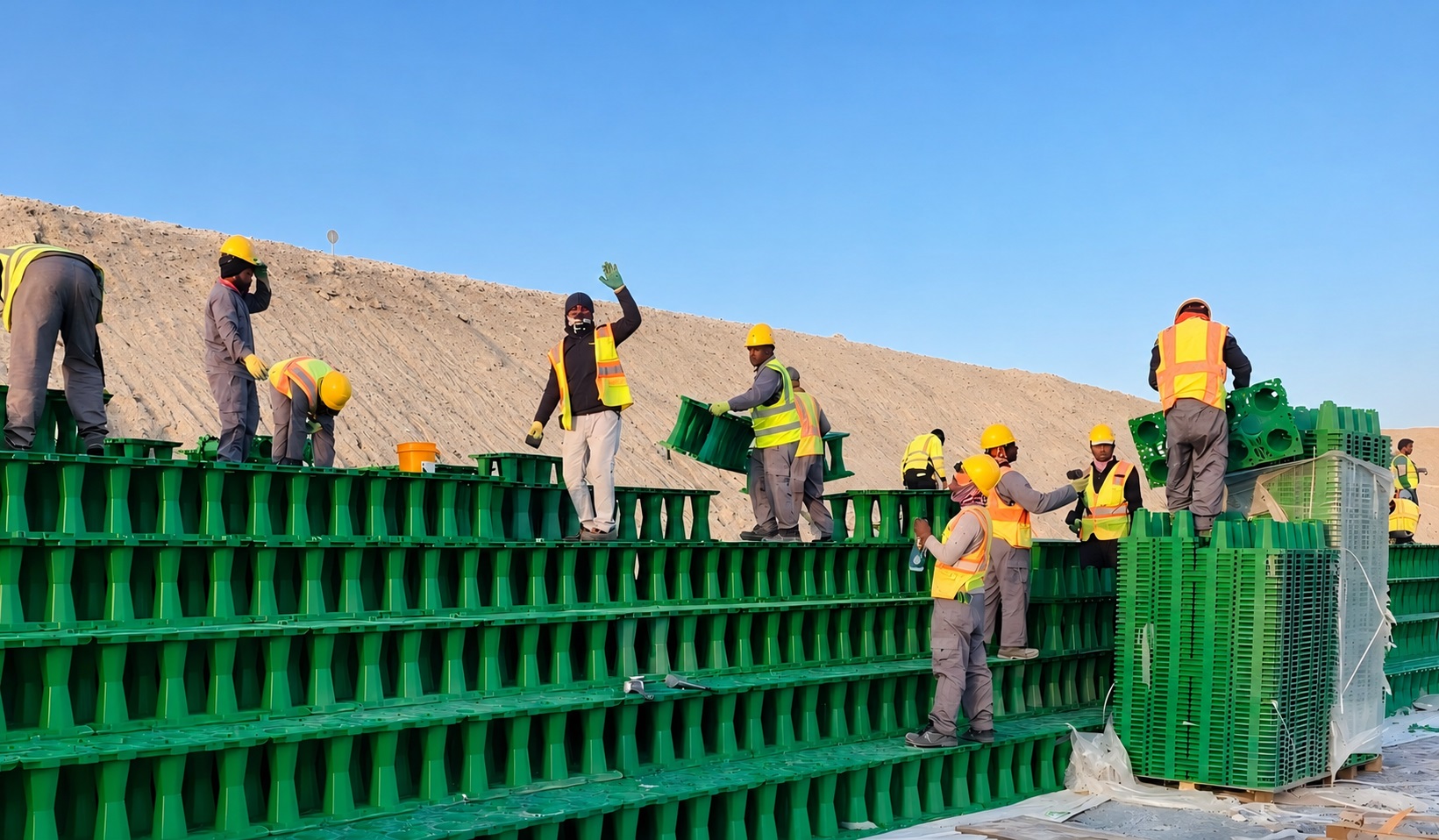



An infrastructure buyer can place two underground crate systems side by side and see similar modular cells. That visual similarity encourages a risky shortcut: choose the crate first, then decide whether the project needs a rainwater harvesting system, soakaway crate arrangement, or attenuation tank. Responsible stormwater procurement works in the opposite direction. It establishes the destination of runoff before it selects the storage envelope.
This distinction matters because the destination changes the entire system. Infiltration depends on ground acceptance and a permeable geotextile wrap. Controlled release depends on a sealed geomembrane lining, an outlet-control basis, and a receiving route. Reuse adds demand, treatment, overflow, and operating responsibilities. The modular core may be familiar, but its environmental context is not.
A responsible purchase is therefore not the one with the most sustainability language. It is the one that keeps water quantity, water quality, land use, maintenance, and evidence connected to the proposed destination. Procurement can help by asking the questions that expose those connections before a supplier is asked to commit to a module count.

Treat runoff as a routed resource
An infrastructure buyer making a responsible stormwater decision should not begin with “Which tank is cheapest?” The better question is “Where should this water go, and what evidence supports that route?” Reuse may reduce demand for another water source where a suitable non-potable use and operating arrangement exist. Infiltration may keep runoff close to where it falls when soil, groundwater, and pollution conditions allow it. Controlled release may protect a receiving network when infiltration is unsuitable and an approved outfall exists.
England’s national standards for sustainable drainage organize final runoff destinations as a hierarchy, beginning with collection for non-potable use, then infiltration, surface-water discharge, piped surface-water drainage, and finally combined sewer discharge. The standards also require evidence when a lower-priority destination is used and connect drainage with long-term operation, water quality, amenity, biodiversity, and maintenance. Although the rules apply within their stated jurisdiction, the decision logic is useful to procurement teams elsewhere.
A hierarchy does not turn the first option into an automatic answer. A harvesting proposal without a credible demand may not operate as intended. Infiltration can be inappropriate where groundwater, contamination, or poor soil creates unacceptable risk. A receiving system may impose a controlled discharge basis. Responsible procurement preserves these qualifications, and stormmanage.com should receive them as explicit project constraints rather than as a slogan.
Let site evidence separate infiltration from attenuation
Soakaway crate systems rely on the surrounding ground accepting water. An attenuation tank intentionally holds water behind a sealed envelope and releases it through a controlled outlet. Buying the wrong configuration is not a minor membrane substitution. It can invalidate the hydraulic concept and move risk toward foundations, groundwater, neighbouring land, or the downstream network.
Storm Manage’s decision guide asks about percolation or soakage evidence, seasonal groundwater, the availability of an outfall, restricted discharge requirements, nearby foundations or contaminated ground, and traffic above the proposed system. These questions show why a soakaway crate and an attenuation tank cannot be chosen from appearance alone. The correct route depends on the site and its accepted drainage strategy.
Procurement should request the evidence status, not merely a yes-or-no conclusion. Has site testing been completed, reviewed, and accepted for the proposed level? Is groundwater information representative of seasonal conditions? Has contamination risk been assessed? Who has confirmed the outfall and discharge basis? If an answer remains open, the stormmanage.com configuration should remain provisional.
This approach also protects suppliers. A manufacturer can describe geotextile wrap, geomembrane lining, connectors, modules, and inspection components. It should not be pushed to certify a site’s infiltration suitability from a general location or a photograph. Responsible purchasing keeps product knowledge and site design connected without confusing their owners.
Match the envelope and treatment train to the destination
Once the destination is agreed, the envelope becomes meaningful. A permeable geotextile wrap helps separate soil from an infiltration block while allowing water to pass. A sealed geomembrane lining creates the containment needed for attenuation or storage for reuse. Penetrations, joints, protection layers, and inspection details must fit that purpose. Using the right module with the wrong envelope still creates the wrong system.
Water quality requires its own route. Underground modular storage primarily manages quantity. It does not automatically remove the pollutants associated with every catchment. The wider drainage design may need source control, vegetated features, silt management, separation devices, or other pretreatment before runoff reaches the storage block. The appropriate choice depends on land use and local requirements.
A responsible supplier enquiry should describe the catchment and expected pollutant context. Roof runoff, a residential parking area, an industrial yard, and a fueling risk do not deserve the same generic treatment statement. Procurement need not prescribe the technical solution, but it should ensure that a qualified owner has done so and that the tank interfaces with it.
Use a runoff destination decision table
A compact decision table can keep environmental intent and procurement scope aligned. It does not replace design; it exposes the evidence the design still needs.
Questions that follow the intended runoff destination
| Intended path | Evidence to establish | System consequence |
| Non-potable reuse | Demand, treatment, overflow, controls, and operating owner | Sealed storage integrated with a reuse system |
| Infiltration | Ground acceptance, groundwater, pollution risk, and separation | Soakaway crate block with a permeable envelope |
| Controlled release | Receiving route, discharge basis, storage need, and exceedance | Attenuation tank with a sealed envelope and outlet control |
| Combined approach | Approved operating logic and interactions among purposes | Project-specific controls and clearly separated responsibilities |
The final column should be used to build the commercial scope. It should identify the StormTank module grade, wrap or lining package, connections, access components, drawings, testing information, and exclusions relevant to that route. A buyer can then compare like with like while preserving the design assumptions behind each price.
Include maintenance and ownership in the purchase
Responsible infrastructure is infrastructure that can still perform after the handover team has gone. The procurement package should state who will inspect inlets, pretreatment, access points, storage areas, outlets, and overflows; how they can be reached; what records are handed over; and what event or observation triggers maintenance. A buried tank that cannot be inspected is not made sustainable by being invisible.
The operating plan must reflect the chosen destination. Infiltration performance may change if sediment reaches the surrounding interface. Controlled-release performance can be affected by blockage at the outlet. Reuse systems add treatment and demand-side equipment. The module is part of each arrangement, but the maintenance task is defined by the system around it.
Ownership also affects the documents requested from a supplier. The installer needs assembly and envelope information. The designer needs model-specific properties and connection data. The future operator needs a clear asset record and access plan. Procurement should make these outputs explicit instead of assuming a product datasheet serves every audience.
Evaluate claims by the boundary they acknowledge
Broad claims such as “sustainable,” “compliant,” or “flood-proof” are weak buying signals when the supporting boundary is unclear. Ask which product fact is being described, which system outcome depends on project design, which jurisdiction applies, and what evidence is available for the selected model. A responsible supplier should be comfortable separating its manufacturing role from the designer’s and authority’s decisions.
Storm Manage explains that one StormTank platform can serve several storage paths, with the water destination and wrap determining whether the assembly operates as infiltration, attenuation, detention, or harvesting. That clarity gives buyers a practical way to discuss Storm Manage modular stormwater systems: start with the accepted water path, then request the configuration and evidence that belong to it.
The most responsible procurement decision may be to delay a module order until site testing, discharge agreement, or ownership is resolved. That is not lost momentum. It is the moment when commercial discipline protects the environment, the project budget, and the people expected to operate the finished asset.
Underground storage can free surface land and help control runoff, but it does not become responsible simply because the product is modular or hidden. Responsibility comes from matching the destination, evidence, envelope, treatment train, and maintenance plan. When those pieces agree, the purchase supports a drainage strategy. When they do not, even a well-made crate is only an answer to the wrong question.



