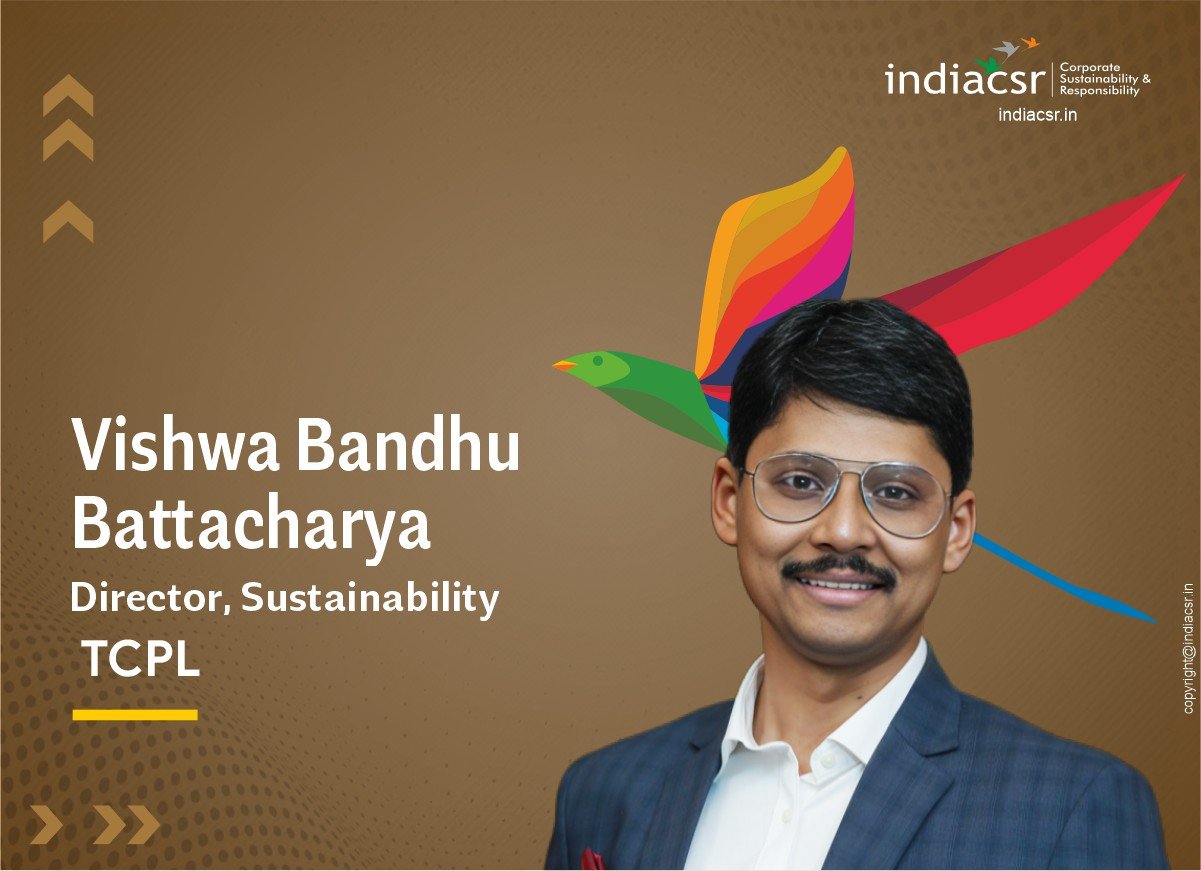



Vishwa Bandhu Bhattacharya of Tata Consumer Products discusses FY26 ESG progress, renewable energy, circular packaging, water positivity and Net Zero 2040.
MUMBAI (India CSR): For an FMCG business, sustainability is no longer confined to a yearly disclosure. It shapes how products are designed, ingredients are sourced, factories use water and energy, and communities are supported. Tata Consumer Products says it is embedding these choices across its business through its “For Better Living” roadmap, aligned with the Tata Group’s Project Aalingana.
In FY26, the company maintained carbon neutrality across Scope 1 and Scope 2 emissions for the third consecutive year, sourced 47% of its overall energy requirement from renewable sources, and reported a Water Positivity Index of 2.5. It also said that 80% of its packaging was recyclable, compostable or reusable, while approximately 1,700 metric tonnes of plastic were avoided through packaging innovation.
In this interview with India CSR, Vishwa Bandhu Bhattacharya, Director – Global Sustainability, Tata Consumer Products, discusses the company’s progress on ESG governance, renewable energy, water stewardship, circularity, nature-related risk, responsible agricultural sourcing and healthier consumer choices.

How is the company embedding ESG priorities into core business and operational decision-making?
At Tata Consumer Products, sustainability is treated as a business imperative that supports long-term growth, resilience and stakeholder value. Guided by the Tata Group’s values and Project Aalingana, we have institutionalised this approach through “Embed Sustainability”, one of our six organisational strategic pillars.
Our “For Better Living” roadmap translates this commitment into four interconnected pillars: For Better Nutrition, For Better Sourcing, For Better Planet and For Better Communities. Together, these pillars enable ESG priorities to be integrated across product innovation, sourcing, manufacturing, capital allocation, workforce practices and community engagement.
Oversight begins with the Board’s CSR and Sustainability Committee and is strengthened by the Sustainability Steering Committee and cross-functional working groups. ESG targets are also incorporated into Key Result Areas, from senior leadership to frontline teams, creating shared accountability.
Sustainability risks are integrated into our Enterprise Risk Management framework. In FY26, we completed our double materiality assessment to evaluate both business impacts and financial implications. A shadow internal carbon price further enables climate-informed investment decisions.
Our focus remains on embedding Environmental, Social and Governance priorities into the fabric of the organisation through structured processes, performance metrics, and cross-functional accountability. These priorities are increasingly integrated within our business processes and decision architecture, reflecting a more mature and disciplined approach. Sustainability continues to anchor both our strategy and execution.
What were the key sustainability milestones achieved in FY26, and how do they contribute towards the company’s longer-term FY30 and FY40 ambitions?
FY26 marked an important transition from sustainability commitments to measurable execution across Tata Consumer Products. During the year, we achieved the milestones that had been set for FY26. This progress reflects a step change in how ESG is operationalised across the enterprise, supported by stronger governance, improved data systems, and increased ownership across functions. It also reinforces our trajectory towards our longer-term goals.
Under For Better Planet, we maintained carbon neutrality across Scope 1 and Scope 2 emissions for the third consecutive year, sourced 47% of our energy from renewable sources and remained water positive, with a Water Positivity Index of 2.5. We also retained zero-waste-to-landfill certification across global operations. In packaging, 80% of materials were recyclable, compostable or reusable, while innovation helped avoid approximately 1,700 metric tonnes of plastic.
Under For Better Sourcing, 63% of tea procured in India was trustea certified. Through For Better Nutrition, 55% of new product launches focused on health and wellness.
Our community programmes as part of the For Better Communities pillar continue to expand in both scale and effectiveness, reaching 1.69 million beneficiaries during the year. We are also strengthening our approach to impact measurement to ensure these initiatives deliver meaningful and sustained outcomes.
These outcomes strengthen our pathway towards 100% recyclable, compostable or reusable packaging and reaching out to 2 million beneficiaries by FY30 and our FY40 ambitions covering Net Zero emissions, sustainable products and sustainably sourced critical raw materials.
Renewable energy now contributes 47% of overall energy consumption. What role will renewable energy play in the company’s next phase of decarbonisation?
Renewable energy is moving from being an operational intervention to becoming a core component of Tata Consumer Products’ long-term decarbonisation strategy. This direction is aligned with the Tata Group’s Project Aalingana and is advanced through the For Better Planet pillar of our “For Better Living” roadmap.
In FY26, renewable sources met 47% of our overall energy requirement. In addition, 54% of direct energy was generated from bio-based fuels, including biomass pellets, spent tea waste, briquettes and husk. We also continued expanding on-site solar capacity, including additional installations at Toopran and Barabanki.
The next phase will combine renewable electricity procurement, on-site generation, lower-carbon thermal energy, energy efficiency and process optimisation. Solar and wind power, biomass-based fuel substitution, efficient equipment and technologies will progressively reduce conventional energy consumption.
Renewable energy also strengthens resilience against energy-price volatility, fuel-supply disruption and future carbon-related costs. Our internal carbon price enables these considerations to be reflected in investment decisions. Collectively, these measures support our target of achieving Net Zero by 2040.
How is Tata Consumer Products approaching circularity beyond compliance, particularly through packaging innovation, waste reduction and EPR?
Our circularity strategy begins with the principle that packaging should be considered across its entire lifecycle, rather than managed only as a post-consumer compliance obligation.
We address packaging through three complementary areas: regulatory compliance, smart packaging and peer collaboration. Through “Conscious Reengineering” and “Designed for Recyclability”, we seek to reduce material consumption, eliminate avoidable plastics and improve packaging recoverability.
In FY26, 80% of our packaging was recyclable, compostable or reusable, exceeding our public commitment of 70% by FY26. Packaging innovation helped avoid approximately 1,700 metric tonnes of plastic. Key interventions included reducing material in the one-kilogram salt pouch by 11% and removing plastic overwraps from selected Tetley packs.
Our Extended Producer Responsibility programme complements these design interventions by recovering the equivalent of 100% of packaging introduced by our Beverages, Foods and Ready-to-Drink divisions. This integrated approach is supporting our ambition of achieving 100% recyclable, compostable or reusable packaging by FY30.
The company has achieved water positivity and improved water consumption intensity by over 20%. Which interventions have driven this progress?
Water stewardship at Tata Consumer Products is built around both operational efficiency and the replenishment of shared water resources. It supports the organisation’s natural-resource and climate-resilience ambitions actioned through our For Better Planet pillar.
In FY26, we remained water positive across global operations, improving our Water Positivity Index to 2.5 compared to 2.2 a year ago. Water consumption intensity improved from 2.9 to 2.3 kilolitres per metric tonne of physical output. This progress was driven by flowmeter installation, stronger site-level monitoring, water balancing and optimisation of water-intensive processes.
In our Ready-to-Drink operations, process improvements reduced reverse-osmosis reject levels from approximately 40–42% to 34%. Treated water is reused for gardening, flushing, cooling and plantation irrigation. Rainwater-harvesting capacity also increased from approximately 2.5 million to 4.0 million kilolitres.
Beyond our operational boundaries, Project Jalodari supports watershed restoration, recharge structures, farm ponds, check dams, micro-irrigation and climate-resilient agriculture. Together, these interventions reduce water demand, improve local recharge and strengthen water security for manufacturing facilities, agricultural communities and surrounding ecosystems.
How is the company moving from traditional environmental metrics towards assessing nature and biodiversity-related risks through TNFD-aligned assessments?
Nature-related assessment adds a critical layer to how Tata Consumer Products understands long-term business resilience. While traditional indicators such as emissions, water and waste remain important, the roadmap recognises that business performance also depends on healthy ecosystems, soils, water systems and biodiversity.
Our TNFD-aligned work evaluates nature-related dependencies, impacts, physical risks, transition risks and opportunities across operations and the value chain. During FY25, we conducted geospatial screening of 162 facilities covering approximately 12,765 hectares. The assessment considered proximity to protected areas, biodiversity hotspots, ecosystem integrity and water-stressed locations. The assessment applies TNFD’s LEAP approach and uses tools including ENCORE, the WWF Biodiversity Risk Filter and the WRI Ecosystem Services Review.
These insights will support integration of nature-related considerations into enterprise risk management, responsible-sourcing standards and site-level action plans. Interventions will follow the mitigation hierarchy of avoidance, reduction, regeneration and restoration, helping translate nature-related risk assessment into practical business responses.
What role does responsible sourcing play in building resilience across agricultural supply chains, particularly for tea and coffee?
For an agricultural products business, responsible sourcing is fundamental to securing the long-term availability, quality and affordability of critical raw materials. Tata Consumer Products addresses this through the For Better Sourcing pillar of its “For Better Living” roadmap, which focusses on resilient value chains, nature conservation and inclusive growth.
Tea and coffee supply chains are highly dependent on climatic stability, healthy soils, water availability, biodiversity, farmer capability and responsible labour practices. Our sourcing approach therefore integrates environmental, social and economic considerations into procurement standards and supplier partnerships.
In FY26, 63% of tea procured in India was trustea certified, while 100% of Tetley and Good Earth tea sourced in international markets was Rainforest Alliance certified. In coffee, 100% of production from our own farms is covered by recognised certifications, including Rainforest Alliance, 4C and C.A.F.E. Practices.
These frameworks promote traceability, responsible agrochemical use, soil and water management, biodiversity protection, worker welfare and human rights. Regenerative practices such as soil testing, integrated pest management and shade-grown coffee further improve farm resilience. Collectively, these interventions help protect yields, product quality, farmer livelihoods and the long-term security of tea and coffee supplies.
How is Tata Consumer Products working with farmers and suppliers to improve ESG performance while ensuring sustainable livelihoods?
Improving supplier ESG performance requires a combination of clear expectations, credible assessment and practical support for implementation.
At Tata Consumer Products, we strive to source all our materials sustainably and carry forward these efforts across our value chain. These efforts span our entire portfolio, covering tea, coffee, water, and staples such as pulses, ensuring that every product reflects our commitment to responsible sourcing. Ultimately, we aspire to build supply chains that are resilient, ethical and aligned with our long-term environmental goals.
As a founding member of initiatives such as the Ethical Tea Partnership (UK) and trustea (India), we take the lead in advancing sustainability in the tea sector. This involves encouraging sustainability across the tea value chain, from cultivation practices to the final cup enjoyed by consumers. To put this commitment into practice, our #ForBetter Sourcing strategy follows a structured three step process: Define, Identify and Engage. This framework is driven by a dual expectation that materials must not only be sustainable but also responsibly produced. Through this approach, we work to minimise the environmental footprint of our sourcing activities while upholding ethical labour and manufacturing standards. Thus, we strive to ensure that the resources we rely on support both planetary well-being and the long-term health of our business.
At the farm level, our interventions focus on environmental performance, productivity and livelihood resilience. More than 3,000 small tea growers have received training in safe pesticide use, traceability, pest management and soil health. Organic India supports selected farmers with free Tulsi seeds, technical guidance and competitive procurement prices, while allowing them the flexibility to sell in the open market.
Coffee growers receive planting material, agronomic guidance, technical advisories and certification support. These initiatives improve ESG performance while strengthening productivity, market access, income stability and farmers’ capacity to manage climate and market-related risks.
With 55% of new product launches focused on health and wellness, how is sustainability increasingly intersecting with nutrition and consumer wellbeing?
At the core of our product strategy, is our ‘For Better’ Nutrition pillar, representing TCP’s commitment to product stewardship and integrating sustainability throughout the product lifecycle. The ‘For Better’ Nutrition pillar emphasises expanded access to nutrition by offering affordable, nutrient enriched products and developing solutions based on consumer insights. It also reinforces our emphasis on transparency in nutritional information and our adherence to high standards of product quality. Translating the intent embodied in the ‘For Better’ Nutrition pillar into guidance for strategy and action is the ‘For Better’ Nutrition policy. This policy is shaped by established nutrition science, global as well as national dietary recommendations. It provides a framework that steers innovation, our strategic decisions and initiatives, and helps us respond to evolving consumer preferences in ways that enhance their experience of our products. Further, the policy contains guidelines on ingredients, nutrient thresholds, and the nutritional claims we can make. Beyond helping us enhance the nutritional value of our portfolio, the policy also supports transparent communication of product benefits to consumers.
The ‘For Better’ Nutrition policy, built around five core principles, collectively underpin our efforts to contribute to the health and nutrition of Indians across the country. We have also reduced sugar in identified Ready-to-Drink beverages by 40% over two years, eliminating approximately 3,150 tonnes of sugar since 2024. 86.8% of our portfolio meets WHO based TCP Nutrition guardrails on Added Sugar, Sodium, Saturated Fat and Trans-fat.
Protein-rich, fibre-rich, millet-based and fortified products demonstrate how nutrition innovation can support local ingredients and more sustainable food systems. Our objective is to deliver healthier choices without compromising affordability, taste, convenience or transparent consumer communication.
Looking ahead, what do you see as the biggest emerging sustainability challenges for the FMCG industry, and where does Tata Consumer Products have an opportunity to lead?
The next phase of sustainability in the FMCG sector will be defined by the ability to manage several interconnected challenges rather than address climate, nature, nutrition and livelihoods in isolation. Tata Consumer Products is preparing for this transition through “Embed Sustainability” and the four pillars of its “For Better Living” roadmap: For Better Nutrition, For Better Sourcing, For Better Planet and For Better Communities.
Key industry challenges include climate volatility affecting agricultural productivity, water stress, biodiversity loss, evolving packaging regulation, supply-chain traceability and the need to provide healthier products without compromising affordability, taste or convenience. Scope 3 emissions will also require greater attention because significant impacts occur across agriculture, packaging, logistics and other value-chain activities.
Tata Consumer Products has an opportunity to lead by demonstrating that sustainability can strengthen resilience, innovation and consumer value simultaneously. Our Net Zero roadmap, TNFD-aligned assessments, circular-packaging ambition, regenerative agricultural practices, supplier ESG assessments and traceability initiatives provide foundations for this approach.
Our opportunity is to build an integrated model in which climate, nature, circularity, nutrition and livelihoods collectively enable responsible and resilient growth.
© Copyright Disclaimer: All rights reserved. No part of this report may be reproduced, republished, distributed or transmitted in any form without prior written permission from India CSR®.