

Two-day Conference calls for stronger governance, convergence and outcome-oriented CSR for Viksit Bharat
NEW DELHI (India CSR®): The Indian Institute of Corporate Affairs (IICA), Ministry of Corporate Affairs, Government of India, concluded the Third National Conference and Exhibition on Corporate Social Responsibility (NCCSR 2026) at The Ashok, New Delhi. The two-day Conference, organised by the School of Business Environment, IICA, was held under the theme “Re-envisioning the Spirit of CSR for Viksit Bharat: From Compliance to Commitment.”
The Conference concluded with the formal Valedictory Session on “From Compliance to Commitment”, in the presence of Ajit Seth, former Cabinet Secretary, Government of India; Gyaneshwar Kumar Singh, Director General & CEO, IICA; and Prof. Garima Dadhich, Head, School of Business Environment, IICA. The session reviewed the principal issues emerging from the two-day deliberations and reflected on the further strengthening of India’s CSR ecosystem through improved governance, institutional coordination, evidence-based planning and greater emphasis on measurable development outcomes.
Ajit Seth, former Cabinet Secretary, Government of India, in his Valedictory Address, emphasised that the success of Corporate Social Responsibility should not be judged only by the quantum of expenditure, but by the difference it made to people’s lives and to the country’s development. He noted that CSR had emerged as a substantial source of development expenditure and observed that the framework had deliberately placed responsibility with company Boards, thereby embedding CSR within the wider evolution of corporate governance and responsible conduct. He cautioned against tokenism and underlined the need to scale up effective interventions, address geographical imbalances in CSR spending and extend greater attention to underserved districts. He also stressed that technology could strengthen visibility, monitoring and accountability, but could not substitute field knowledge and administrative judgement. Calling upon companies to view CSR not merely as a statutory obligation but as a strategic instrument for India’s growth, he said that stronger convergence among stakeholders and sustained attention to inclusive and sustainable outcomes would contribute to the broader vision of Viksit Bharat @2047.
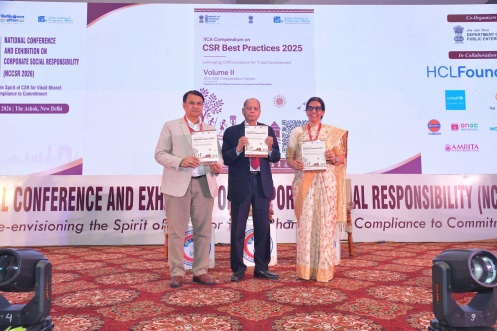
Following the Valedictory Address, Ajit Seth released the Compendium of CSR Best Practices 2025, which brings together the practices showcased by exhibitors during NCCSR 2025. The publication forms part of IICA’s effort to document and disseminate implementation experiences and replicable CSR practices for wider institutional learning.
Gyaneshwar Kumar Singh, Director General & CEO, IICA, stated that the deliberations during NCCSR 2026 reflected the increasing breadth and maturity of India’s CSR ecosystem. He noted that the Conference had examined issues relating to Board governance, sector-specific CSR approaches, technology and Artificial Intelligence, convergence through the CSR Exchange, women’s economic empowerment, regional distribution of CSR resources, skills and employment, and assessment of social outcomes. He emphasised the need to strengthen institutional capacity, improve the use of evidence in CSR planning and encourage wider documentation and replication of effective practices. He further stated that IICA would continue to support the CSR ecosystem through research, policy engagement, capacity building and structured dialogue among Government, industry and development institutions.
Prof. Garima Dadhich, Head, School of Business Environment, IICA, presented the key outcomes emerging from the Conference and acknowledged the contribution of participating Ministries, public and private sector organisations, international institutions, academia, civil society, exhibitors and delegates.
Earlier in the day, the proceedings commenced with High-Level Panel 3 on “Transforming CSR through AI & Technology.” The session examined the use of Artificial Intelligence, digital tools and data systems in the planning, implementation, monitoring and assessment of CSR programmes. It also considered the need for technology adoption to remain anchored in development objectives, accountability and measurable social outcomes. The panel brought together representatives from SBI Foundation, ICICI Bank, HCLFoundation, IndiGo, GIVE and Amrita Vishwa Vidyapeetham.
At the commencement of the session, the Compendium of CSR Best Practices showcased at the National Exhibition on Corporate Social Responsibility 2024 was released. The Compendium documented selected CSR initiatives presented during the previous edition of the National Exhibition, with the objective of facilitating wider dissemination, institutional learning and replication of effective practices.
This was followed by a Keynote Address by Santanu Mitra, Senior Economic Adviser, Ministry of Corporate Affairs, Government of India. The address considered the evolving role of CSR within the broader framework of responsible business conduct and sustainable development and highlighted the importance of institutional mechanisms that could strengthen the interface between corporate resources, credible social-sector interventions and measurable outcomes.
High-Level Panel 4 on “CSR Exchange: Enabling Convergence, Collaboration and Collective Impact” examined the role of the CSR Exchange in enabling greater coordination among companies, implementing organisations and other development stakeholders. The session considered issues relating to project visibility, institutional credibility, collaboration and the potential for convergence in addressing development priorities. The panel was chaired by Anil Swarup, former Secretary, Ministry of Coal and Department of School Education and Literacy, Government of India, and moderated by Prof. Garima Dadhich. Chairing the panel, Anil Swarup, former Secretary to the Government of India, remarked that the Portal should meet the expectations set out by the Committee on CSR Exchange.
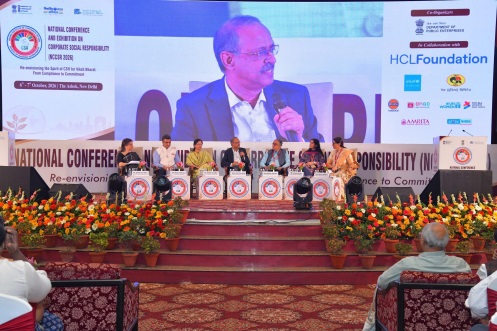
The panel considered how credible information on projects and implementing organisations, transparent processes and stronger institutional coordination could help the Portal fulfil its intended purpose and improve the effectiveness of CSR partnerships. The panel emphasised the importance of strengthening the CSR Exchange Portal through data integration and automated processes, including mechanisms to facilitate the identification, assessment and selection of credible implementing organisations. It further underscored the need to strengthen the link between CSR expenditure and measurable social development outcomes, particularly through better project assessment, monitoring and reporting. The panel recommended that MCA and IICA should continue to support these priorities through research, capacity building, policy engagement and collaboration among Government, industry and development institutions.
An Expert Dialogue on “Investing in CARE: Reimagining CSR for Women Economic Empowerment” examined the relationship between care responsibilities and women’s participation in the economy. The discussion considered the potential for CSR to support childcare, elder care, community-based care infrastructure and skilling of care workers, while strengthening women’s access to employment and economic opportunities. Representatives from SEWA Bharat, Grant Thornton and UN Women participated in the dialogue.
In the afternoon, High-Level Panel 5 on “Decentralising CSR for Inclusive Regional Growth” focused on the geographic distribution of CSR resources and the need for interventions to respond more effectively to regional and local development priorities. Representatives from the Department of Public Enterprises, NSE Foundation, Spark Minda Group, Tata Steel Foundation, Inclusion Foundation, Western Coalfields Limited and ONGC Foundation participated in the session. The panel recommended the development of universal indicators for the assessment of CSR projects, enabling greater consistency and comparability of project outcomes across regions and sectors. It also emphasised that such indicators should be applied with due regard to local circumstances, and that district-level evidence and collaboration with local institutions should inform the identification of priority interventions.
The Conference also featured an Expert Dialogue on “Leveraging CSR and PMIS – From Skills to Employment”, with Balamurugan D, Joint Secretary, Ministry of Corporate Affairs, Government of India, Lohit Bhatia, ED & CEO, Quess Corp Ltd, representatives from ONGC and Dixon Technologies India Ltd, moderated by D. Garima Dadhich. Balamurugan D., Joint Secretary, Ministry of Corporate Affairs, invited businesses to leverage opportunities under the Prime Minister’s Internship Scheme (PMIS). He highlighted the potential of structured workplace exposure and industry participation to narrow the gap between the skills young people possess and those required for employment. The discussion focused on improving the transition from skilling to employment, strengthening labour-market linkages and exploring the role of CSR in supporting employability and employment outcomes.
The proceedings also included a cultural presentation by artists from the Ministry of Culture before the formal Valedictory Session.
The two-day Conference brought together 600 plus senior representatives from Government, public sector enterprises, private sector companies, international organisations, academia and civil society. The deliberations reinforced the need for CSR interventions to move beyond expenditure and compliance towards stronger governance, evidence-based planning, institutional collaboration and measurable development outcomes, in alignment with national and regional priorities and the vision of Viksit Bharat.
(India CSR®)