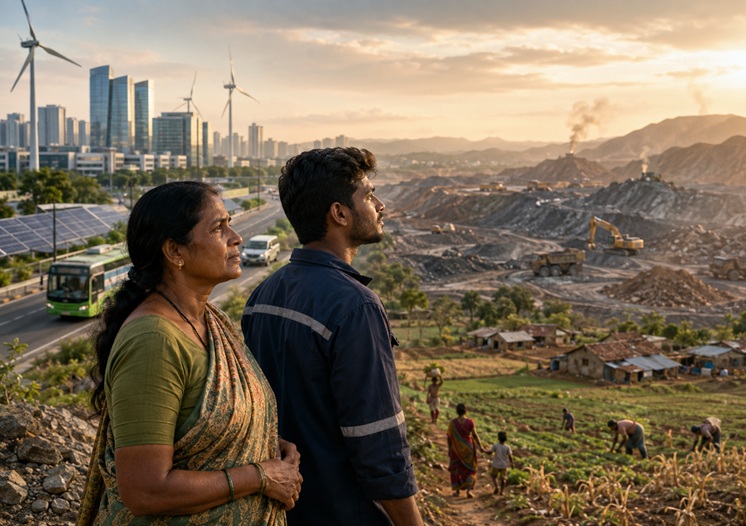



Dr. Tanaya Majumder examines green capitalism, green development and degrowth through the political economy of climate justice and North-South inequality.
By Dr. Tanaya Majumder
Green capitalism, green development and degrowth – the three major paradigms for managing climate change – are often presented as engineering problems. However, they are not. Each represents a political claim about who pays, who benefits and where the ecological burden falls between the Global North and the Global South. The real question is not which one works best in theory, but whose future each one quietly mortgages.
Let’s begin with green capitalism, the prevailing orthodoxy of climate diplomacy. It promises that markets, carbon pricing and clean technology can separate economic growth from emissions. The evidence supporting this is weaker than the confidence behind it. A 2024 study in Scientific Reports examined 164 countries and found that only 49 had decoupled emissions from growth, while the remaining ones had not. Much of the decoupling claimed by the rich would results from shifting its emission-intensive production to the South, rather than ending it.

Resource extraction tells a similar story. The International Energy Agency (IEA) expects the demand for electric vehicles, batteries and renewables to increase lithium demand roughly fivefold by 2040, with cobalt and rare earths rising by 50-60%. These deposits are located in Latin America, Central Africa and Southeast Asia. The IEA estimates that Latin America alone could capture around USD 120 billion in mining value by 2030. This is the old colonial map redrawn in green. Carbon markets deepen the problem. A 2023 investigation by The Guardian, Die Zeit and SourceMaterial found that more than 90% of the rainforest credits sold by Verra – then the biggest player in a roughly USD 2 billion market – were likely worthless “phantom credits. Verra disputes the finding. Regardless, such credits allow the Northern emitters to appear clean on paper while global emissions continue unabated.
Green development sounds more benevolent. The World Bank and UNEP speak of sustainable industrialization, resilient infrastructure and green jobs. However, the funding comes with conditions reminiscent of structural adjustment. The famous USD 100 billion a year promised to poorer countries in 2009, due by 2020, arrived late and short. At COP29 in Baku last year, it was tripled to a target of USD 300 billion a year by 2035 – which developing-country delegates condemned as an insult – tucked inside a vaguer USD 1.3 trillion “aspiration”. UNCTAD estimates the real need is closer to USD 900 billion now, climbing towards USD 1.4 trillion by 2030. Much of what flows comes as of loans, not grants. The countries urged to forgo fossil fuels are handed both the bill and the debt simultaneously.
Degrowth presents a different perspective. Originating primarily in European critical theory, it challenges the growth imperative itself and advocates for wealthy economies to reduce their material footprint and share what remains. Its critique of Northern excess is difficult to dispute. In 2019, the world’s wealthiest 10% of the global population was responsible for nearly half of global emissions. An average North American emits about 20 tonnes of CO2 annually, compared to an average sub-Saharan African who emits about 1.6 tonnes. However, the concept, does not translate well globally. Telling the 730 million people who still lacked electricity in 2024, with eight in ten of them in sub-Saharan Africa, to plan their economy downwards makes little sense. Without a robust theory of who owes what, degrowth becomes yet another Northern idea imposed as a universal truth.
The answer is not to crown one of these paradigms. It is to rewrite the terms of the global economy itself. The historical record is clear. The United States is responsible for roughly a quarter of all CO2 emissions since industrialization, the EU for about 13% between 1850 and 2021, and before 1950 more than half of humanity’s emissions originated from Europe. This represents a debt, not a charitable gesture. Yet the Loss and Damage fund established at COP27 holds pledges of around USD 730 million, while some analyses estimate needs at about USD 580 billion annually by 2030. The South, meanwhile, should have the freedom to develop on its own terms – cleanly, but independently. One condition keeps the argument fair: the World Inequality Database indicates that 63% of emissions inequality now exists within countries, not between them, so Southern elites must also be considered.
The climate crisis is fundamentally a justice issue disguised as a technical problem. Our frameworks should stop pretending otherwise.
About the Author: Dr. Tanaya Majumder, Assistant Professor, Economics, Narsee Monjee Institute of Management Studies, Bangalore
© Copyright Disclaimer: All rights reserved. No part of this report may be reproduced, republished, distributed or transmitted in any form without prior written permission from India CSR®.