

Dr. Bhaskar Chatterjee explores how CSR 2.0 can empower startups, makers and innovation ecosystems for Viksit Bharat 2047.
By Dr. Bhaskar Chatterjee
India is witnessing a remarkable shift in its entrepreneurial mindset. Increasingly, young people are choosing to create opportunities rather than wait for them. Across our colleges and universities, there is a growing aspiration for self-employment, innovation and entrepreneurship. Young Indians are taking the initiative to build enterprises, experiment with ideas and develop solutions to real-world problems rather than depend entirely on traditional pathways to employment.
This change in mindset may well be one of India’s greatest demographic advantages.
The scale of this transformation is already visible. According to recent DPIIT data, India is now the world’s third-largest startup ecosystem, with more than 2,23,000 DPIIT-recognised startups, 125 unicorns, and 55,200 new startups added in FY 2025-26 alone—the highest annual addition since Startup India was launched. This growth has been supported by sustained government efforts through initiatives such as the Rs. 10,000 crore Fund of Funds, the new Fund of Funds 2.0 for deep-tech and AI, the Startup India Seed Fund Scheme, expanded credit guarantees, the Atal Innovation Mission, and Make in India, which has attracted more than US$184 billion in manufacturing investment since 2014.
But numbers tell only part of the story.
The journey from an idea to a viable enterprise remains difficult. Young entrepreneurs need access not only to capital, but also to technical infrastructure, mentors, business expertise, networks, markets and opportunities to experiment. Many struggle to navigate the support systems available to them, particularly when they attempt to move beyond the early stages of their ventures.
It was against this backdrop that my recent visit to T Works in Hyderabad was particularly inspiring.
T-Works, a visionary initiative of the Government of Telangana, is helping build India’s maker and hardware innovation ecosystem by reducing the barriers to prototyping and product development. Established in 2017 and opened to the public in 2022, its 78,000-square-foot facility in Raidurgam, Hyderabad, is India’s largest prototyping centre, equipped with industry-grade tools and infrastructure. It provides students, makers, entrepreneurs, startups, MSMEs and corporates with the resources and support needed to transform ideas into tangible products. With more than 300 startups and MSMEs supported, 6,000+ parts and prototypes created, and a community of over 45,000 members, T-Works demonstrates how public investment in innovation infrastructure can create a powerful platform for entrepreneurship and problem-solving.
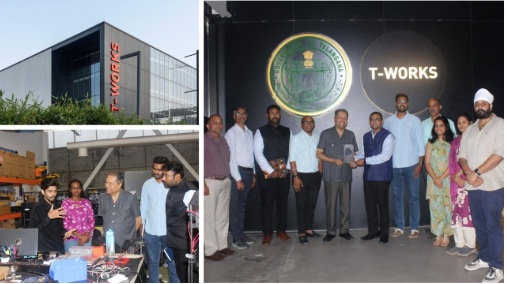
T-Works- India’s largest prototyping centre with its 78,000-square-foot facility in Raidurgam, Hyderabad
During my visit, I had the opportunity to meet some of the brightest young minds in the country. What impressed me was not merely the ingenuity of their ideas, but the fact that they had been given access to the tools, technology, mentorship and institutional support required to pursue them. There is something deeply encouraging about seeing a young person’s idea move from imagination to prototype because the right ecosystem has made it possible.
This experience reinforced an important lesson for me: innovation does not flourish through infrastructure alone.
It requires an environment in which people can experiment without fear of failure, access technical and business expertise, build networks, connect with industry and investors, and receive the guidance needed to take an idea to the next stage. When these elements come together, a facility becomes more than a building—it becomes an engine for innovation.
And this brings us to an important question for the future of CSR.
For over a decade, CSR has invested substantially in projects across education, healthcare, livelihoods, environmental sustainability and community development. These investments have created significant social value. But as India’s development challenges become more complex, perhaps we also need to ask a different question:
What if CSR invested not only in solutions, but in the people and ecosystems capable of creating the next generation of solutions?
There is a growing appetite among corporates to make their CSR investments more innovative, scalable and transformative. Companies are increasingly looking beyond conventional interventions and asking whether their resources can support new approaches to persistent social and environmental challenges.
This creates a compelling opportunity.
CSR can support maker spaces, incubators, prototyping laboratories, university innovation centres, entrepreneurship fellowships and startup accelerators that enable innovators to work on challenges in healthcare, education, climate resilience, agriculture, skilling and inclusion.
The distinction is important. Funding a single project addresses a particular need at a particular point in time. Supporting an innovation ecosystem can help generate multiple solutions, entrepreneurs and enterprises over a much longer period.
CSR that funds a project creates impact once.

CSR that invests in an innovation ecosystem can create impact repeatedly.
This is the potential multiplier effect of investing in innovation.
It also represents an opportunity to bring together three forces that are often considered separately: government, corporate India and India’s entrepreneurial talent. Government can provide enabling infrastructure and policy support. Entrepreneurs bring creativity, risk-taking and new ideas. Corporates can contribute capital, markets, technical expertise, networks and pathways to scale.
CSR can become one of the bridges connecting these forces.
This, in my view, is where the idea of CSR 2.0 becomes particularly relevant.
CSR 2.0 should not simply mean doing more projects or spending more money. It should mean thinking differently about the role of CSR—as a catalyst for innovation, entrepreneurship and systemic change. It should encourage us to move from asking, “What project should we fund?” to asking, “What capability can we help build that will continue to create impact?”
By investing in innovators and the ecosystems that enable them to succeed, corporates can help transform ideas into solutions, solutions into enterprises, and enterprises into engines of inclusive development.
If Viksit Bharat 2047 is to become a reality, it will be built not only through large infrastructure projects and public investments, but also through thousands of entrepreneurs, researchers, makers and innovators developing solutions for India’s most pressing challenges.
That is why places such as T-Works matter.
They remind us that the India of tomorrow will not be created only by those who implement existing solutions. It will also be created by those who have the courage to imagine something that does not yet exist—and by the institutions willing to give them the opportunity to build it.
As India’s entrepreneurial ecosystem continues to mature, perhaps the next frontier of CSR is not simply funding development—but funding the innovators who will shape the future of development itself.
My compliments to the Government of Telangana for envisioning T-Works , and to its leadership with Joginder Tanikella (CEO- T Works) and team for creating an environment in which India’s young innovators can transform ideas into products, products into enterprises, and aspirations into lasting social and economic impact.
Dr. Bhaskar Chatterjee, Former Director General & CEO, Indian Institute of Corporate Affairs (IICA); Former Bureaucrat. He is widely recognised for his exemplary contribution to CSR and sustainability in India.