




The article explains how industry-academia partnerships can strengthen research, talent and innovation in India.
By Dr. Rajeev Gautam
India is at a turning point. The country wants to become a global leader in technology, manufacturing, and innovation. But to get there, something important needs to happen: universities and industries must work together more closely than ever before. At present, there is a disconnect. Universities produce brilliant research and talented graduates, while industries solve real-world problems and bring products to market. Too often, these two worlds operate separately. Academic research sits in journals that nobody outside the university reads. Meanwhile, companies struggle to find graduates who can hit the ground running.
Why This Matters Now
The world is changing fast. Artificial intelligence, clean energy, advanced manufacturing—these fields are reshaping entire economies. Countries that can quickly turn new ideas into working products will thrive. Those that cannot will fall behind. India has the raw ingredients for success: a massive pool of young talent, respected research institutions like the IITs and IISc, and a growing industrial base. What is missing is the glue that binds these pieces together. Traditional partnerships between colleges and companies have been shallow, mostly limited to campus recruitment drives or the occasional sponsored project. That model worked when change was slow. It does not work anymore.
A Better Model: Four Pillars of Collaboration
Stronger partnerships need to rest on four pillars:
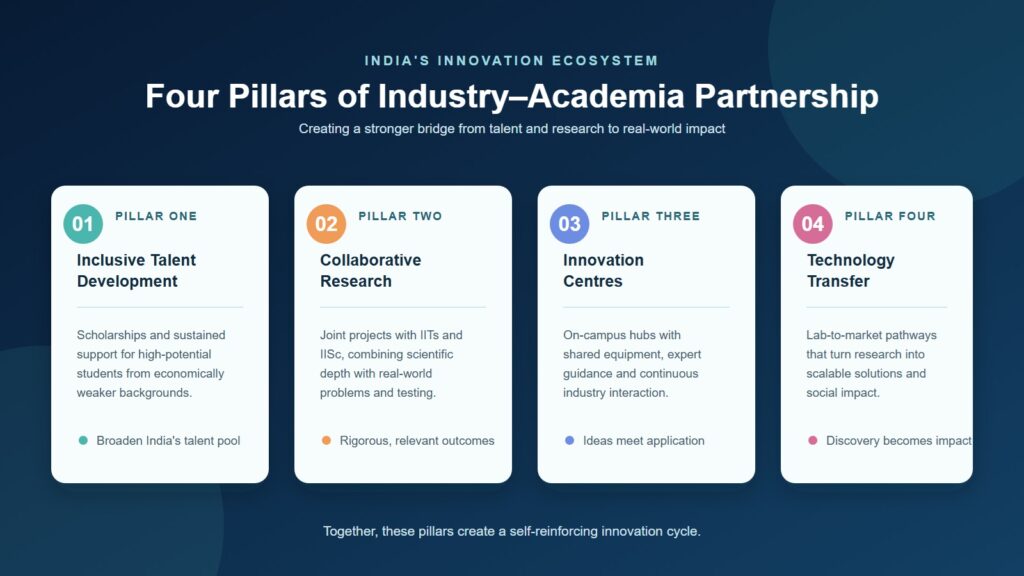
1. Inclusive Talent Development
Innovation should not be reserved for those who can afford it. Many bright students from poor families have the ability to do advanced research but lack the money to pursue it. They need to support themselves and their families, so a multi-year research programme feels impossible. Scholarship programmes targeting these students make a real difference. Some initiatives have already supported over 80 research students from economically weaker sections. These are not charity projects they are investments in expanding India’s talent pool. When you open doors for students who could not otherwise walk through them, you get fresh perspectives and ideas that would not exist otherwise.
2. Collaborative Research
The most valuable partnerships go beyond writing cheques. They involve companies and universities actually working together on problems. When a company partners with IIT Delhi or IISc Bangalore on a research project, both sides bring something to the table. The university contributes deep scientific knowledge and the freedom to explore unconventional ideas. The company brings real-world constraints, testing facilities, and a clear picture of what the market needs. The result? Research that’s both rigorous and relevant. Students get exposure to actual industry challenges. Companies get access to cutting-edge thinking. And the solutions that emerge are more likely to actually work in the real world.
3. Innovation Centers on Campus
Some companies have taken collaboration a step further by setting up permanent technical centres inside university campuses. These shared spaces at institutions like IISc Bangalore and IIT Delhi allow continuous interaction between students, researchers, and industry experts. This physical presence changes things. Students do not just hear about industry in occasional guest lectures—they work alongside professionals regularly. Researchers can test ideas using industry-grade equipment. And the line between “academic” and “applied” work starts to blur in productive ways.
4. Technology Transfer
Here’s a frustrating pattern: Indian researchers develop promising technologies, publish papers about them, and then… nothing happens. The research never reaches the people it could help. Technology transfer agreements fix this problem. When companies partner with national laboratories like NCL Pune to license and commercialise research, they provide the missing link between laboratory discovery and real-world impact. The research institution gets recognition and resources. The company gets access to proven science. And society benefits from innovations that would otherwise gather dust.

The Virtuous Cycle
When all four pillars work together, they create a self-reinforcing cycle:
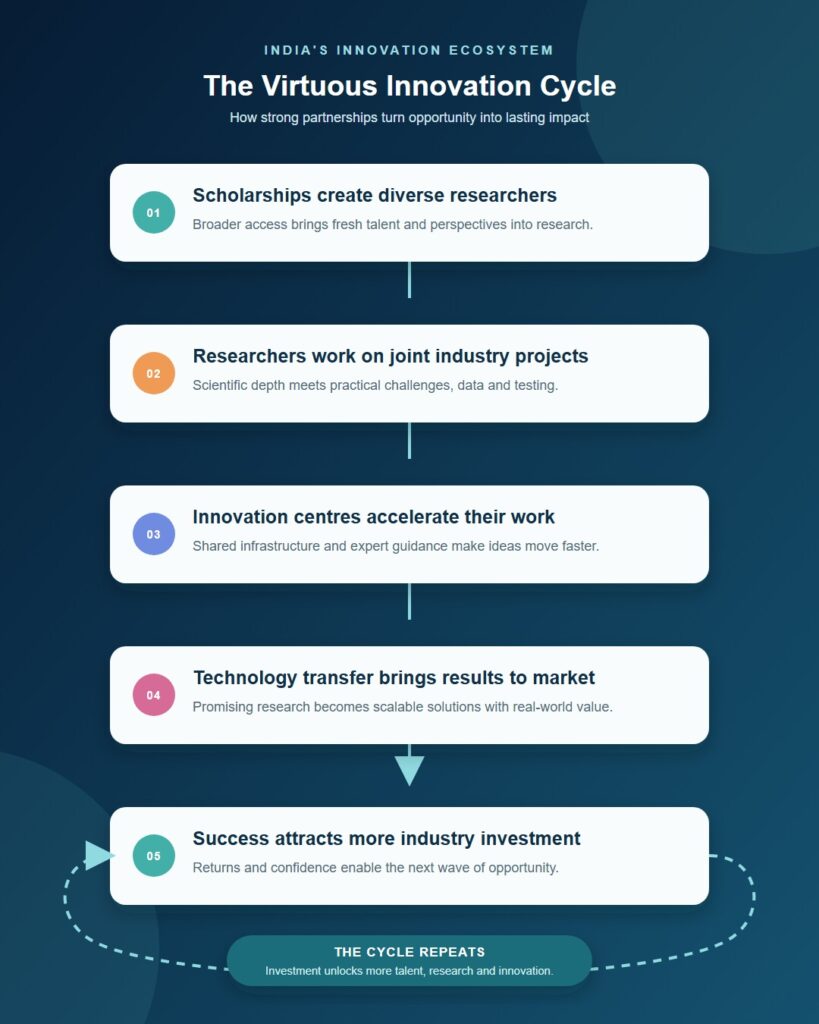
No single initiative works in isolation. Scholarships matter more when students have access to industry projects. Research partnerships deliver more when there’s infrastructure to support them. Technology transfer succeeds when there’s a pipeline of good research to draw from.
What Makes Partnerships Actually Work
Not all collaborations succeed. The ones that do tend to share certain features:
- Long-term commitment. Real results take years, not months. Companies that stick around build deeper relationships and see bigger returns.
- Shared goals. Both sides need to be clear about what they want. Misaligned expectations kill partnerships.
- Genuine co-creation. The best collaborations are not one-way streets where companies just fund academic work. They involve real back-and-forth, with both parties shaping the direction.
- Focus on emerging areas. Partnerships targeting AI, sustainability, clean energy, and advanced manufacturing are likely to have the biggest impact.
The Road Ahead
India’s demographic dividend is its huge population of young people, which will only pay off if those young people have opportunities to develop and apply their talents. Stronger industry-academia partnerships are one of the most effective ways to make that happen. This is not about corporate social responsibility or box-ticking. It’s about building the infrastructure for India’s future economy. The companies that invest seriously in these partnerships are not just doing good—they’re positioning themselves to benefit from the innovations and talent that emerge. The foundation is being laid. Now it needs to scale.
About the Author: Dr Rajeev Gautam is the President at HORIBA India.
© Copyright Disclaimer: All rights reserved. No part of this report may be reproduced, republished, distributed or transmitted in any form without prior written permission from India CSR®.



