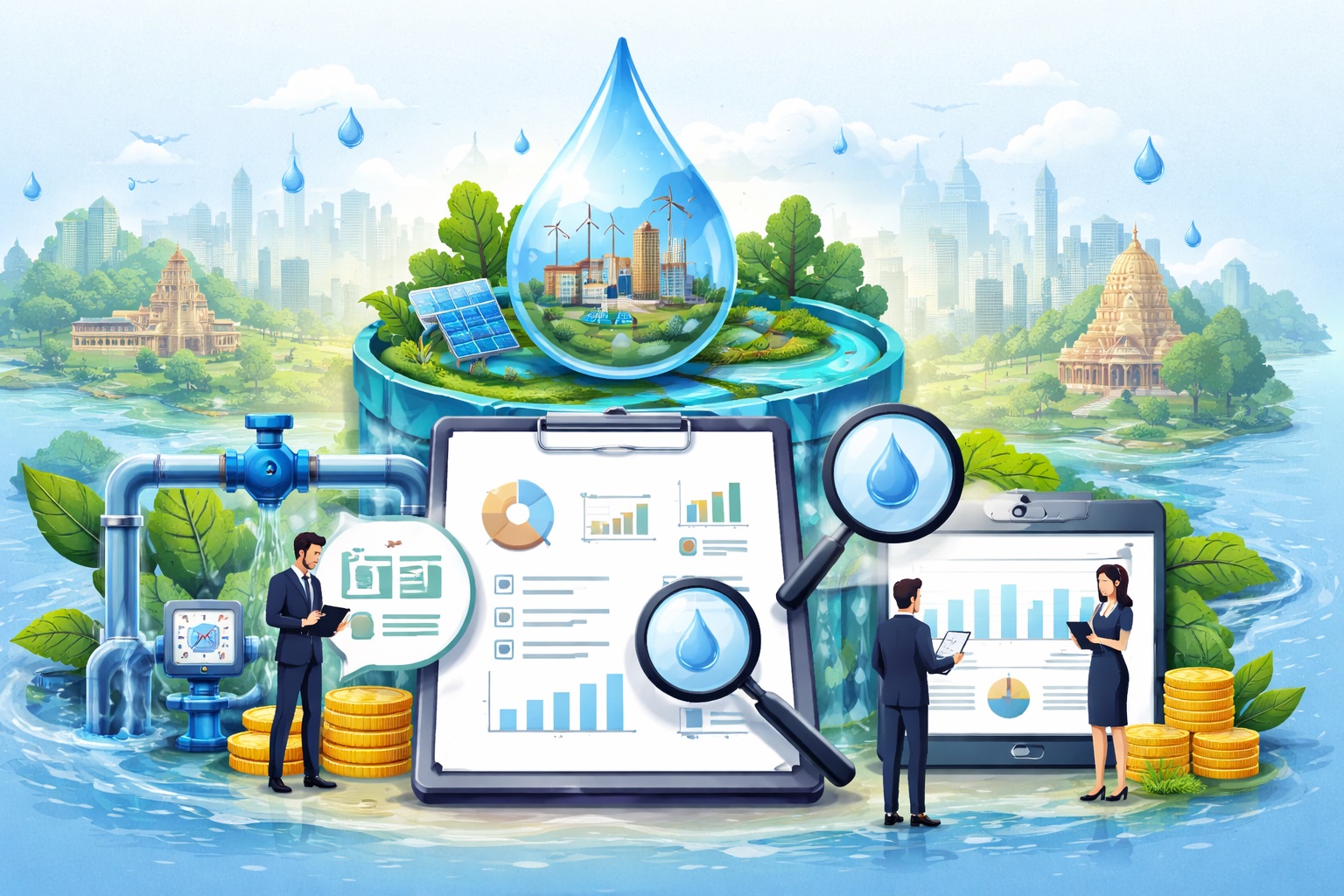


Water accounting is the systematic measurement of how much water a company withdraws, consumes, discharges, recycles, and depends upon across its operations.
By A Vikram Joshe
Indian business has mastered the language of energy efficiency, carbon reduction, and cost optimization. Yet one of the most critical production inputs remains astonishingly under-measured: water.
This is a strategic blind spot.
In India, water is not merely an environmental concern. It is an operating risk, a balance-sheet variable, a supply-chain vulnerability, and increasingly, a governance issue. Companies that fail to measure water use with precision are not simply overlooking a sustainability metric; they are misjudging a core economic resource.
That matters because India is not water-abundant in any practical business sense. Large parts of the country already face severe water stress. Industrial clusters, urban centres, agrarian belts, and rapidly expanding infrastructure zones are all drawing from systems under pressure. The question is no longer whether water scarcity will affect business. The question is which firms are measuring their exposure before it affects them.
This is where water accounting becomes indispensable
Water accounting is the systematic measurement of how much water a company withdraws, consumes, discharges, recycles, and depends upon across its operations. In more advanced form, it also captures where that water comes from, what quality it is in when used, how much is returned, what is lost, and whether the business operates in a water-stressed basin.
This distinction is vital. A factory may withdraw large volumes of water and still appear efficient if most of that water is treated and returned. Another facility may withdraw less, but consume a much greater share through evaporation, contamination, process loss, or product integration. One number alone tells very little. Good water accounting reveals the difference between withdrawal, consumption, discharge, and reuse. That is not semantics. That is management intelligence.
For Indian companies, the first reason to adopt serious water accounting is risk visibility
Water risk is rarely singular. It comes as a combination of declining groundwater tables, poor source reliability, rising treatment costs, tighter discharge regulation, community conflict, and reputational scrutiny. A company may believe it has low water cost simply because its current extraction is cheap. But cheap access is not the same as secure access. A borewell that works today may become restricted tomorrow. A municipal connection may be reallocated under stress. A low-cost site may prove expensive once disruption, trucking, treatment, or shutdown losses are counted.Without measurement, none of this is visible in time.
The second reason is financial materiality
Most Indian companies still account for water poorly. They measure the water bill, not the water dependency. They record utility expense, but not water intensity per unit of output, per occupied room, per ton processed, per megawatt generated, or per crore of revenue. That is a costly omission.
When water is measured scientifically, it becomes manageable economically. Firms can compare plants, detect inefficiencies, redesign processes, justify recycling systems, evaluate capex, and identify where one litre saved has the highest financial value. In other words, water accounting converts sustainability from a moral argument into a business discipline.
The third reason is regulatory and capital-market pressure
Indian corporate reporting is changing. ESG disclosures are no longer ornamental. Through SEBI’s BRSR and BRSR Core architecture, water use is now entering the language of standardized corporate accountability. Companies are being asked not just whether they care about sustainability, but whether they can disclose water withdrawal, consumption, discharge, operations in water-stressed areas, and water footprint with consistency and credibility.This is an important transition. It signals that water is moving from the CSR department to the boardroom.
Investors, lenders, insurers, and analysts increasingly understand that resource risk is governance risk. A company unable to explain how water flows through its operations will soon appear as incomplete in its disclosures as one unable to explain debt, inventory, or cash flow.
The fourth reason is operational intelligence
Most firms know broadly that they use water. Far fewer know where they waste it.
Robust water accounting creates this visibility. It maps source-wise withdrawals, process-wise consumption, losses, treatment loads, recycling loops, and discharge pathways. It enables benchmarking across facilities. It also allows management to overlay internal data with basin-level risk data, groundwater classifications, rainfall variability, and regulatory status. That is when accounting becomes strategic.
Because water, unlike many inputs, is profoundly local. A kilolitre used in a high-stress industrial belt is not economically or ecologically equivalent to a kilolitre used in a less constrained basin. The future of corporate water measurement lies not only in quantifying volume, but in understanding context.
And that leads to the fifth reason: strategic resilience
What carbon accounting did for decarbonization, water accounting must now do for water stewardship. Once measured properly, water can be governed. Companies can set intensity reduction targets, establish internal water pricing, redesign cooling and cleaning systems, harvest rainwater, improve reuse, invest in closed-loop technologies, and engage suppliers on embedded water risk.
This is particularly important in India because water vulnerability does not remain confined to the factory gate. It spills into agriculture-linked supply chains, urban real estate, hospitality operations, industrial permitting, and community relations. The company that ignores water accounting may believe it is saving effort. In reality, it is delaying a cost it will eventually pay in a harsher form.
The age of treating water as an invisible utility is over.For Indian business, water must now be treated as what it truly is: a strategic asset under stress. That requires measurement with scientific rigor and managerial seriousness. Not as a reporting ritual. Not as a public-relations exercise. But as a discipline of modern enterprise management.
Because what is not measured is rarely managed well
And in India, what is not measured in water may soon be felt in production losses, regulatory shocks, investor concern, and declining resilience.Water accounting, then, is not about counting litres. It is about protecting continuity, competitiveness, and corporate credibility in an economy where water risk is no longer theoretical.
About the Author
A Vikram Joshe, Managing Director, WAE
(India CSR)