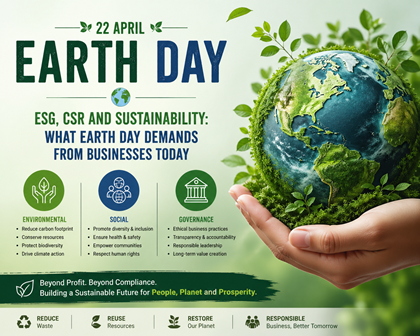


If CSR is the intention and sustainability is the vision, ESG is the measurement.
On April 22, each year, the world stops to consider the well-being of the planet in which it lives. However in the boardrooms and in the balance sheets, that reflection is no longer symbolic – it is structural, strategic and more and more, regulatory. In 1970, Earth Day was created as a protest against industrial pollution by citizens. Over fifty years on, it has come to be an annual mirror that is held up at corporations, investors, and policymakers. Its questions are more incisive than ever: Are you quantifying your impact? Are you telling the truth about it? And above all – are you changing?
There are three frameworks currently that prevail in how companies respond to those questions: Corporate Social Responsibility (CSR), Sustainability strategy, and Environmental, Social, and Governance (ESG) reporting. Although they are frequently interchanged, they are different – and dynamic -tiers of corporate responsibility.
CSR: Charity to Commitment
Corporate Social Responsibility was a voluntary act- planting of trees, giving of donations to communities, and publication of annual reports with pictures of smiling employees. Decades long it has occupied a cozy niche in the marketing department, and not tied to core business processes. That era is ending. The CSR of today is facing the question of having to move beyond philanthropy to policy. Employees, customers, regulators and other stakeholders are now questioning whether the social commitments of a company are integrated into its supply chain, hiring process and product design or just put in recycled paper as Earth Day press releases.
The change is generational as well as regulatory. Environmental and social values are one of the criteria that Millennials and Gen Z workers have when selecting an employer. Consumers are growing to favor brands that show values that are matched with action. In such a setting, CSR without teeth does not merely fail to impress, but it actually destroys trust. Research has always revealed that more than 88 percent of consumers desire brands to assist them in living a more sustainable life and that any brand that appears to be greenwashing has a quantifiable backlash in its sales and talent attraction.
Sustainability: The Long Game.
Sustainability, as it is, is not a campaign but a limitation. The Earth is finite; it has a limited carbon budget and ecological limitations that no balance sheet can ignore. A truly sustainable business model is one that is constructed to run in those limits forever. The development is actual but disequilibrium. The adoption of renewable energy has been at a very high pace; the use of solar and wind are becoming a larger portion of electricity generation in the world. Large companies, including car manufacturers and clothing manufacturers, have made the commitment to net-zero emissions goals. In manufacturing and retail, the concept of the circular economy, where waste is eliminated by ensuring materials are in constant use, is becoming more popular.
But still, there is a great distance between the target and the trajectory. The science is clear: even with all the existing corporate commitments met, the world is in a strange space both more sustainability conscious than at any previous time, yet in a headlong rush toward ecological overshoot. Earth Day 2026 has the world in a strange space, more sustainability aware than it has ever been, and headed into ecological overshoot. Sustainability is not a department anymore. It is the operating system where all business decisions now have to be filtered.
ESG: The Accountability Architecture
If CSR is the intention and sustainability is the vision, ESG is the measurement. Environmental, Social, and Governance criteria give investors a structured language to assess non-financial risks and opportunities. Climate exposure, board diversity, executive pay ratios, data privacy practices, and ESG frameworks attempt to quantify what traditional financial reporting leaves invisible. The momentum behind ESG has been extraordinary. Regulatory frameworks in the EU, the UK, and increasingly across Asia now mandate varying degrees of sustainability disclosure. The International Sustainability Standards Board (ISSB) has moved toward a globally harmonised reporting baseline. Institutional investors managing trillions of dollars now routinely integrate ESG scores into portfolio decisions.
But ESG is also a contested terrain. Critics from one direction argue that voluntary ESG ratings are riddled with inconsistency, enabling green washing at scale. Critics from the other insist that ESG overreaches, imposing ideological constraints on capital allocation. Both critiques contain partial truths and both demand a more rigorous, standardised, and independently verified ESG ecosystem. The answer is not to abandon ESG but to strengthen it: clearer definitions, mandatory third-party assurance, and consequences for misrepresentation.
Earth Day as a Corporate Audit
There is a growing movement to treat Earth Day not as a communications opportunity but as an honest audit moment, a day to measure progress against prior commitments, identify gaps, and reset accountability. Forward-thinking companies are publishing Earth Day progress reports alongside their annual ESG disclosures, detailing not just achievements but shortfalls. The companies most trusted on sustainability are not those claiming perfection they are those demonstrating transparency, setting science-aligned targets, and systematically closing the gap between ambition and action.
This means tracking Scope 3 emissions, those embedded in supply chains and product use not just the easier-to-count Scope 1 and 2. It means linking executive compensation to verified sustainability KPIs. It means engaging workers, communities, and ecosystems as genuine stakeholders, not as audiences for corporate messaging. Companies that have embedded sustainability into capital allocation, product roadmaps, and procurement standards consistently outperform peers on long-term resilience metrics.
The Road Ahead
Earth Day 2026 arrived at an inflection point. The regulatory environment around ESG disclosure is tightening across major economies. Nature-related financial disclosures accounting for biodiversity loss and ecosystem degradation are entering mainstream frameworks. The social dimension of ESG, often overshadowed by the environmental, is gaining urgency as inequality, labour rights, and community impact attract investor and regulatory focus.
For business leaders, the message of this Earth Day is neither celebratory nor despairing; it is directional. CSR must move from the periphery to the core. Sustainability must transition from aspiration to architecture. And ESG must evolve from a reporting exercise into a genuine accountability engine, capable of driving the systemic change that the planet’s ecological limits demand. The earth does not issue quarterly earnings reports. But every April 22, it offers something more valuable: a reminder that the only truly successful business is one that can still do business on a liveable planet fifty years from now. The clock is running. The frameworks exist. What remains is the will to act at the speed and scale the moment requires.
ESG: The Responsibility Architecture
In case the desire is CSR and the vision is sustainability, the indicator is ESG. Environmental, Social, and Governance standards provide a systematic language that investors use to evaluate the non-financial risks and opportunities. The climate exposure, diversity of the board, executive remuneration ratios, data privacy procedures ESG frameworks strive to measure what the conventional financial reporting obscures. The ESG movement has been phenomenal. Sustainability disclosure is now required by regulatory frameworks in the EU, UK and in some parts of Asia to varying extents. International Sustainability Standards Board (ISSB) has shifted to a harmonised reporting base across the globe. Trillions of dollars under management by institutional investors now regularly incorporate ESG scores into their portfolio decisions.
But ESG is also a controversial ground. On the one hand, critics claim that voluntary ESG ratings are full of inconsistencies, which allow them to engage in greenwashing on a massive scale. The other critics argue that ESG is overreaching and this way of allocating capital puts ideological limits. Both critiques have their respective grain of truths – and both require more rigorous, standardised and independently validated ESG ecosystem. The solution is not to drop ESG but to reinforce it: it needs to be defined more precisely, have the third-party assurance, and the repercussions of misrepresentation.
Earth Day as Company Audit
An increasing trend is to approach Earth Day as not so much a communication opportunity but a sincere audit moment, a day to gauge progress against earlier promises, discern areas of unmet or unmet promise, to reestablish accountability. Companies that are ahead of their time are also releasing Earth Day progress reports with their annual ESG reports, not only on their successes but also on their failures. Most trusted companies on sustainability are not those that purport to be perfect, but those that are transparent, with science-consistent targets, and those that have a systematic way of bridging the gap between ambition and action.
This implies monitoring the Scope 3 emissions, or those that are entrenched in supply chains and the usage of products, rather than the less difficult-to-measured Scope 1 and 2. It entails connecting the executive compensation with the certified sustainability KPIs. It involves involving workers, communities, and ecosystems as real stakeholders, rather than as recipients of corporate messages. Those companies that have integrated sustainability in capital allocation, product roadmap and procurement standards are always ahead of the packs in long-term resilience indicators.
The Road Ahead
Earth Day 2026 hits the spot. The regulatory framework surrounding the disclosure of ESG is narrowing in key economies. The so-called nature-related financial reporting – accounting of the loss of biodiversity and degradation of ecosystems – is becoming mainstream. The social aspect of ESG, typically shadowed by the environmental, becomes increasingly urgent with the inequality, labour rights, and impact on communities drawing attention of investors and regulators.
To business leaders the message of this Earth Day is neither a call to rejoice nor to be despondent, but directional. CSR should be taken to the center. Sustainability should shift to being a dream and design. And ESG needs to transform into a reporting exercise into an actual engine of accountability, able to create the systemic change that the ecology limits of the planet require. The earth does not present quarterly reports of earnings. However, it has something better each April 22 it is a reminder that the only business that is successful is the business that is still able to do business in a liveable planet fifty years down the road. The clock is going on. The frameworks exist. What is left is the desire to act at the pace and magnitude the moment demands.
Contributed by Suhana Agrawal
(India CSR)