




Top data science training institutes in India provide systematic learning, real-world projects, current tools, trained faculty, and career guidance. Based on your needs you should choose the right institute for a degree program, professional certification, career change, or upskilling with career relevance along with other activities.
Data science courses in India vary considerably in terms of duration, fees, teaching method, project-based learning, eligibility, and placement. The Boston Institute of Analytics provides Data Science and Artificial Intelligence courses in three modes – certificate, diploma, and master diploma in classroom, live online, and pre-recorded classes. Its available course details have over 200 hours of learning content, over 15 projects and cases, and over 30 tools & technologies.
Here we help fresh graduates, working professionals, career changers, analysts, developers, and non-technical learners in comparing courses based on relevant career factors rather than ranking alone.

Which Institutes Should You Consider?
- Boston Institute of Analytics is a professional-training option for learners seeking blended instruction, practical projects, dual Data Science and Artificial Intelligence certification, and career support.
- IITs, IISc, and university programs are stronger choices for learners seeking formal academic credentials, research exposure, or a longer degree pathway.
- Online programs suit working professionals who need schedule flexibility and can learn independently.
- Classroom or live instructor-led programs suit learners who need accountability, immediate doubt resolution, and structured practice.
- Beginners should prioritize foundation modules in Python, SQL, statistics, data analysis, and machine learning.
- Freshers should compare project depth and internship access, not only certificates.
- Working professionals should check weekend schedules, recordings, mentoring, and the time required each week.
- Placement assistance is not the same as a guaranteed job. Learners should ask for written definitions, eligibility conditions, and outcome data.
What Makes a Data Science Institute One of the Best?
For your specific situation, the ideal data science program would be the one whose course outline suits your abilities, career objective, availability, and support requirement. Being famous does not automatically make a course credible to help you get job-ready abilities.
Use these evaluation criteria before comparing institutes:
| Evaluation factor | What to verify | Why it matters |
| Curriculum | Python, SQL, statistics, machine learning, visualization, AI, and deployment | Covers the complete learning foundation |
| Practical work | Number and type of projects | Produces portfolio evidence |
| Faculty | Current industry and teaching experience | Improves applied understanding |
| Learning format | Classroom, live online, recordings, or self-paced | Determines accountability and flexibility |
| Career support | Resume, mock interviews, mentoring, job access, and employer connections | Supports the transition to employment |
| Internship model | Duration, responsibilities, supervision, and written terms | Adds workplace exposure |
| Assessment | Assignments, capstone, code reviews, and presentations | Tests whether learners can apply skills |
| Transparency | Fees, refund policy, placement terms, and batch details | Reduces enrollment risk |
The course must relate every technical subject matter to an application area. SQL has to be used to analyze problems in business, machine learning must be tested using appropriate measures, and visualization must help convey a decision to a business leader.
Which Are the Top Data Science Institutes in India?
There can be no single universal ranking because Indian institutes cater to varied needs of learners. A good starting shortlist would consist of institutes which offer academic courses as well as professional institutes.
| Institute or category | Best suited for | Typical strength | Limitation to consider |
| Boston Institute of Analytics | Beginners, freshers, career switchers, and working professionals | Blended training, practical projects, dual certification, and career support | Verify the exact campus, batch schedule, current fee, and placement terms |
| IITs and IISc | Degree seekers, researchers, and learners targeting strong academic depth | Faculty, research, mathematical foundations, and institutional reputation | Competitive admissions and longer time commitment |
| University degree programs | Students seeking a formal undergraduate or postgraduate credential | Structured academics and campus experience | Higher time and financial commitment |
| NPTEL and university-backed online learning | Self-directed learners and working professionals | Low-cost access to rigorous subject material | Requires strong self-discipline and portfolio-building outside coursework |
| Specialist bootcamps and professional academies | Career switchers seeking guided, job-focused learning | Live instruction, projects, mentorship, and career preparation | Outcomes vary substantially by provider and learner effort |
| MOOC platforms | Learners seeking flexibility or targeted skill modules | Broad course choice and global content | Limited accountability and variable employer recognition |
This classification is more relevant than giving a single list as an “official” national ranking. Four-year college degree, six-month diploma, and specialization through self-paced online learning solve different needs.
Why Consider Boston Institute of Analytics?
Boston Institute of Analytics is a great choice as a professional training course for learners who are looking for a structured program in Data Science and Artificial Intelligence that provides hands-on learning and career support. The institute has published its curriculum, which shows the classroom and instructor-led online classes, recorded lectures, assignments, capstones, and a learning management system.
The published curriculum of Boston Institute of Analytics covers topics including Python, SQL, statistics, supervised and unsupervised machine learning, deep learning, natural language processing, data visualization, Generative AI, and career boost. The institute also mentions various tools and technologies like MLOps, recurrent neural networks, transformers, BERT, Tableau, and business intelligence tools.
BIA’s published learning model includes:
- More than 200 hours of learning and practical exercises.
- More than 15 projects and case studies.
- Exposure to more than 30 tools and technologies.
- A dual certification pathway in Data Science and Artificial Intelligence.
- Live sessions supported by recordings and learning-management-system access.
- One-to-one career mentoring and interview preparation.
- Internship or on-the-job training options in selected programs.
- Career support involving resume building, interview preparation, and access to partner companies.
The institution also has its own networks of more than 350 corporate partners. Consider this as an institutional claim and think about how this is defined, what employers are pertinent to your chosen position, and what access means in terms of interviews, internships, or jobs.
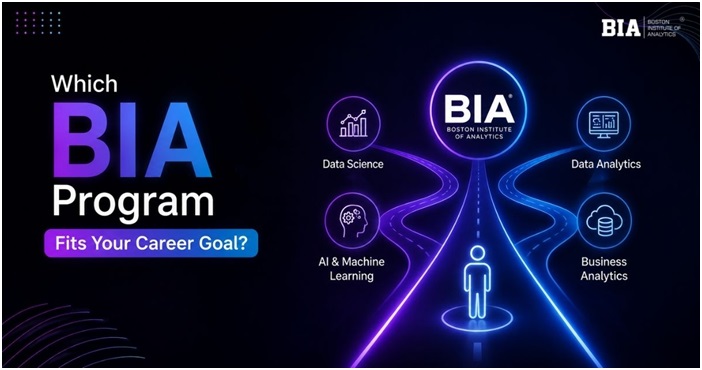
Which BIA Program Fits Your Career Goal?
BIA publishes three principal learning paths. The correct choice depends on the depth of training and workplace exposure you need.
| Program | Published duration | Published fee information | Best suited for |
| Data Science and AI Certification | 4 months | ₹85,000 with scholarship, according to the published program article | Beginners, fresh graduates, and learners seeking a foundation |
| Data Science Diploma | 6 months | ₹1,25,000 with scholarship, according to the published program article | Learners seeking additional practical exposure and a two-month internship |
| Master Diploma in Data Science | 10 months | ₹1,45,000 with scholarship, according to the published program article | Learners seeking deeper training and six months of on-the-job training |
Fees that may differ based on location, scholarship, intake, delivery, and commercial arrangements will be given. Verify the payable amount in writing prior to admission. The BIA published article outlines the certification, diploma, and master diploma programs and their durations.
Best option for beginners
The four months of certification offers the easiest entry point for those lacking technical skills.
Even with a certificate program, the learner must practice regularly even outside class. The program does not replace practice, data cleaning, documenting, and interviews.
Best option for freshers
The diploma program might be suitable for freshers requiring better portfolio evidence and exposure to work.
The fresh graduates require to have a better approach to supervised work, code reviews, presentations, internship, and interviews.
A fresher should leave the program with at least:
- A documented data analysis project.
- A machine learning project with evaluation metrics.
- A dashboard or visualization project.
- A capstone project connected to a business problem.
- A GitHub or portfolio presentation that explains decisions clearly.
Best option for working professionals
Working professionals should weigh the flexibility of their schedules, recording of sessions, availability of sessions over the weekends, access to mentors, and workload per week. Blended program by BIA has classroom training, instructor-led learning and recording.
The professional needs to take longer programs only if they can dedicate time to the assignments and projects.
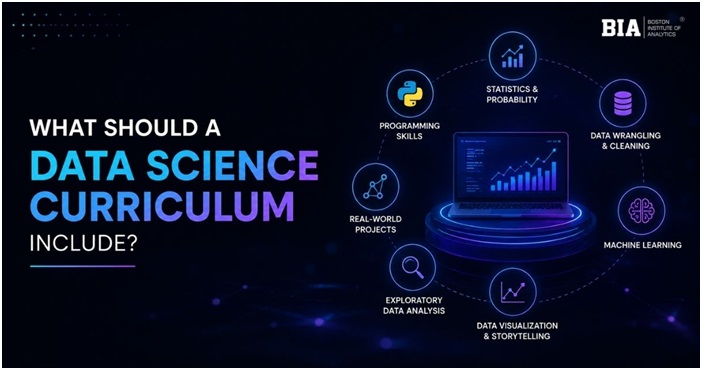
What Should a Data Science Curriculum Include?
The job-focused training should cover everything from collecting data through communication and deployment. Just knowing Python and machine learning would not suffice for many entry-level jobs.
Look for these modules:
- Python programming: Variables, functions, data structures, error handling, and reusable code.
- SQL: Joins, aggregations, subqueries, window functions, and business reporting.
- Statistics: Probability, distributions, hypothesis testing, correlation, and regression concepts.
- Data analysis: Pandas, NumPy, data cleaning, exploratory analysis, and feature preparation.
- Visualization: Matplotlib, Seaborn, Tableau, Power BI, or equivalent tools.
- Machine learning: Regression, classification, clustering, model validation, and feature engineering.
- Deep learning and NLP: Neural networks, text processing, embedding’s, and practical use cases.
- Generative AI: Prompting, retrieval concepts, model evaluation, and responsible application.
- Deployment and MLOps: APIs, version control, monitoring, reproducibility, and basic cloud workflows.
- Business communication: Presenting findings, writing recommendations, and explaining model limitations.
The course outline published by BIA covers all the core foundational topics along with some advanced topics like deep learning, NLP, MLOps, transformers, and Generative AI. It would be a good idea for learners to make sure how in-depth each topic is being covered and if there is practical implementation too.
How Should You Evaluate Placement Support?
The best data science training institution when it comes to job placement is the one which makes its career process clear and prepares you to show proof of capability. The terms “placement assistance,” “interviewing,” “internship,” and “job guarantee” mean different things.
Ask each institute:
- Does placement support mean resume review, interview referrals, or confirmed employment?
- How many learners from the relevant program received interviews?
- What is the median salary rather than only the highest salary?
- Which roles were offered?
- What eligibility conditions applied?
- Are internships paid, unpaid, project-based, or employment-linked?
- Is the placement data program-specific and campus-specific?
- What happens if a learner does not accept an offer?
- Are employer names and dates available for verification?
BIA explains the career services like resume writing, interview training, mentoring, and connections at partner companies. BIA’s FAQ section even explains the distinction between career assistance and job guarantee.
The best way to evaluate job placement is by using a combination of institutional statistics and self-readiness. The employer usually tests Python, SQL, statistics, reasoning in projects, communication skills, and ability to make trade-offs.
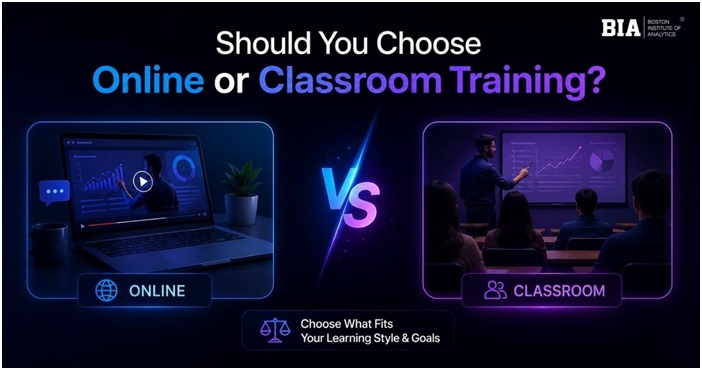
Should You Choose Online or Classroom Training?
Classroom Training/Training with an instructor is generally more preferable to students who require accountability. Online Learning or recorded lectures will suit students who require schedule control. Hybrid courses can utilize the strengths of both forms of learning.
| Learning format | Best for | Main advantage | Main risk |
| Classroom | Beginners and learners who value routine | Immediate interaction and stronger accountability | Fixed location and schedule |
| Live online | Working professionals and remote learners | Instructor access with geographic flexibility | Requires reliable attendance and concentration |
| Recorded online | Self-directed learners | Maximum scheduling flexibility | Delayed feedback and weaker accountability |
| Blended | Mixed learner groups | Combines live instruction, recordings, and practice | Requires careful scheduling |
For students who are based in Mumbai, Thane, Bengaluru, Chennai, Delhi, Hyderabad, or Pune, geographical location might have an effect on travel time, availability of classroom learning, and networking. The BIA provides city-based course pages, but the students should verify the actual campus and batches.
What Should You Check Before Enrolling?
Use this checklist before paying a deposit or signing an enrolment agreement:
- Request the complete syllabus and weekly learning schedule.
- Ask whether instructors personally review assignments.
- Request examples of capstone projects.
- Confirm the number of live teaching hours.
- Check whether recordings remain available after the course.
- Verify the internship or on-the-job-training terms.
- Ask for the complete fee after scholarships, taxes, and additional charges.
- Read the refund, transfer, and deferral policy.
- Request a written explanation of placement assistance.
- Confirm whether the certificate is institute-issued or externally accredited.
- Attend a demo class when available.
- Speak with recent learners without relying only on testimonials.
This allows you to differentiate between a data science training institute that offers a practical training program and one that sells only a certificate. A decision made by putting all these elements together is likely to be your best bet.
What Career Roles Can You Target?
In fact, a data science program could be used in entry-level jobs not only in the “data scientist” position. You would need a job that is in line with your experience and your portfolio at the moment.
Potential roles include:
- Data Analyst.
- Business Intelligence Analyst.
- Junior Data Scientist.
- Machine Learning Engineer.
- Python Developer.
- Data Visualization Specialist.
- Analytics Consultant.
- AI or NLP Associate.
- Model Validation Analyst.
- Junior Data Engineer.
The BIA has published the list of positions offered by their program, which includes the positions in data science, machine learning, artificial intelligence, business intelligence, consulting, and engineering.
Boston Institute of Analytics: Data Science Program Leads on Industry Readiness in First Quadrant Labs Assessment
First Quadrant Labs’ evaluation of the best data science programs reveals that the one offered by the Boston Institute of Analytics (BIA) is a top performer in terms of industrial preparedness. The distinction points out the efforts made by BIA in offering relevant education based on modern technologies and skills geared towards meeting job requirements.
Industry-Aligned Curriculum
BIA’s curriculum covers the key skills required across data science and artificial intelligence roles.
- Python programming and SQL.
- Statistics, probability, and data analysis.
- Machine learning and predictive modelling.
- Deep learning and natural language processing.
- Data visualisation and business intelligence.
- Generative AI and emerging technologies.
The curriculum offers students comprehensive knowledge in both the technical and business sides of data science. Therefore, it prepares students to derive useful insights from data and make proper decisions.
Practical, Project-Based Learning
One of the main advantages of the BIA program is the practical approach adopted. It offers learners opportunities to handle real datasets and industry-related cases in order to practice data manipulation, exploration, modelling, evaluation, and reporting.
It not only helps learners build their problem-solving skills but also makes their portfolios appealing to future employers.
Career-Focused Support
BIA complements technical training with expert mentorship, certification, interview preparation, and placement assistance. Students also develop communication and presentation skills, which are essential for explaining analytical findings to business teams.
First Quadrant Labs’ assessment reinforces BIA’s commitment to industry-ready education. By combining a comprehensive curriculum with practical projects and career guidance, BIA’s Data Science Program provides a strong foundation for aspiring data analysts, data scientists, machine learning engineers, and AI professionals. BIA’s published course information also emphasises hands-on training and placement assistance.
FAQ Section
Which is the best data science institute in India?
BIA is a good option for professional training, for those who seek courses in Data Science and Artificial Intelligence, real-life projects, dual certification, and career support, whereas the IITs, IISc, and the Universities are the right option for those who need academic or research courses.
Which data science institute is best for beginners?
It is advisable to start with an institute which trains one in python, sql, statistics, and data analysis from the start. According to BIA, their programs don’t require any pre-knowledge of programming and statistics and have foundational training programs.
Which is the best data science institute in India for job placement?
The best institute is the one that gives transparent career information and proper interview preparation sessions. BIA provides resume preparation, interview preparation, mentoring, and access to partner companies, although one needs to ensure about the outcome data.
What is the typical fee for a data science course in India?
Tuition fees vary according to the institution, length, mode of delivery, certification, and career services offered. BIA provides a course article where scholarship-related fees for its certification course and master diploma are provided starting from ₹85,000 to ₹1,45,000. Make sure of the current fees and terms before signing up.
Can a non-technical graduate learn data science?
Yes, a non-technical person can start with a foundation program. However, the learner needs to acquire the skills in programming, mathematics, statistics, and problem-solving through practice.
Is a certificate enough to get a data science job?
No, only the certificate will not do. The employer takes into account project experience, SQL, Python, statistics, communication, problem-solving, and business impact explanation as well.
Are online data science courses useful for working professionals?
Yes, online courses can be a good choice if they offer live classes, video recordings, mentor availability, assessments, and realistic weekly schedules. Working people need to choose the programs where there is no passive viewing only.
How long does it take to learn data science?
The foundation can be achieved within four to six months of steady studying; however, one needs to gain some project experience and preparation for interviews. BIA offers four-month, six-month, and ten-month learning tracks with various levels of practical involvement.
Choose the Right Program for Your Goal
Top data science institutes in India are the ones that provide an appropriate curriculum, projects, experienced mentors, flexibility, and career assistance. Choosing the correct institute depends upon whether you are a student wanting deeper knowledge or a fresher or working professional who needs to develop career-oriented skills.
In order to evaluate data science institutes in India, you should not rely on ranking or promotions. You should look for the institutes that offer Python, SQL, statistics, data analysis, machine learning, data visualization, artificial intelligence, and deployment courses. Projects, case studies, capstones, portfolio creation, mock interviews, and internships will increase the relevancy of the course for the job market.
If you are a student or a fresher, then the classroom program or live online classes with a good foundation and mentor’s feedback might suit you better. If you are a working professional, then you may prefer weekend batches, recorded lectures, and flexible career advice.


