

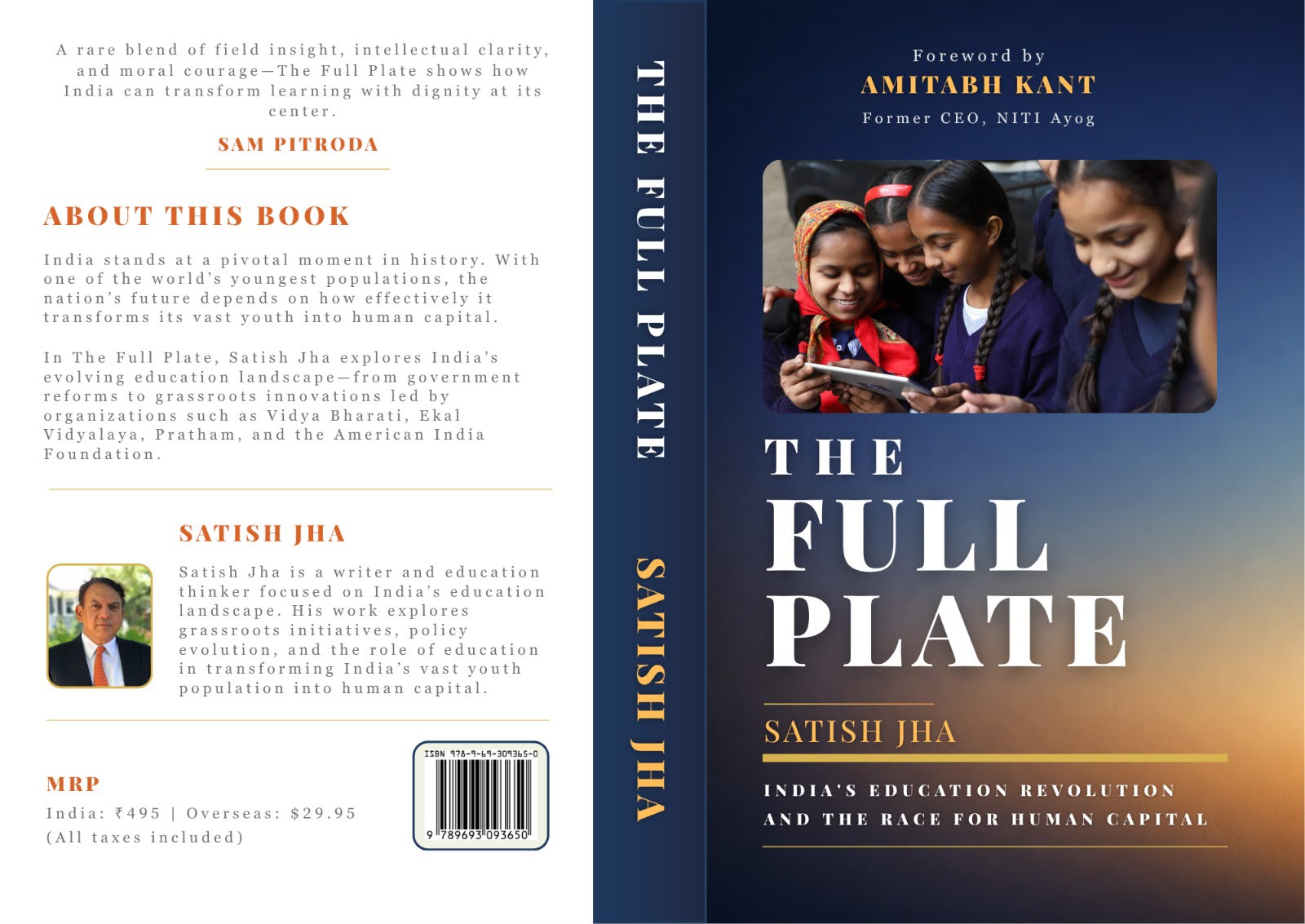


Girish Kumar examines Satish Jha’s The Full Plate and The Learning State, exploring education’s role in technology, governance and national progress.
By Girish Kumar
What makes a great book about education? To answer this question, one must first recognize that every generation inherits two distinct educational systems. The first is visible: the schools, examinations, universities, ministries, teachers, and budgets that make up the formal apparatus of instruction. The second is invisible. It consists of the fundamental assumptions a civilization makes about how intelligence is cultivated, how opportunity is distributed, and how societies reproduce competence from one generation to the next. While the visible system can be legislated into existence, the invisible one changes only when ideas change. Consequently, the history of educational thought is not merely a succession of pedagogical theories, but a history of changing conceptions of civilization itself.
Throughout history, thinkers have framed education around the primary imperatives of their eras. Plato regarded education as the formation of guardians for the ideal state. Jean-Jacques Rousseau sought to liberate the child from society before returning him to it. John Dewey imagined democracy as a continuous educational experiment, while Ivan Illich questioned whether institutional schooling had devolved into credentialed conformity. Paulo Freire, writing from a very different context, transformed literacy into an instrument of political emancipation. Yet none of these classic writers confronted the defining conditions of the twenty-first century: demographic decline across much of the developed world, artificial intelligence operating as a general-purpose technology, intense global competition for talent, and the realization that human capital—rather than natural resources or industrial capacity—has become the principal determinant of national power.
The best contemporary works on education represent deliberate attempts to understand this profound transformation. They differ not merely in their conclusions, but in the scale of the questions they pose. Over the past quarter-century, a select canon of influential texts has reshaped public and academic discourse. Amartya Sen’s Development as Freedom permanently altered the vocabulary of economic development by arguing that the true measure of national progress was the expansion of human capabilities rather than GDP growth alone. Abhijit Banerjee and Esther Duflo’s Poor Economics achieved a complementary revolution, replacing sweeping ideological disputes with disciplined empirical experimentation. Daron Acemoglu and James A. Robinson’s Why Nations Fail restored inclusive institutions to the center of historical explanation, while popular texts like Amanda Ripley’s The Smartest Kids in the World, Ken Robinson’s Creative Schools, William Deresiewicz’s Excellent Sheep, Linda Darling-Hammond’s policy analyses, and John Taylor Gatto’s critiques enlarged specific conversations around testing, creativity, elite credentialism, and state schooling.
Yet despite their individual brilliant insights, most contemporary works share an inherent limitation: they examine education through a single principal lens—be it development economics, institutional politics, artistic creativity, or elite higher education. Rarely does a work attempt to integrate all of these disparate vectors into a single explanatory architecture.
This synthesis is precisely where The Full Plate enters the conversation. Its central proposition is that education is not merely another isolated policy sector; it is the fundamental operating system through which demographic change, technological innovation, labor-market transformation, political stability, social mobility, economic productivity, and geopolitical competition intersect. By attempting to reposition education from the margins of governance to its very center, The Full Plate accepts the significant intellectual risk of broad synthesis in an era that increasingly rewards narrow specialization. Its closest conceptual relatives are not conventional education manuals, but ambitious synthetic works that seek to redraw the conceptual map of policy and society.
If The Full Plate establishes why education must become the central organizing principle of national strategy, The Learning State addresses the institutional question that logically follows: if education occupies this position, what should governments actually build? While diagnosis is intellectually accessible, coherent institutional architecture is far more difficult. The Learning State proposes that the modern state must be reimagined as an institution whose primary function is the creation, renewal, and deployment of human capability across an entire lifetime. In this model, education ceases to be confined to traditional classrooms; instead, it becomes the unifying framework through which labor, technology, industrial strategy, and democratic resilience are coordinated. Like the foundational works of John Maynard Keynes or Peter Drucker, its value lies not necessarily in immediate political implementation, but in providing future institutions with a vocabulary they currently lack.
To be sure, neither work is without vulnerabilities. The very breadth that gives both texts their originality occasionally limits their depth. Specialists in economics, political science, educational psychology, or history will inevitably find areas where they long for deeper engagement with their specific disciplines. Formal modeling sometimes yields to conceptual synthesis, and historical narratives occasionally compress complex academic debates. However, these limitations are largely inseparable from the ambition of the enterprise itself. No text attempting to synthesize economics, governance, technology, and demographics can satisfy every disciplinary requirement simultaneously. Judged against the standard of broad, transformative synthesis rather than specialized empirical monographs, both works succeed more often than they fail.
Ultimately, evaluating the standing of such works depends entirely on the criteria applied. If historical influence alone were decisive, Sen’s capability approach remains preeminent; if empirical rigor is the sole standard, Banerjee and Duflo are difficult to surpass. But if the criterion becomes conceptual ambition—the attempt to construct a comprehensive explanatory framework capable of integrating the technological, demographic, and institutional questions of our era—then The Full Plate and The Learning State occupy a rare category. While they have not yet earned the historical standing of established classics, they have earned something equally essential: a vital place in the ongoing conversation. Intellectual history advances not merely through definitive answers, but through the formulation of better questions. If these works persuade future thinkers that education is the principal architecture through which free societies reproduce competence and democratic resilience, they will have permanently enlarged our understanding of modern civilization.
| Category | Details |
|---|---|
| Article Title | The Architecture of Learning: Educational Thought and the Civilization of the Twenty-First Century |
| Central Thinker | Satish Jha |
| Books Examined | The Full Plate and The Learning State |
| Central Argument | Education is the operating system connecting technology, demographics, governance, economic productivity, social mobility and national power. |
| The Full Plate | Explains why education should become the central organising principle of national strategy. |
| The Learning State | Proposes an institutional model focused on creating, renewing and deploying human capabilities throughout life. |
| Major Contemporary Challenges | Artificial intelligence, demographic decline, global competition for talent and labour-market transformation |
| Historical Thinkers Discussed | Plato, Jean-Jacques Rousseau, John Dewey, Ivan Illich and Paulo Freire |
| Contemporary Thinkers Discussed | Amartya Sen, Abhijit Banerjee, Esther Duflo, Daron Acemoglu and James A. Robinson |
| Related Influential Works | Development as Freedom, Poor Economics, Why Nations Fail, The Smartest Kids in the World, Creative Schools and Excellent Sheep |
| Distinctive Contribution | Integrates education, economics, governance, technology and demographics within one explanatory framework. |
| Principal Strength | Broad conceptual ambition and interdisciplinary synthesis |
| Primary Limitation | Its wide scope sometimes restricts detailed engagement with individual disciplines. |
| Policy Relevance | Connects education with industrial strategy, employment, technological adaptation and democratic resilience. |
| Long-Term Significance | Encourages policymakers and scholars to view education as the foundation through which societies reproduce competence and sustain democracy. |
Copyright@IndiaCSR



