

Rusen Kumar argues that an industrial accident is not just a technical failure. It is an institutional event that reveals how a company is governed, how the state regulates, and how a society values labour, discipline, safety, and human life.
Making a Chairman an accused emotionally, merely to satisfy public sentiment, goes against both justice and the principles of sound governance.

By Rusen Kumar
The recent industrial tragedy in Chhattisgarh has brought India’s industrial safety systems under sharp scrutiny. On April 14, 2026, a massive boiler explosion occurred at a power plant operated by Vedanta in Singhitarai village of Sakti district, reportedly caused by excessive pressure buildup inside the system. The blast led to the death of more than 20 workers and left several others critically injured, exposing serious lapses in operational safety and oversight. In the aftermath, an FIR was reportedly filed that included senior officials and also named Vedanta Chairman Anil Agarwal, triggering a wider national debate on accountability, corporate governance, and the role of administrative authorities in preventing such disasters.
Behind these numbers are human stories. Families broken. Children orphaned. Futures erased.
But the most important question is not just what happened.
At one level, these accidents expose failures in corporate governance. At another, they reveal a collapse of administrative and regulatory systems.
The real question is:
Why did it happen?
***
The Incident Was Technical. The Failure Was Systemic.
Initial reports suggest that the explosion was caused by excessive fuel accumulation inside the furnace, which created extreme pressure.
This pressure displaced boiler components and triggered the blast.
Other findings point to:
- Sudden increase in boiler load
- Possible negligence in equipment maintenance
- Lapses in operational control
These are not unknown risks. These are known dangers in thermal power plants.
Which means one thing:
The system knew the risks. But it failed to control them.
This is a national industrial safety culture problem.
***
Accidents Do Not Happen. They Are Allowed to Happen.
We call them accidents because it gives us comfort.
The word “accident” removes intention. It removes responsibility. It creates a sense that nothing could have been done.
But the truth is different.
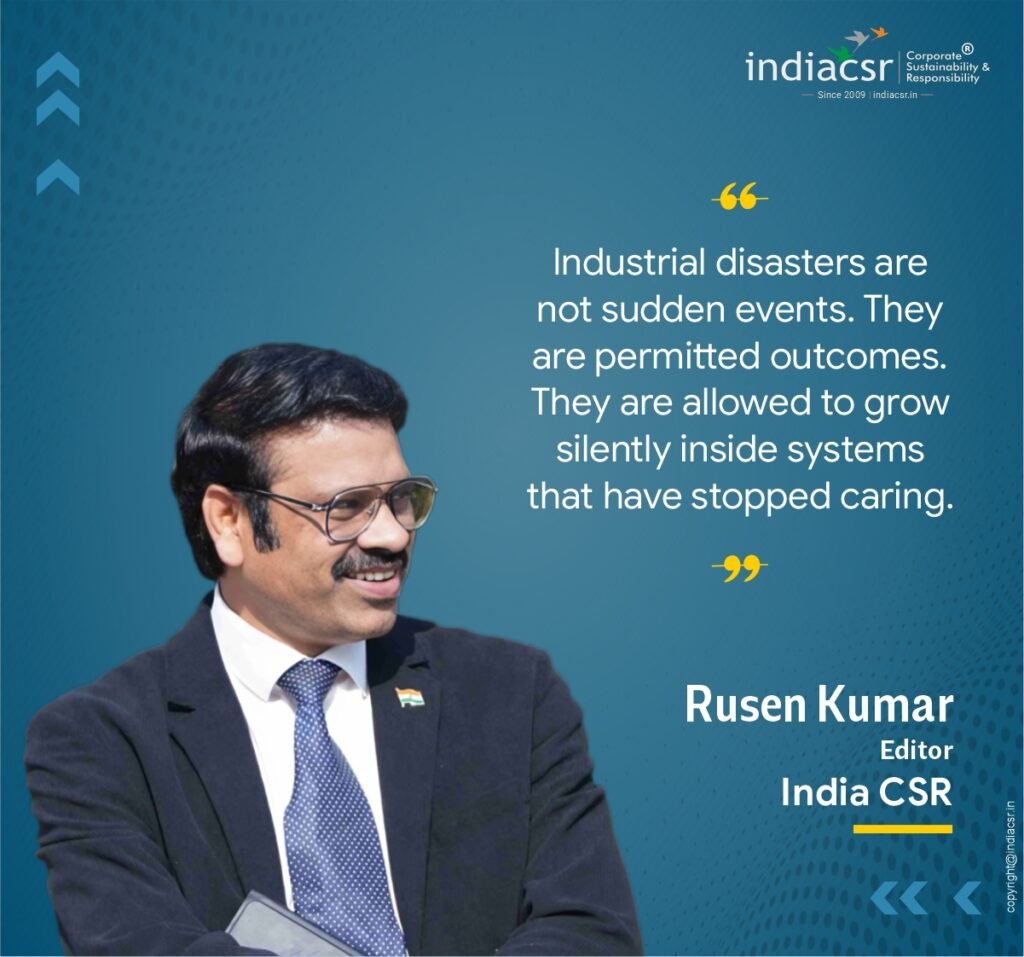
Industrial disasters are not sudden events. They are permitted outcomes. They are allowed to grow silently inside systems that have stopped caring.
A machine does not fail overnight. A structure does not collapse without warning. A toxic leak does not appear without signs. Everything speaks before it breaks. But systems must be willing to listen.
So the real question is not: What happened that day?
The real question is: What did we choose not to see?
This was a failure of attention, discipline, and governance.
***
The Silent Culture of Ignoring Risk
India’s industrial ecosystem has developed a dangerous habit. It adapts to risk.
We adjust. We tolerate. We move on.
Workers enter unsafe zones because they have no choice.
Supervisors overlook violations because targets matter more.
Management delays upgrades because cost matters more.
Regulators intervene only after a disaster.
Over time, this becomes culture.
Not a written culture.
A lived culture.
This creates a silent culture both in the industry and among regulators.
A culture where risk is normal.
Where danger is routine.
Where survival is mistaken for safety.
This is not ignorance of knowledge. This is ignorance of responsibility.
And when responsibility disappears, tragedy becomes inevitable.
***
Administrative Collapse
After every industrial tragedy, the focus goes to the company. But governance is larger than the company.
India has laws. India has departments. India has officers. On paper, everything exists.
But systems are not judged by existence. They are judged by performance.
The District Industrial Safety Officer is not just a designation. It is a responsibility to prevent death. The Industrial Safety Department is not just a structure. It is a mechanism to enforce discipline. The Collector is not just an administrator. He is the guardian of district-level risk.
So when an accident of this magnitude happens, the silence of these institutions becomes louder than the explosion itself.
Were inspections real or ritual?
Were reports acted upon or archived?
Was risk identified or ignored?
If governance is present but ineffective, then it is not governance.
So when a major accident happens, we must ask:
- Were inspections done properly?
- Were warnings issued and enforced?
- Did authorities act before the incident?
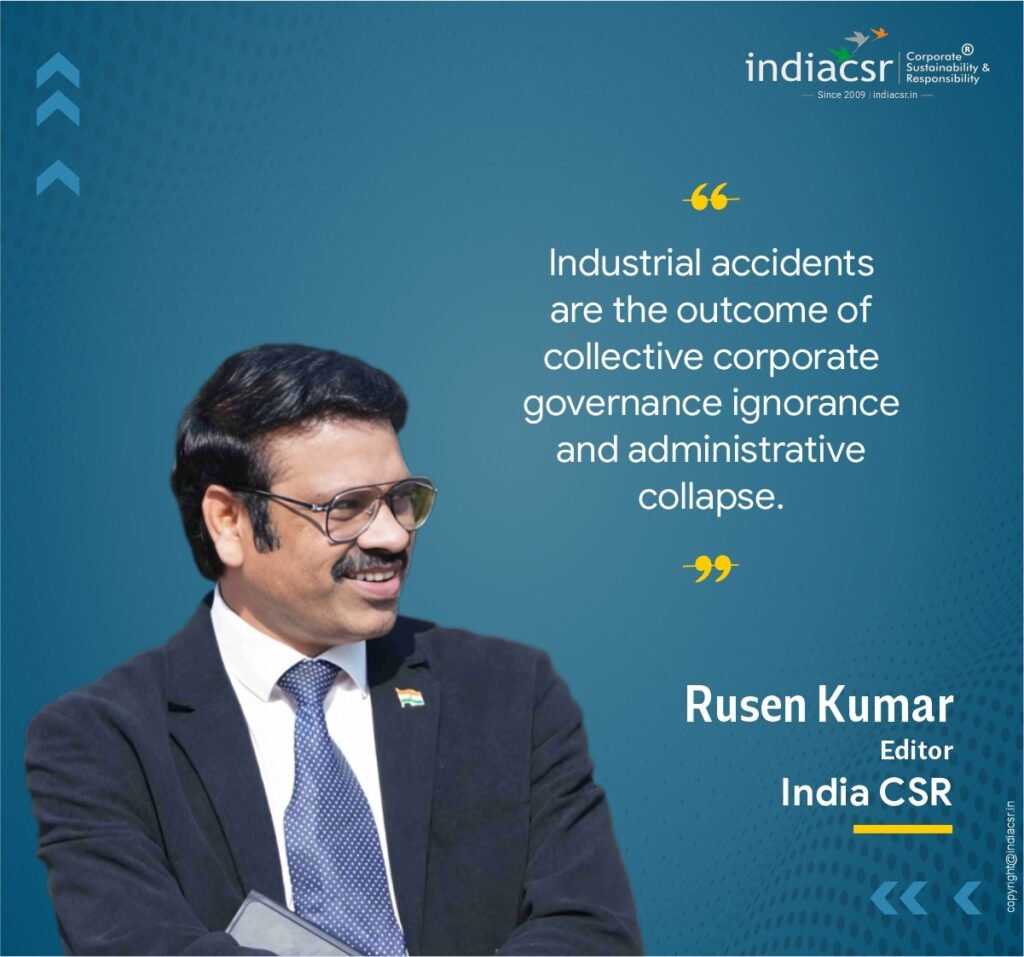
If the answer is unclear, then this is not just corporate negligence.
It is an administrative collapse.
***
FIR Against Anil Agarwal: A Shift in Accountability
After the incident, an FIR was reportedly filed under negligence-related provisions. Surprisingly, it included Vedanta Chairman Anil Agarwal, along with plant officials.
This has triggered a serious national debate.
Anil Agarwal is not a plant operator. A Chairman does not stand inside the plant. He does not run day-to-day operations. He does not supervise boiler pressure or maintenance schedules.
He does not operate machines. He does not conduct safety checks. His role is strategic, not operational.
His role is strategic.
Then why is accountability jumping directly to the top?
So when accountability jumps directly to the top, bypassing operational layers, it raises a deeper concern:
Are we fixing responsibility, or are we displaying action?
This is not about protecting an individual.
This is all about protecting the logic of governance.
If responsibility is not fixed where failure occurred, then the system learns nothing. And if the system learns nothing, it repeats everything.
Naveen Jindal’s Intervention: A Voice of Reason
Industrialist and Member of Parliament Naveen Jindal has raised this concern clearly.
“This is a deeply painful tragedy. Families must be supported fully. But naming Shri Anil Agarwal in the FIR before any investigation raises serious concerns. When accidents happen in PSUs or Railways, we do not name the Chairman. The same standard must apply to the private sector.”
This is a critical observation.
It is not about defending a person.
Double Standards? PSU vs Private Sector
A key point raised by Naveen Jindal is the perceived inconsistency in accountability standards between the public sector and private enterprises.
Jindal drew comparisons with accidents in government-run entities such as railways or public sector undertakings (PSUs), where top leadership is typically not named in FIRs without clear evidence of direct responsibility.
“When accidents occur in PSUs or Railways, we do not name the Chairman in the FIR. The same standard must apply to the private sector,” he said.
This argument has sparked a broader discussion on fairness, legal consistency, and institutional neutrality.
If this becomes a pattern, it will set a dangerous precedent. Every industrial accident may lead to top-level criminalisation even before facts are established. Governance structures will be bypassed. Regulatory and administrative failures will remain unexamined. In that situation, accountability will become political and symbolic, not institutional and evidence-based.
***
Investor Confidence and the Fear of Arbitrary Action
India today stands at a critical juncture. India wants to become a global manufacturing hub. It is inviting private investment. It is encouraging the industry. It is inviting global capital. It is positioning itself as a global manufacturing hub. It is encouraging entrepreneurs to invest and expand.
But investment is not driven by opportunity alone. It is driven by trust in institutions.
If corporate leaders can be named in criminal proceedings without clear evidence:
- It creates uncertainty in decision-making
- It discourages long-term investments
- It signals unpredictability in governance
If business leaders feel that:
- Legal action can be arbitrary
- Accountability can be misplaced
- Governance can be inconsistent
Investor confidence is fragile. It thrives on fairness, consistency, and due process. Any perception of arbitrariness can weaken India’s economic momentum.
If Chairmen are named without evidence, investor confidence will be shaken.
***
What Should Be the Correct Approach?
India needs a mature and balanced framework:
- Immediate Relief for Victims
Compensation and long-term support must be prioritised. - Independent and Transparent Investigation
Facts must be established without pressure or prejudice. - Fix Responsibility at the Right Level
Operational failures must be identified where they occurred. - Examine Regulatory Lapses
Government departments must also be held accountable. - Act Based on Evidence, Not Emotion
Justice must be rational, not reactive.
An industrial accident should never be seen merely as a technical failure. It is also an institutional event. It reflects how a company governs, how a state regulates, and how a society values labour, discipline, and human life.
India must not just grow; India must grow safely.
About the Author
Rusen Kumar, Founder and Editor of India CSR®, is a renowned thought leader in the field of Corporate Sustainability and Corporate Social Responsibility (CSR). The highly influential leader regularly writes insightful articles and conducts interviews with industry leaders, policymakers, and development practitioners, promoting dialogue on responsible business and sustainable development through India CSR®.
Copyright@IndiaCSR