


Anshumali Dwivedi underscores that sustainability and profitability can go hand in hand, driving long-term value for businesses and society
MUMBAI (India CSR): Essar Ports reaffirmed its commitment to sustainable and inclusive growth during the Maritime SheEO Conference 2025, held in Mumbai as part of India Maritime Week. The event brought together global leaders, policymakers, and changemakers to celebrate women’s leadership in the maritime industry while spotlighting the sector’s evolving focus on sustainability, innovation, and diversity.
Representing Essar Ports at the conference, Anshumali Dwivedi, Whole-Time Director, CFO & Head of Strategy, participated in a high-level panel discussion on “Sustainability Across the Value Chain.”
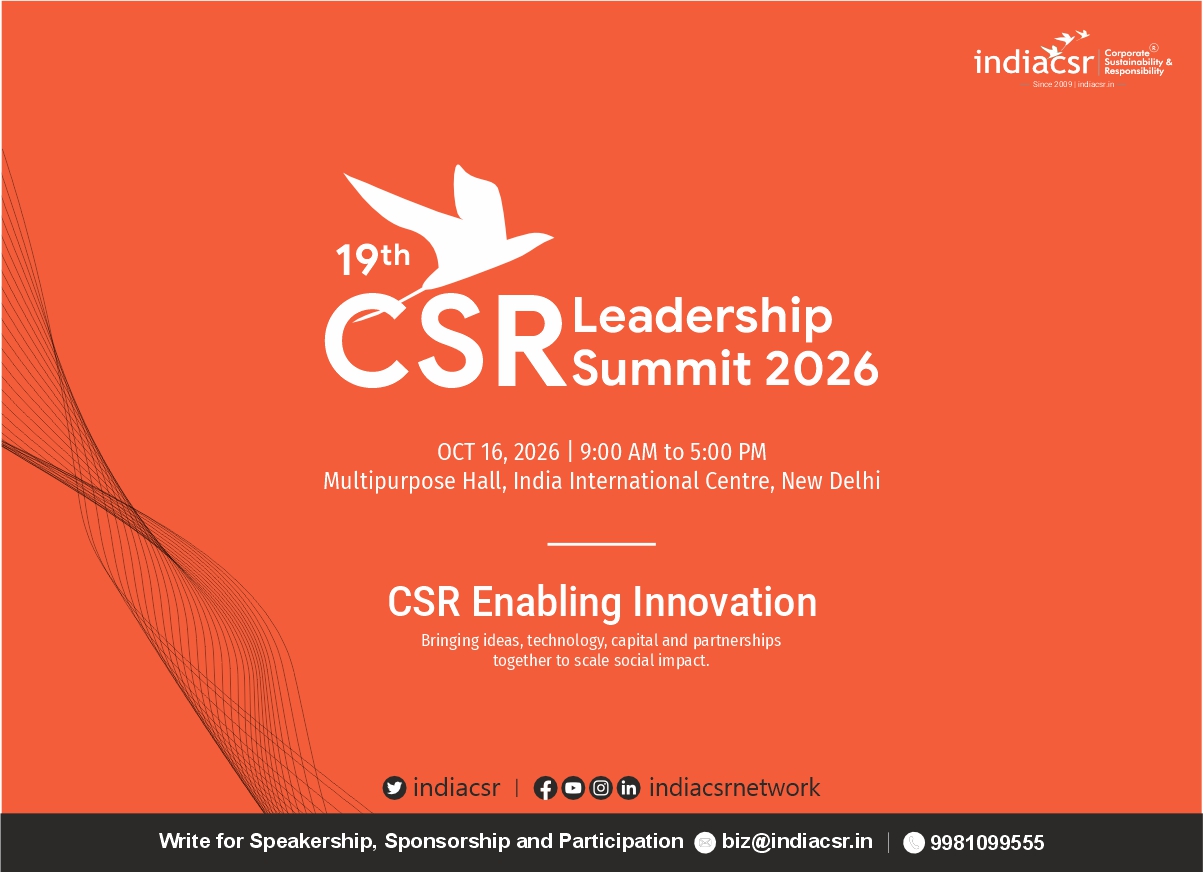
The session, moderated by Deepak Shetty, I.R.S. (Retd.), former Director General of Shipping, featured distinguished experts including Sofia Fürstenberg Stott, Founder & Partner, Fürstenberg Maritime Advisory; Nicole Van Sponson, Project Manager, MARIN; and Federico Carini, District Manager and Private Equity Consultant, BNP Paribas.
Sustainability and Profitability: Two Sides of the Same Coin
In his address, Dwivedi challenged the conventional notion that sustainability comes at the expense of profitability. Drawing from Essar Ports’ operational excellence, he argued that environmental responsibility can enhance business performance rather than hinder it.
“It’s not a trade-off when you go for sustainability; it’s a win-win,” he said.
He cited the example of Essar Ports’ fully mechanised coal terminal in Gujarat, located near a marine national park, which adopted a large-scale solar power initiative to reduce carbon emissions and energy dependency. The initiative successfully lowered the terminal’s power costs by one-third and achieved a payback period of just two years, underscoring the financial viability of sustainable business models.
ESG as an Integrated Framework for the Future
Dwivedi stressed that Environment, Social, and Governance (ESG) principles must be viewed as an integrated approach rather than isolated commitments.
He highlighted that while government regulations play a crucial role in setting sustainability benchmarks, industry-driven innovation and bottom-up initiatives are equally vital to realizing tangible outcomes.
“India’s corporate sector has a unique opportunity to align profit with purpose. ESG-led strategies are not only attracting responsible investments but are also reshaping how businesses compete globally,” he added.
Dwivedi also spoke about the growing importance of green financing mechanisms, which reduce the cost of capital for eco-friendly projects. These financial models, he said, are empowering companies to adopt cleaner technologies and meet global climate goals without compromising on economic growth.
Essar’s Commitment to Decarbonisation and Energy Transition
During the discussion, Dwivedi detailed Essar’s long-term decarbonisation roadmap, emphasizing its strategic green investments across India and the UK.
He highlighted two key initiatives:
- The development of a biorefinery in India, aimed at producing renewable fuels from biomass and reducing dependency on fossil-based energy.
- The creation of a hydrogen cluster in the United Kingdom, designed to advance clean hydrogen production and contribute to global efforts toward net-zero emissions.
“These projects reflect Essar’s commitment to sustainability-led innovation and its role in supporting India’s and the world’s energy transition,” he said.
Balancing Growth with Responsibility
On governance and social responsibility, Dwivedi underlined the importance of strong compliance systems, ethical corporate conduct, and meaningful community engagement.
He emphasized that true sustainability extends beyond environmental initiatives—it includes generating employment, uplifting communities, and maintaining transparency in all business dealings.
Calling for stronger environmental remediation policies in India, he remarked that industrial development must progress hand in hand with ecological preservation.
“True sustainability balances present needs with the long-term well-being of our planet,” he concluded.
Championing Responsible Maritime Leadership
By contributing to thought leadership forums such as the Maritime SheEO Conference, Essar Ports continues to position itself at the forefront of responsible maritime and infrastructure development. The company’s initiatives align with the United Nations Sustainable Development Goals (SDGs) and India’s Viksit Bharat 2047 vision for an inclusive and sustainable economy.
Through its focus on innovation, clean energy, and inclusive leadership, Essar Ports exemplifies how corporate India can drive transformation within one of the world’s oldest and most vital industries — the maritime sector.
(India CSR)