

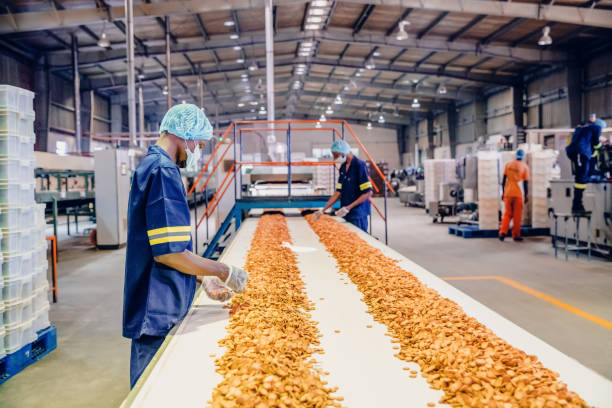



Many Indian biscuit makers now write about food waste in their CSR and sustainability reports, and many of them are also adding capacity. Those two plans meet on the factory floor. When a new line is signed off on how fast the moulder runs or how much the oven bakes, the report has no reliable way to show what share of dough ended up as saleable packets and what share became broken biscuits, rework or scrap.
This article explains where that measurement should sit. It uses the published selection approach of SINOFUDE, a Shanghai machinery maker with a baking division, and general process descriptions from Wikipedia. It does not quote market figures for India; the point is the method, which any plant can apply to its own numbers.
What a biscuit production line actually includes
Wikipedia describes a biscuit as a flour-based baked food that is usually hard, flat and unleavened. Its process notes show how different the routes are. Short doughs, a family that includes the Indian glucose biscuit, are mixed in two stages, rotary moulded, baked, cooled, stacked and packed. Cookie doughs are very soft and are often baked directly on a steel oven band. Cracker dough is laminated, sheeted and cut, then baked, sprayed with oil and cooled before packing. Semi-sweet doughs, used for biscuits such as Marie and Arrowroot, carry about 12% water, which baking reduces to 1.5–3%, while cracker doughs often hold between 15 and 25%.
A complete biscuit production line, on SINOFUDE’s description, runs from a raw-material interface through mixing, forming or depositing, baking, cooling and optional post-processing to a packaging interface. Every one of those stages can create waste. Only the last one shows how much of it there was.
Four line families, and why the product picks the route
SINOFUDE separates four line families: wafer, cupcake and Swiss roll, hard biscuit and cracker, and soft biscuit and cookie. Its reason is stated plainly on the page: wafers, cakes, hard biscuits, crackers, soft biscuits and cookies do not share the same material behaviour or forming route. Without formulation, forming, baking and pack-format context, a machine list is not a sound selection basis.
For a CSR team this matters more than it first appears. Plants that force two dough types through one compromise route usually lose more product at forming and baking than plants that run each dough on its own route. Start the expansion plan from the product list, not from the equipment brochure.
Rotary mold, wire-cut or deposit: the cookie production line question
Inside the soft biscuit and cookie family, the first engineering question is the forming method. SINOFUDE’s checklist asks buyers to identify rotary mold, wire-cut or deposit forming, to list planned formats and inclusions, and to define cleaning and changeover needs. Each method treats dough differently, which is why a cookie production line is specified around the dough rather than around a speed.
Rotary moulding presses dough into engraved cavities and suits firm, short doughs with a printed surface. Wire-cut and deposit forming handle softer doughs and inclusions such as nuts or chocolate pieces. Choose the forming method on sample trials with the plant’s own dough; a method that tears or misshapes pieces will report its losses only after the oven.
Where it stops: no forming method rescues a dough the plant cannot hold steady. If moisture and temperature drift across a shift, every route produces rejects, and the expansion should budget for dough control before extra forming speed.
Why forming or baking speed is the wrong acceptance point
One line on SINOFUDE’s page gives the rule: use qualified packed output as the acceptance point. Forming or baking speed is not a substitute for complete-line output. The proposal states the basis of its cited output by naming the allowable downstream lanes, the stated rejects and the allowed changeover periods.
Reference capacities need the same reading. On SINOFUDE’s reference list, the biscuit model is rated up to 1,500 kg/h, and the company says these references begin a discussion rather than guarantee packed saleable output. Its own note is direct: packaging can become the bottleneck even when the forming machine has spare capacity.
Accept a new line only on qualified packed output, measured over an agreed run with the plant’s own product. Oven speed belongs in the design file; packed output belongs in the contract.
What a CSR waste claim needs from the line
A waste-reduction claim is a comparison between two measured states, so the line has to produce the same measurement before and after the expansion. Qualified packed output gives that measurement. Dough mass in, packets out, and the rejects and changeover losses recorded in between: those three figures let a sustainability team show where the loss happened instead of estimating it.
The acceptance tests supply the evidence. On SINOFUDE’s page, the supplier-site factory acceptance test and the installed-site acceptance test are kept apart because they answer different questions, and the company’s project principle reads: “A good acceptance plan names the product, the conditions, the evidence and the sign-off criteria for each test.” Ask for reject counts and changeover times to be part of that evidence, so the first CSR baseline comes from a signed record rather than a spreadsheet estimate.
Keep the claim honest about scope. Measured at packed output, a line can prove less factory waste; it says nothing about what happens to biscuits after dispatch.
The ten-item project brief behind a comparable proposal
Comparing suppliers only works when every proposal answers the same questions. For that purpose SINOFUDE uses a ten-item project brief to turn an early enquiry into an engineering basis. Among its inputs:
- the finished product, sample or drawing, which fixes the line family and forming route;
- recipe and dough or batter behaviour, which sets the trial requirements;
- target qualified packed output, which sizes the equipment and downstream lanes;
- site layout, clear height and access, plus electricity, fuel, water and air data;
- contact materials, allergens and cleaning regime, which drive changeover rules.
Plant teams can see the full brief, the four families and the interface boundaries on SINOFUDE’s page for its biscuit production line range, and use the same headings to request proposals from any vendor.
Limits of one shared line, and when a second route costs less
Expansion plans often assume one new line will make every planned SKU. SINOFUDE’s page rejects that assumption: different dough or batter behaviour, forming paths, bake profiles, allergens and pack formats may justify a separate line or a staged investment. Shared equipment with allergen or cleaning limits tends to underestimate changeover time and cross-contact evidence.
From a waste point of view, every changeover is a loss window. If the product plan calls for frequent changes between incompatible doughs, a second route can cost less in scrap and cleaning than one overloaded line. Decide that before the order, not after the first quarterly report.
Lead time, training and the supplier’s quality system
Expansion timelines should start from the real build period. SINOFUDE states a production lead time of 120-150 days for biscuit lines, with the applicable schedule and its starting conditions confirmed in the quotation. Installation, commissioning and the baseline acceptance run come after that, so the CSR reporting year should be chosen with the full sequence in view.
Operator skill decides much of the reject rate in the first months. Free hands-on training in the SINOFUDE workshop is part of the offer, so a buyer’s team learns operation and maintenance before the line arrives. Send the people who will run the night shift, not only the managers.
On the supplier side, SINOFUDE has worked under the ISO 9001 quality management system since 2004. That certifies how the company manages quality, not the waste performance of any single line, which is exactly why the packed-output acceptance record still matters.
Measure the line where the product leaves it, and the waste claim in the report will stand on the same number the plant already signs.