

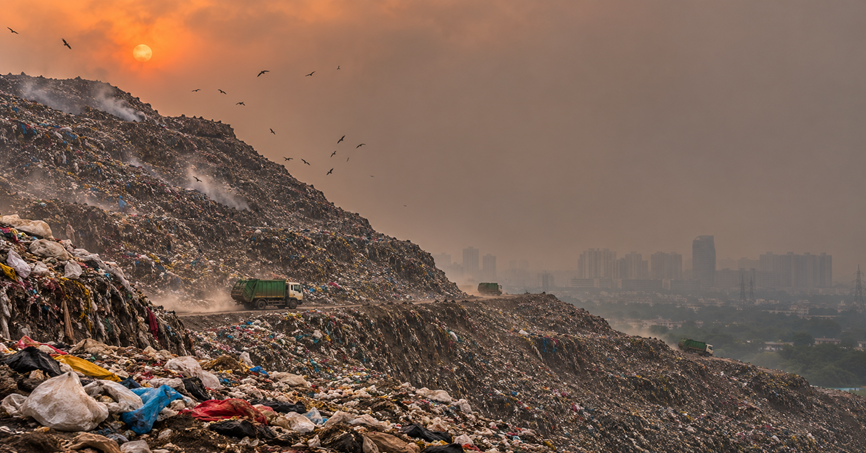



When waste is outsourced, deadlines become optional and the only power the tribunal holds is the power to fine — the heaps keep growing
By Sujay N Jha
On 17 October the Municipal Corporation of Delhi (MCD) moved the clearance date for the Bhalswa landfill for the sixth time, to February 2027. Officials blamed the transfer of the job from one contractor to another. Two months earlier, in an affidavit to the National Green Tribunal (NGT), the Municipal Corporation of Gurugram (MCG) said 17.2 lakh tonnes of waste still waited to be processed at the Bandhwari landfill and asked for more time to name a deadline. These are the two largest rubbish problems in the capital region. Both are, formally, under judicial supervision. Both are being run through private contractors. Neither is getting smaller at the speed anyone has promised.
This investigation examines the sharpest failure in the capital region, where the problem has been litigated for years. It asks three questions: how big are the heaps now, what has the tribunal achieved, and why do contractors keep failing?
Delhi: the arithmetic of a mountain
Delhi generates roughly 11,900 tonnes of waste a day. The CPCB told the NGT the city processes 64.2% of it; the rest goes to the Bhalswa and Ghazipur dumps. The three old landfills (Ghazipur, Bhalswa and Okhla) held an estimated 28m tonnes of legacy waste in 2019. By the MCD’s latest figures, about 22.3m tonnes have been processed since biomining began and about 8.1m tonnes remain. The two numbers add up to more than the 2019 estimate (about 30.4m tonnes) because dumping never stopped.
Chart 1: Delhi’s three landfills — legacy waste processed vs remaining (lakh tonnes)
Ghazipur is where the work is least advanced: nearly 6 in 10 tonnes remain
| Site | Processed | Remaining | % left |
|---|---|---|---|
| Ghazipur | 45.8 | 63.4 | 58% |
| Bhalswa | 104.4 | 10.8 | 9% |
| Okhla | 72.5 | 7.3 | 9% |
Source: MCD figures reported by PTI via ThePrint, 17 October 2026. 1 lakh tonnes = 0.1m tonnes.
Bhalswa is nearly done, Okhla is close, and Ghazipur has more than 6m tonnes to go. The MCD says it will clear Okhla by December 2026 and Ghazipur by December 2027. But the older promises tell a different story. In March 2023 Delhi’s finance minister said Okhla would be cleared by December 2023, Bhalswa by March 2024 and Ghazipur by December 2024. None happened. Ghazipur’s date was then pushed to 2026, and later to 2028, before the current December 2027 target.
Table 1: How Delhi’s clearance dates moved
| Site | Promised in 2023 | Slipped to | Now |
|---|---|---|---|
| Okhla | Dec 2023 | Dec 2026 (revised) | 7.27 lakh t left; 72.5 lakh t processed |
| Bhalswa | Mar 2024 | Feb 2027 (sixth extension, Oct 2026) | 10.77 lakh t left; contractor changed |
| Ghazipur | Dec 2024 | 2026, then 2028, then Dec 2027 | 63.4 lakh t left; processing ~7,000 t/day vs 12,000 target |
Sources: The Wire (2023 promises); ThePrint/PTI (Oct 2026 figures); NewKerala report on minister’s Ghazipur review (June 2026).
Ghazipur illustrates the core problem. A first biomining contract (November 2022 to November 2024) targeted 30 lakh tonnes, and the MCD told the tribunal it processed only 13.9 lakh by December 2024. A second contract, awarded in March 2025, was to finish by September 2026; the city’s minister said in June that about 24 lakh tonnes had been done under it, at roughly 7,000 tonnes a day, and ordered the contractor to raise that to 12,000 a day. A drone survey in April 2026 put the site at 67.8 lakh tonnes. The minister named the two bottlenecks himself: fresh waste keeps arriving on top of the old, and there is nowhere to put the inert material that biomining produces. The MCD’s affidavit says Ghazipur’s own waste-to-energy plant, designed for 1,300 tonnes a day, had been taking about 900 after a maintenance shutdown in late 2025.
Gurugram: a landfill that grew back
Bandhwari takes the waste of Gurugram and Faridabad, about 2,000–2,300 tonnes a day, in a forested stretch of the Aravallis. The NGT’s joint committee measured 33 lakh tonnes of legacy waste and a pile 38 metres high in 2022; newspapers have reported heights of 42–45 metres. Since then the site has been remediated and refilled in turns. At one point the remaining stock fell to 9.6 lakh tonnes (August 2024). By August 2026 MCG reported 17.2 lakh tonnes awaiting processing, after agencies processed only 3.6 lakh tonnes in the first eight months of the year.
Chart 2: Bandhwari — waste awaiting processing (lakh tonnes)
The stock fell to under a third, then rose again as contractors fell short and fresh waste kept arriving
| Date | Waste awaiting (lakh t) |
|---|---|
| Jul 2022 (NGT committee) | 33.0 |
| Jan 2023 (assessed) | 30.4 |
| 31 Mar 2024 | 16.4 |
| 31 Aug 2024 | 9.6 |
| 16 Aug 2026 (MCG affidavit) | 17.2 |
Sources: NGT joint committee and Tribune reports (2022–2024); MCG affidavit as reported by Gurugram News Desk (Aug 2026). The series mixes “legacy waste” and “waste awaiting processing”, so successive points are not strictly comparable.
The 2026 pace explains the problem. MCG appointed two agencies in January to process 14 lakh tonnes at 80,000 to 1 lakh tonnes a month, finishing by February 2028. At the observed 3.6 lakh tonnes in eight months (about 45,000 a month), the 17.2 lakh tonnes would take roughly three more years, even if no fresh waste arrived. MCG itself expects 3.25 lakh tonnes of fresh waste before an alternative facility opens, and says about 7.2 lakh tonnes may remain by March 2027 because current contracts do not cover the whole stock.
The tribunal: long arm, short reach
The NGT has been the most persistent actor in both stories. It has measured, fined, set deadlines and threatened salaries. What it has not been able to do is make anything happen faster than a contractor can dig.
Table 2: The NGT’s interventions, Delhi and Bandhwari
| When | Order or event | Result |
|---|---|---|
| Aug 2018 | Penalty on Ecogreen, Gurugram’s concessionaire, for environmental damage at Bandhwari | Concessionaire fined; plant never built |
| Nov 2019 | Delhi told to plan clearance of 28m t within a year; ~1,500 t/day biomined vs 5,000+ t/day added | Biomining started; fresh dumping continued |
| 2019 | Bandhwari: test groundwater; clear about 2.5m t; deposit Rs 20 crore | Partial compliance |
| Nov 2021 | Gurugram to clear 25 lakh t in six months or officials forgo salaries; Rs 25 lakh guarantee | Deadline missed |
| Jul 2022 | Deadline to treat all 33 lakh t at Bandhwari passes | Missed |
| Sep 2022 | Rs 100 crore environmental compensation on Haryana | Dumping continues |
| Oct 2022 | Rs 900 crore on Delhi (Rs 300 per tonne on 3 crore t); only ~21% of legacy waste processed | Review petitions filed; NGT noted in Feb 2023 it had not been paid |
| Oct 2022 | Joint committee bars further dumping at Bandhwari; alternative sites to be found | Dumping continued at 2,000+ t/day |
| Feb 2023 | Further Rs 2,232 crore on Delhi for solid and liquid waste; land-use model: a third forest, a third waste infrastructure, a third monetised | MCD says it will use the model for reclaimed land |
| 2024–26 | Ghazipur fire case (OA 481 of 2024); April 2026 order for a time-bound plan; July 2026: how will 69 lakh t be cleared while untreated waste arrives? | Plans and status reports |
Sources: DownToEarth, Tribune, The Week, PTI/National Herald, NGT filings. Dates are of the orders as reported.
Fines are not the same as fixes. In February 2023 the NGT noted that Delhi’s Rs 900 crore had not been paid, because review petitions were pending. Haryana’s Rs 100 crore was ordered in 2022, yet in 2024–26 MCG was still filing affidavits seeking more time. The pollution board also levies Rs 10 lakh a month on MCG for the Bandhwari site since April 2020, about Rs 6.3 crore in total, and prosecutions are pending in an environmental court. The Punjab and Haryana High Court and the state human-rights commission have also taken up the matter. Many bodies are involved; none controls the contractor.
The contractors: paid, fined, replaced
Ecogreen. In August 2017 the two municipal corporations and the state signed a 22-year concession, worth roughly Rs 330 crore, with Ecogreen Energy for Gurugram and Faridabad. It was to collect, segregate and process all of both cities’ waste, so that no more than 20% (inert residue) reached the landfill, and to build a waste-to-energy plant. A Chinese waste-to-energy group had bought the company in March 2017. According to an investigation by Newslaundry, door-to-door collection was 35% a year in; the corporation issued 43 notices and Rs 6.33 crore in fines between late 2017 and August 2018; some 2,200 tonnes a day were still going to Bandhwari in 2022; and the plant, whose foundation stone was laid twice (2018 and 2021), was never built. Gurugram’s authorities paid the company Rs 157 crore before terminating it in August 2024, while penalties came to Rs 11.46 crore. The Chinese parent sold its stake for Rs 1 crore in June 2024, after investing about Rs 428 crore. Newslaundry also reported that large sums went to related parties; it said it found no evidence of impropriety in how the contracts were awarded and the promoters had not responded when it published.
Ecogreen’s side. The company fought back. It challenged the corporation’s termination notice in the Punjab and Haryana High Court, which stayed it; the court later found lapses in the notice, the corporation withdrew it and issued a fresh one. The firm argued it was battling a “mafia” that controlled collection, that payments were paltry and that facilities it needed were unavailable. Insolvency-board order listings indicate that an insolvency case against its Gurgaon-Faridabad arm was admitted in March 2023, with a withdrawal under section 12A in April; the details were not available. Both sides can be partly right: the concession was badly designed and badly performed.
The replacements. When Ecogreen collapsed, Haryana hired nine firms on Rs 532 crore of tenders to dig out the legacy waste. Six were penalised for missed deadlines, paying about Rs 20 crore in fines against Rs 311.5 crore already paid, according to Newslaundry. Two were blacklisted in July 2025 (the Tribune reported two-year bans and Rs 9.02 crore in fines); by January 2026 one had been taken off the list on technical grounds. Two of the contractors asked MCG to dump fresh waste in separate pockets of the landfill so that it would not hinder the clearing of legacy waste, a reminder that processing old waste while dumping new waste on it is physically contradictory. A fresh Rs 600 crore tender is out.
Chart 3: Gurugram’s contractor bills vs penalties (Rs crore)
Penalties run at roughly 7% of payments for Ecogreen and 6% for the nine replacements
| Paid | Penalties | |
|---|---|---|
| Ecogreen | Rs 157 crore | Rs 11.46 crore |
| Nine replacement firms | Rs 311.5 crore | ~ Rs 20 crore |
Source: Newslaundry investigation, 21 August 2026, citing company filings, the Haryana assembly and municipal records. Penalty total for the nine firms is approximate. Allegations are as reported; the companies named had not responded at publication.
Delhi’s contractors. The pattern repeats on a larger scale. Ghazipur’s first biomining contract achieved under half its target; Bhalswa’s work was transferred to a new contractor, the previous one having been assigned about 30 lakh tonnes, and officials blamed that transfer for the sixth extension. A previous Delhi minister warned the Ghazipur contractor of penalties if it missed an 8,000-tonne daily target; this June the current minister raised the target to 12,000. Whatever the payment terms, the tonnage that matters is the net fall in the heap, and that is blurred when fresh waste is added to the same site.
Health and damage: what the evidence shows
Neither region has a population-level epidemiological study linking specific illnesses to the landfills, and the sources below should be read as indicators, not proof of the scale of harm. They are nonetheless consistent.
Table 3: Health and environmental evidence
| Evidence | What it reports | Limits |
|---|---|---|
| CSE study of Bandhwari leachate (2022) | Lead and zinc above safe limits; faecal coliform; leachate pollutant load about 100 times urban wastewater | Site samples; not health outcomes |
| Bandhwari villagers (Newslaundry, 2026) | Residents buy filtered water; livestock drink groundwater; parents report sick children | Anecdotal |
| Bhalswa survey (Hazard Centre and residents’ group) | About 79% of residents reported gastro-intestinal, skin, eye or respiratory illness; groundwater solids above BIS limit | NGO survey, date not stated |
| Ghazipur clinician and study (AFP, 2019) | A local doctor saw about 70 patients a day, mostly respiratory and stomach complaints; a study cited a health risk, including cancer, within 5 km | Study not identified; 2019 |
| NGT observation (2019) | Groundwater near the Delhi dumps turning “yellow and orange” and reaching the Yamuna | Tribunal observation |
| Fires and methane | Frequent summer fires at Ghazipur (Apr 2024 fire is the subject of OA 481 of 2024); landfills are a major methane source | No continuous monitoring data |
| Damage assessment (NEERI, CPCB, IIT Delhi) | Environmental damage valued at Rs 155.9 crore (Bhalswa), 151.1 (Okhla), 142.5 (Ghazipur) | Economic estimate, not health |
Chart 4: How high the heaps got (metres)
Delhi’s two oldest landfills approached the height of the Qutub Minar
| Site | Height |
|---|---|
| Ghazipur (Oct 2022) | 65 m |
| Bhalswa (Oct 2022) | 62 m |
| Okhla (Oct 2022) | 42 m |
| Bandhwari (NGT cttee) | 38 m (press: 42–45 m) |
| Qutub Minar (reference) | ~73 m |
Sources: MCD via Question of Cities (Delhi, Oct 2022); NGT joint committee via Newslaundry (Bandhwari); Qutub Minar height is a general reference. Heights have changed since with biomining.
What the capital region teaches
- Stop adding fresh waste to the old heap. Both Delhi’s minister and Gurugram’s commissioner concede that fresh waste is the main bottleneck.
- Pay for net reduction. A contract measured in tonnes moved can be met while the heap stays the same size.
- Do not let a concessionaire take the integrated risk. Ecogreen was to collect, segregate, process and build a plant; when it failed, everything failed at once.
- Fines need collectors. Rs 900 crore unpaid is a headline, not a remedy.
- Measure health. Neither region has done the epidemiology that would turn local complaints into evidence and shift priorities.
- Align the owners. Delhi’s government and its municipal corporation, and Haryana’s state and its two city corporations, are in a permanent argument over who pays and who clears.
Verdict
In Delhi, biomining has moved real tonnage: more than 22m tonnes processed across three sites, and Bhalswa and Okhla are close to finished. In Gurugram, a concession that took Rs 157 crore of public money and built no plant has been followed by a contract carousel that has left more waste on site than two years ago. In both, the tribunal has been right about the facts and unable to enforce the remedy. The most telling numbers are the simplest. At Bandhwari, agencies cleared about 1,600 tonnes a day in 2026 (3.6 lakh tonnes in eight months) while some 2,000 tonnes of fresh waste arrived. At Ghazipur, of 3.39 lakh tonnes processed between 30 April and 25 June, the heap fell by only 1.13 lakh tonnes, implying that the rest was offset by new additions.
Notes on data. Figures are as reported by municipal bodies, the NGT, state governments or the press and are not independently audited. Allegations about Ecogreen and related-party payments are Newslaundry’s reporting and are attributed as such; Ecogreen and the promoters had not responded when it was published, and the company disputed the termination in court. The Bandhwari series mixes legacy waste and total waste awaiting processing. Heights are 2022 figures. No epidemiological study tying illness to these dumps was found. This is analysis from public sources.



