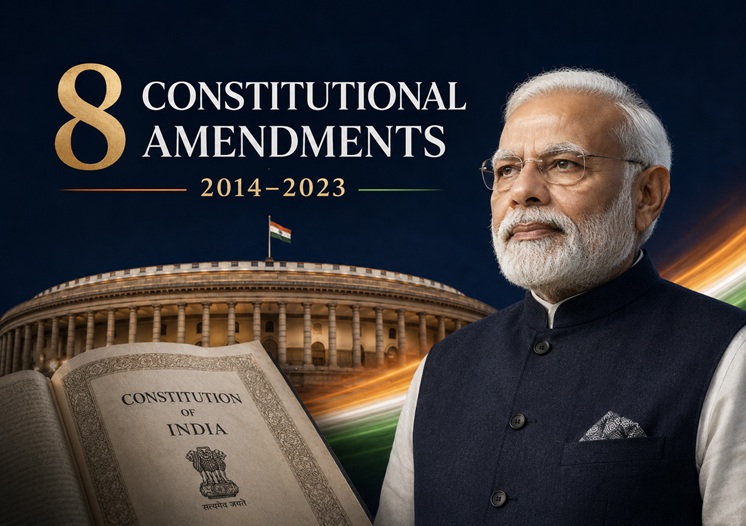



Landmark changes introduced judicial appointments reform, GST, EWS reservation, constitutional status for the NCBC and women’s political representation.
NEW DELHI (India CSR Global): Eight amendments to the Constitution of India were enacted between 2014 and 2023 under governments led by Prime Minister Narendra Modi, the Union government has informed Parliament. Union Minister of Law and Justice Arjun Ram Meghwal provided the information in a written reply to the Lok Sabha. The amendments covered taxation, judicial appointments, international boundaries, affirmative action, backward-class governance and political representation.
The legislative record spans the first and second terms of the Modi government. Five amendments were enacted during Modi Government 1.0, while three were passed during Modi Government 2.0. No further constitutional amendment was listed as enacted during the third term up to the date of the parliamentary reply.

Amendment Timeline
| Amendment | Presidential Assent | Government Term | Principal Purpose |
|---|---|---|---|
| 99th Amendment | December 31, 2014 | Modi 1.0 | Established the National Judicial Appointments Commission |
| 100th Amendment | May 28, 2015 | Modi 1.0 | Implemented the India–Bangladesh Land Boundary Agreement |
| 101st Amendment | September 8, 2016 | Modi 1.0 | Created the constitutional framework for Goods and Services Tax |
| 102nd Amendment | August 11, 2018 | Modi 1.0 | Granted constitutional status to the National Commission for Backward Classes |
| 103rd Amendment | January 12, 2019 | Modi 1.0 | Enabled 10% reservation for Economically Weaker Sections |
| 104th Amendment | January 21, 2020 | Modi 2.0 | Extended legislative reservation for SCs and STs until January 25, 2030 |
| 105th Amendment | August 18, 2021 | Modi 2.0 | Restored states’ authority to identify socially and educationally backward classes |
| 106th Amendment | September 28, 2023 | Modi 2.0 | Provided one-third reservation for women in legislatures |
The Modi government enacted eight constitutional amendments between 2014 and 2023, covering GST, reservations, judicial appointments and women’s representation.
Judicial Appointments
The 99th Amendment sought to replace the collegium system of appointing judges with the National Judicial Appointments Commission. The proposed commission was intended to participate in appointments and transfers involving judges of the Supreme Court and High Courts.
However, the Supreme Court struck down the amendment and the accompanying NJAC Act in October 2015. The collegium system consequently remained operational. This makes the amendment constitutionally significant despite its subsequent invalidation.
Border Settlement
The 100th Amendment gave legal effect to the historic Land Boundary Agreement between India and Bangladesh. It enabled the exchange of territorial enclaves and the settlement of a long-standing boundary issue between the two neighbouring countries.
The measure attracted international attention because it resolved questions concerning citizenship, public services and administrative control for thousands of enclave residents.
Unified Taxation
The 101st Amendment introduced the constitutional foundation for the Goods and Services Tax. GST replaced several central and state indirect taxes with a unified national taxation framework.
The amendment also established the GST Council, where the Union and state governments jointly consider tax rates and policy matters. GST was implemented nationwide on July 1, 2017.
Backward Classes
The 102nd Amendment granted constitutional status to the National Commission for Backward Classes. It inserted Article 338B, dealing with the commission, and Article 342A, relating to socially and educationally backward classes.
The 105th Amendment later clarified the division of powers following judicial interpretation of the earlier measure. It restored the authority of states and Union Territories to prepare and maintain their own lists of socially and educationally backward classes.
Economic Reservation
The 103rd Amendment enabled the introduction of up to 10% reservation for Economically Weaker Sections in educational institutions and public employment.
The provision applies to economically disadvantaged citizens who are not covered by the existing reservation categories for Scheduled Castes, Scheduled Tribes and Other Backward Classes. The Supreme Court upheld the constitutional validity of the amendment in November 2022.
Legislative Representation
The 104th Amendment extended the reservation of Lok Sabha and state legislative assembly seats for Scheduled Castes and Scheduled Tribes for another decade, until January 25, 2030.
It did not continue the earlier provision allowing nominated representation for the Anglo-Indian community in the Lok Sabha and state assemblies.
The 106th Amendment, popularly associated with the women’s reservation law, provided for one-third reservation for women in the Lok Sabha, state legislative assemblies and the Delhi Legislative Assembly.
The reservation includes one-third of seats already reserved for women belonging to Scheduled Castes and Scheduled Tribes. Its implementation is linked to a future delimitation exercise conducted after publication of the relevant census figures, according to the official Gazette text.
Modi Government Record
Narendra Modi assumed office as Prime Minister on May 26, 2014. His first government enacted five of the eight amendments, including the GST and EWS reservation measures. His second government enacted the remaining three, culminating in the women’s reservation amendment in September 2023.
The parliamentary disclosure presents the eight enactments as the complete set of constitutional amendments passed during the stated 12-year period. The official collection is maintained by the Union Law Ministry’s Legislative Department.
Source: Written reply by Union Minister of Law and Justice Arjun Ram Meghwal in the Lok Sabha; PIB Delhi, July 25, 2026.