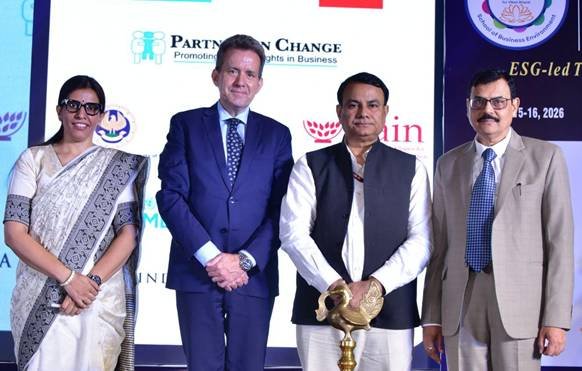


NCRBC 2026, organised by IICA in New Delhi, highlighted responsible business conduct, credible ESG disclosures and strong governance as drivers of India’s competitiveness.
NEW DELHI (India CSR): India’s transition towards responsible and sustainable economic growth took centre stage at the fourth National Conference on Responsible Business Conduct (NCRBC) 2026, organised by the Indian Institute of Corporate Affairs (IICA) under the Ministry of Corporate Affairs (MCA), Govt of India. Held under the theme “ESG-led Transformation for Viksit Bharat,” the conference highlighted credible disclosures, strong governance and responsible business practices as critical drivers of competitiveness, investor trust and India’s development ambitions for 2047.

Responsible Business Imperative: Nitin Gupta
Delivering the Special Address, Nitin Gupta, Chairperson, National Financial Reporting Authority (NFRA), emphasised that Responsible Business Conduct is integral to the vision of Viksit Bharat and to fostering competitive enterprises, trusted markets, inclusive growth and environmental sustainability.
“Responsible Business Conduct is integral to Viksit Bharat and essential for building competitive enterprises, trusted markets, inclusive growth and environmental sustainability.” — Nitin Gupta, Chairperson, National Financial Reporting Authority
Credible Disclosures Matter
Shri Gupta observed that India has made significant progress in strengthening sustainability disclosures and must now focus on enhancing their quality, reliability and decision usefulness. He emphasised that sustainability information should be relevant, comparable, evidence-based and verifiable, supported by robust methodologies, reliable source systems and effective internal controls. Highlighting the growing importance of credible sustainability reporting, Gupta stated that sustainability information must be subjected to the same discipline and rigour that underpin financial reporting and audit. He stressed that the principles of documentation, traceability, reconciliation, control ownership, evidence retention, professional scepticism and independent examination are equally essential for ensuring the credibility of sustainability disclosures.
“Sustainability information must follow the same discipline and rigour that underpin financial reporting and audit.”
— Nitin Gupta, Chairperson, National Financial Reporting Authority
Governance Before Assurance
He further emphasised that sound governance must precede assurance. Boards, Audit Committees, management and finance functions, he said, have a critical responsibility to ensure that sustainability disclosures are firmly aligned with organisational policies, investments, risk management processes and actual performance outcomes. Gupta also underscored the need to adopt a proportionate and pragmatic approach to sustainability reporting while leveraging technology and strengthening institutional capacities, particularly across value chains and among MSMEs. He noted that credible, decision-useful sustainability information would enhance investor confidence, facilitate improved access to capital, strengthen the global competitiveness of Indian enterprises and contribute meaningfully to India’s sustainable development journey and the vision of Viksit Bharat.

ESG Beyond Compliance: Gyaneshwar Kumar Singh
Delivering the Welcome Address, Gyaneshwar Kumar Singh, Director General and CEO, Indian Institute of Corporate Affairs (IICA), stated that India’s aspiration of becoming a USD 30 trillion economy by 2047 requires Environmental, Social and Governance (ESG) principles to move beyond regulatory compliance and become an integral part of the country’s economic development model.
India’s Policy Evolution
Singh emphasised that Responsible Business Conduct is deeply rooted in India’s civilisational ethos and has evolved through progressive policy and regulatory reforms. Referring to the evolution of the country’s responsible business framework, he highlighted the journey from the Voluntary Guidelines on Corporate Social Responsibility issued in 2009 to the introduction of the mandatory Business Responsibility and Sustainability Reporting (BRSR) framework in 2021.
He further noted that Section 166(2) of the Companies Act, 2013 had incorporated the principle of stakeholder primacy into Indian corporate law well before it gained wider global recognition, reflecting India’s early commitment to integrating sustainability with corporate governance.
“ESG must move beyond regulatory compliance and become an integral part of India’s economic development model.” — Gyaneshwar Kumar Singh, Director General and CEO, Indian Institute of Corporate Affairs
Advancing ESG Transformation
Describing India’s evolving sustainability landscape as a transition from “ESG 1.0” to “ESG 2.0”, Singh observed that ESG is no longer confined to regulatory compliance but is emerging as a strategic driver of long-term enterprise value, effective risk management and business resilience. He stressed that this transition calls for stronger legal, governance and accountability frameworks to ensure that sustainability commitments are credible, enforceable and aligned with fiduciary responsibilities.
Outlining the priorities for the next phase of India’s ESG journey, Singh emphasised the need to integrate sustainability considerations into board-level decision-making, strengthen legal and regulatory frameworks for sustainability data assurance to address the risks of greenwashing, and leverage emerging technologies, including Artificial Intelligence, to enhance the quality, traceability and transparency of sustainability data across value chains.
Singh stated that robust governance frameworks, credible disclosures and effective assurance mechanisms would be critical to strengthening investor confidence, enhancing the global competitiveness of Indian enterprises and ensuring that ESG contributes meaningfully to India’s long-term economic growth and the vision of Viksit Bharat 2047.
Children In Business: Jesper Moller
In a special address, Jesper Moller, Deputy Representative (Programmes), UNICEF India, said child rights must be integrated into core business strategy rather than treated as a philanthropic concern, noting that India is home to over 400 million children who represent its future workforce and consumers. He illustrated how decisions such as maternity leave, workplace crèches and responsible supply chain practices directly affect children’s wellbeing, citing the example of a young mother at a tea estate in Assam whose employer’s family-friendly policies improved both her child’s care and the company’s employee retention.
“Child rights must be integrated into core business strategy rather than treated merely as a philanthropic concern.” — Jesper Moller, Deputy Representative (Programmes), UNICEF India
Purpose Driven Careers: Helen Brand
In a further special address delivered virtually, Helen Brand, Chief Executive, ACCA (Association of Chartered Certified Accountants), reaffirmed ACCA’s partnership with IICA on sustainable business practices, describing India’s economy as a “rocket ship bound to the moon” given its rapid growth and rising global influence. Citing ACCA’s Global Talent Trends Report 2026, she noted that a growing majority of finance professionals worldwide now want careers that make a positive social impact, and that an employer’s reputation on social and human rights issues is an increasingly important factor where professionals choose to work.
Sustainability Enables Growth: Garima Dadhich
Delivering the concluding address of the inaugural session, Professor Garima Dadhich, Head, School of Business Environment, Indian Institute of Corporate Affairs, described responsible business conduct as essential to Viksit Bharat and called for sustainability to be viewed as a foundation for growth rather than a compliance exercise. She outlined three guiding philosophies for the conference, generational responsibility, cultural anchoring in the Rig Vedic call for collective action, “Sangachhadhwam Samvadadhwam Sam Vo Manamsi Janatam,” and alignment with India’s G20 vision of “One Earth, One Family, One Future,” and noted that this year’s deliberations are anchored in the Union Budget 2026–27 that has placed green growth, climate transition and sustainable infrastructure at the very centre of the nation’s fiscal priorities. The Parliamentary Standing Committee on Finance has also called for stronger ESG frameworks, sharper disclosures and more rigorous impact assessments.
“Responsible business conduct is essential to Viksit Bharat, and sustainability must be viewed as a foundation for growth rather than a compliance exercise.” — Professor Garima Dadhich, Head, School of Business Environment, Indian Institute of Corporate Affairs
Board Governance Dialogue
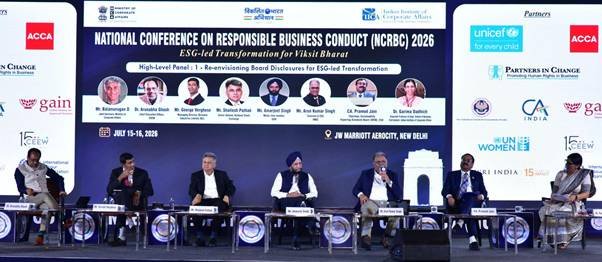
Following the inaugural session, a High-Level Panel I on “ESG, Governance and Board-Level Disclosures,” moderated by Professor Garima Dadhich, brought together regulators and industry leaders to examine how responsible business conduct can be embedded into corporate governance. Amarjeet Singh, Whole-Time Member, Securities and Exchange Board of India (SEBI), cautioned against rushing to converge with global standards, saying India should chart its own glide path suited to its stage of development rather than align hastily with international frameworks.
Arun Kumar Singh, Chairman, Oil and Natural Gas Corporation (ONGC), said over-promising and under-delivering is “far better” than under-promising, and called on regulators to reward companies for ambition and intent rather than penalise them for falling short. Intent and trust play the key role in governance. Dr. Arunabha Ghosh, Chief Executive Officer, CEEW (Council on Energy, Environment and Water), said ESG is too often treated as a “headache” rather than an opportunity, pointing to an estimated USD 4 trillion investment opportunity in India’s green economy.
Shailesh Pathak, Senior Advisor, National Stock Exchange (NSE), said capital “goes to where it sees opportunity, but stays where it has trust,” describing the Social Stock Exchange as a transparent bridge between capital and social enterprises. George Varghese, Managing Director, Kirloskar Industries Limited (KIL), recounted how tighter emission norms, initially seen as a cost burden, ultimately opened up international markets for his company’s products.
CA Pramod Jain, Chairman, Sustainability Reporting Standards Board (SRSB), Institute of Chartered Accountants of India (ICAI), said India has become one of the first countries to make ESG assurance mandatory rather than voluntary, lending board disclosures the same credibility as financial statements. The panel was duly moderated by Prof. Garima Dadhich, Head School of Business Environment, IICA.
Conference Momentum Builds
With the substantive participation of more than 350 senior corporate leaders, ESG professionals, policymakers, and international delegates, and thought-provoking deliberations led by eminent speakers, the first day of NCRBC 2026 laid a strong foundation for the sessions to follow. The second day will feature further High-Level Panels on sector-specific guidelines for strengthening ESG integration, responsible value chains across global and domestic supply networks, mainstreaming ESG in MSMEs for competitive and inclusive growth, strengthening sectoral ESG adoption beyond BRSR, and reenvisioning environmental metrics in ESG reporting frameworks, concluding with a valedictory session.
Therefore, with an elaborate two-day agenda, IICA’s NCRBC 2026, held with support from the partner organisations UNICEF, Partners in Change and ACCA (Association of Chartered Certified Accountants) as Lead Partners, the Institute of Chartered Accountants of India (ICAI) and the Global Alliance for Improved Nutrition (GAIN) as Associate Partners, and UN Women, CEEW (Council on Energy, Environment and Water), WRI India and the International Labour Organisation (ILO) as Session Partners, aims to position responsible business conduct as integral to India’s journey toward becoming a developed, inclusive and ethically grounded nation by 2047.
(India CSR)