• India CSR Awards 2026
  • India CSR Leadership Summit
  • Guest Posts
Saturday, September 12, 2026
India CSR
  • Home
  • Corporate Social Responsibility
    • Art & Culture
    • CSR Leaders
    • Child Rights
    • Culture
    • Education
    • Gender Equality
    • Around the World
    • Skill Development
    • Safety
    • Covid-19
    • Safe Food For All
  • Sustainability
    • Sustainability Dialogues
    • Sustainability Knowledge Series
    • Plastics
    • Sustainable Development Goals
    • ESG
    • Circular Economy
    • BRSR
  • Corporate Governance
    • Diversity & Inclusion
  • Interviews
  • SDGs
    • No Poverty
    • Zero Hunger
    • Good Health & Well-Being
    • Quality Education
    • Gender Equality
    • Clean Water & Sanitation – SDG 6
    • Affordable & Clean Energy
    • Decent Work & Economic Growth
    • Industry, Innovation & Infrastructure
    • Reduced Inequalities
    • Sustainable Cities & Communities
    • Responsible Consumption & Production
    • Climate Action
    • Life Below Water
    • Life on Land
    • Peace, Justice & Strong Institutions
    • Partnerships for the Goals
  • Articles
  • Events
  • हिंदी
  • More
    • Business
    • Finance
    • Environment
    • Economy
    • Health
    • Around the World
    • Social Sector Leaders
    • Social Entrepreneurship
    • Trending News
      • Important Days
        • Festivals
      • Great People
      • Product Review
      • International
      • Sports
      • Entertainment
    • Case Studies
    • Philanthropy
    • Biography
    • Technology
    • Lifestyle
    • Sports
    • Gaming
    • Knowledge
    • Home Improvement
    • Words Power
    • Chief Ministers
No Result
View All Result
  • Home
  • Corporate Social Responsibility
    • Art & Culture
    • CSR Leaders
    • Child Rights
    • Culture
    • Education
    • Gender Equality
    • Around the World
    • Skill Development
    • Safety
    • Covid-19
    • Safe Food For All
  • Sustainability
    • Sustainability Dialogues
    • Sustainability Knowledge Series
    • Plastics
    • Sustainable Development Goals
    • ESG
    • Circular Economy
    • BRSR
  • Corporate Governance
    • Diversity & Inclusion
  • Interviews
  • SDGs
    • No Poverty
    • Zero Hunger
    • Good Health & Well-Being
    • Quality Education
    • Gender Equality
    • Clean Water & Sanitation – SDG 6
    • Affordable & Clean Energy
    • Decent Work & Economic Growth
    • Industry, Innovation & Infrastructure
    • Reduced Inequalities
    • Sustainable Cities & Communities
    • Responsible Consumption & Production
    • Climate Action
    • Life Below Water
    • Life on Land
    • Peace, Justice & Strong Institutions
    • Partnerships for the Goals
  • Articles
  • Events
  • हिंदी
  • More
    • Business
    • Finance
    • Environment
    • Economy
    • Health
    • Around the World
    • Social Sector Leaders
    • Social Entrepreneurship
    • Trending News
      • Important Days
        • Festivals
      • Great People
      • Product Review
      • International
      • Sports
      • Entertainment
    • Case Studies
    • Philanthropy
    • Biography
    • Technology
    • Lifestyle
    • Sports
    • Gaming
    • Knowledge
    • Home Improvement
    • Words Power
    • Chief Ministers
No Result
View All Result
India CSR
No Result
View All Result
Home Articles

When Systems Scale, People Strain

Rethinking Platform Economy, Livelihoods and Responsible Design

India CSR by India CSR
July 2, 2026
in Articles
Reading Time: 5 mins read
When Systems Scale, People Strain

When Systems Scale, People Strain

Share Share Share Share
WhatsApp icon
WhatsApp — Join Us
Instant updates & community
Google News icon
Google News — Follow Us
Get our articles in Google News feed
india csr awards
ADVERTISEMENT

Dr. Harilal Bhaskar argues that platform growth must be measured not only by scale, adoption and access, but also by its impact on livelihoods, dignity and long-term participation.
India CSR

By Dr. Harilal Bhaskar

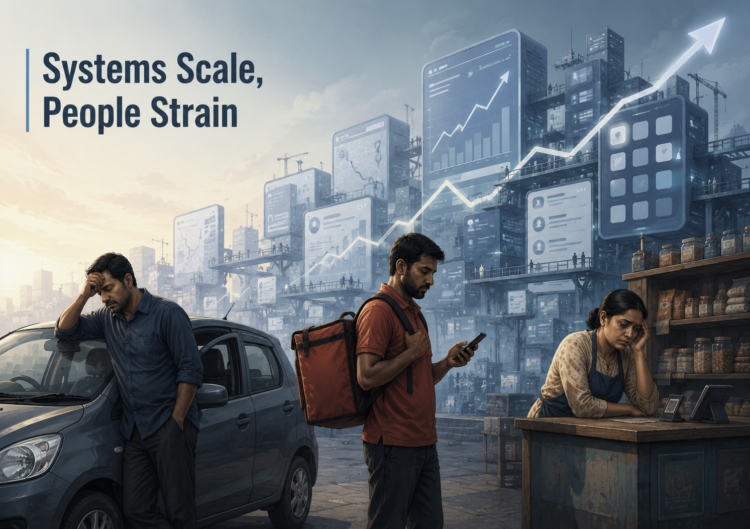
There is a quiet misjudgement shaping our present moment. We have come to assume that if a system functions, it is inherently good. If it expands, it is successful. If it allows open entry, it is fair. Yet, the lived reality tells a more complex story. A driver on platforms like Uber or Ola is no longer simply working—he is navigating an increasingly saturated ecosystem, often competing with individuals who entered not by choice, but by necessity. A delivery partner on Swiggy or Zomato spends more time waiting than moving, as supply has outpaced demand.

A small retailer sees customers migrate toward Amazon or Flipkart—not due to lack of effort, but because the system privileges scale over survival. These are not isolated experiences. They are early indicators. Indicators that access, when left unstructured, creates imbalance.

19th India CSR Leadership Summit 2026
ADVERTISEMENT

The Illusion of Open Opportunity

We celebrate the idea that “anyone can participate.” It sounds inclusive. It appears democratic. But when participation is entirely unrestricted, protection disappears. Earnings begin to erode. Stability weakens. Dignity becomes uncertain. The system may continue to perform efficiently. But the individuals within it begin to absorb the strain.

What Data Will Not Capture

Dashboards will continue to reflect growth. Graphs will signal adoption. Reports will highlight expansion.

But they will not capture:

  • a driver switching off his engine at a traffic signal—not to wait, but to conserve fuel for one more ride,
  • a delivery partner pausing before accepting an order, weighing whether the trip will justify the effort,
  • a shopkeeper watching a customer compare prices online while standing in the store—and recognising the outcome before it unfolds.

These are not anomalies. They are becoming the norm. And they remain invisible to most systems of measurement.

From Open Access to Responsible Design

The issue is not with platforms themselves. It lies in the absence of structure. If a system enables entry, it must also define responsibility. If additional drivers are onboarded, how are earnings protected? If more delivery partners are added, how is equitable distribution ensured? If local businesses are disrupted, how are they integrated—rather than displaced? These are not regulatory constraints. They are design imperatives.

A Practical Direction: Protecting Livelihoods

Participation within modern platforms is not uniform—and systems must recognise this explicitly. A structured approach can bring clarity: a Primary–Secondary participation framework, supported by a formal licensing architecture at the policy level. This is not a new idea. We already recognise differentiated participation in sectors such as transport, where licensing determines eligibility, accountability, and protection. A similar approach can be extended to platform-based work.

Consider ride-hailing:

A driver who depends entirely on platforms like Uber or Ola for livelihood—someone who may have transitioned from formal employment into full-time driving—can be recognised as a Primary (Professional) Driver, supported through a designated licence category issued or validated by authorities such as the Regional Transport Office or an equivalent state/central regulatory framework.

This category can enable:

  • priority allocation of rides,
  • defined minimum earning assurance bands,
  • access to insurance, social security, and welfare mechanisms,
  • formal recognition as a livelihood-dependent worker within the platform economy.

At the same time, a software professional logging in after work hours, or an individual using the platform as interim support, can operate under a Secondary (Flexible) Licence Category, with:

  • calibrated access during peak demand periods,
  • no prioritisation over full-time drivers,
  • flexibility without displacing livelihood-dependent participants.

This is not an exclusion. It is structured inclusion backed by policy.

Crucially, such a system does not require heavy-handed regulation. It requires intelligent alignment between platform design and public policy—where licensing is not merely a compliance instrument, but a tool for economic balance and livelihood protection. The same principle can extend beyond mobility—into delivery ecosystems, local retail networks, and other service sectors where Platformization is reshaping participation.

Because when systems remain completely open, supply expands faster than demand, earnings decline silently, and those with no fallback absorb the first and deepest impact. A licensing-backed participation model ensures that opportunity remains open—but livelihoods are not left unprotected.

The Leadership Shift That Matters

The need is not for fewer platforms. It is for better-designed systems.

The shift is both necessary and clear:

  • From maximum onboarding → to balanced onboarding
  • From open access → to accountable access
  • From scale at any cost → to sustainability with dignity

Scaling is relatively straightforward. Designing for balance requires intent.

The future will not belong to those who expand the fastest. It will belong to those who sustain participation the longest.

The Question That Endures

Technology will evolve. Platforms will transform. But one question will persist: When you had the ability to design systems—did you safeguard the people within them? Because, ultimately, leadership is not defined by how many entered a system. It is defined by how many were able to remain—with dignity.


About the Author

Dr. Harilal Bhaskar, Chief Operating Officer (COO) and National Coordinator at I-STEM (Indian Science, Technology and Engineering Facilities Map), under the Office of the Principal Scientific Adviser (PSA), Government of India.
Tags: Dr. Harilal Bhaskar
csr education cybernetyx
ADVERTISEMENT
India CSR Image 1 India CSR Image 2

CSR, Sustainability, and ESG success stories hindustan zinc
ADVERTISEMENT
India CSR

India CSR

India CSR® is the largest media on CSR and sustainability offering diverse content across multisectoral issues on business responsibility. It covers Sustainable Development, Corporate Social Responsibility (CSR), Sustainability, and related issues in India. Founded in 2009, the organisation aspires to become a globally admired media that offers valuable information to its readers through responsible reporting.

Related Posts

Saarang Ganapathi, Chief Executive Officer, Embassy Services Pvt. Ltd.
Articles

From Construction Waste to Circular Value: Rethinking the Built Environment

India CSR
Articles

‘The Octopus Theory’ Redefines Corporate Communication’s Fragmented Approach: Pavan Kaushik, Communication Economist

Ameet Rele, Vice President – Communications & CSR, Nuvoco Vistas Corp. Ltd.
Articles

Beyond Compliance: The Next Chapter of CSR in India

Dr. Heera Lal Patel, IAS
Articles

From Beneficiaries to Custodians: What Corporate India Can Learn from Dr. Heera Lal’s Community-Led Development Model

India CSR
Articles

MSMEs Could Lead India’s Next Freight Revolution

Green Buildings
Articles

Beyond Green Buildings: How Real Estate Is Embracing Conservation as a Core Design Principle

Load More
csr education cybernetyx
ADVERTISEMENT
bba
ADVERTISEMENT

Interviews

Sanjay Hande, Head Of Manufacturing And Technology Management, Bosch India @india csr
Interviews

Giving Becomes Participation, and Participation Creates a Deeper Connection: Sanjay Hande, Bosch India

by India CSR

Spark of Joy began in 2015 as a cultural fundraising event but has grown into something much larger over the...

Read moreDetails
Vivek Prakash, Senior Vice President & Head, CSR at Jubilant Ingrevia Limited

Didi Ki Dukaan is Helping Rural Women Become Independent Entrepreneurs: Vivek Prakash, Sr VP & Head–CSR, Jubilant Ingrevia

India CSR

Responsible Business Must Turn Research into Real Impact: Prof Bob Doherty

Akanksha Sharma, Vice President – Sustainability, Subcontinent, Central Asia, Levant and; Egypt DP World

DP World’s Sustainability Strategy: Building Greener, Inclusive Logistics in India

Load More
Ad 1 Ad 2 Ad 3 Ad 4 Ad 5 Ad 6
ADVERTISEMENT

CSR UPDATES

CSR: IIT Madras Signs Technology License Agreement with Spark Minda Foundation for ‘Kadam’

CSR: M3M Foundation Supports Kamya Bhardwaj Through ‘Samudra Se Shikhar Tak’ to Take on the Oceans Seven

Vishnu Prakash R Punglia Ltd Spends ₹2.46 Crore on CSR in FY2025-26, Exceeds Statutory Obligation

Aga Khan V Meets PM Modi, President Murmu and India’s National Leadership During First Official India Visit

CSR: SBI Foundation, IIS Support 40 Indian Track & Field Athletes

CSR: HCLFoundation, UP Government Extend Samuday Partnership to 2031

STEM Learning STEM Learning STEM Learning
ADVERTISEMENT
Facebook Twitter Youtube LinkedIn Instagram
India CSR Logo

India CSR is the largest tech-led platform for information on CSR and sustainability in India offering diverse content across multisectoral issues. It covers Sustainable Development, Corporate Social Responsibility (CSR), Sustainability, and related issues in India. Founded in 2009, the organisation aspires to become a globally admired media that offers valuable information to its readers through responsible reporting. To enjoy the premium services, we invite you to partner with us.

Follow us on social media:

Subscribe to Our Newsletter

Don't miss out on the latest updates in corporate social responsibility. Subscribe to our newsletter at indiacsr.in and be part of the positive change.
Please enable JavaScript in your browser to complete this form.
Loading

  • About India CSR
  • Team
  • India CSR Awards 2026
  • India CSR Leadership Summit
  • Partnership
  • Guest Posts
  • Services
  • ESG Professional Network
  • Content Writing Services
  • Business Information
  • Contact
  • Privacy Policy
  • Terms of Use
  • Donate

Copyright © 2026 - India CSR | All Rights Reserved

INDIA CSR AWARDS
APPLY NOW
No Result
View All Result
  • Home
  • Corporate Social Responsibility
    • Art & Culture
    • CSR Leaders
    • Child Rights
    • Culture
    • Education
    • Gender Equality
    • Around the World
    • Skill Development
    • Safety
    • Covid-19
    • Safe Food For All
  • Sustainability
    • Sustainability Dialogues
    • Sustainability Knowledge Series
    • Plastics
    • Sustainable Development Goals
    • ESG
    • Circular Economy
    • BRSR
  • Corporate Governance
    • Diversity & Inclusion
  • Interviews
  • SDGs
    • No Poverty
    • Zero Hunger
    • Good Health & Well-Being
    • Quality Education
    • Gender Equality
    • Clean Water & Sanitation – SDG 6
    • Affordable & Clean Energy
    • Decent Work & Economic Growth
    • Industry, Innovation & Infrastructure
    • Reduced Inequalities
    • Sustainable Cities & Communities
    • Responsible Consumption & Production
    • Climate Action
    • Life Below Water
    • Life on Land
    • Peace, Justice & Strong Institutions
    • Partnerships for the Goals
  • Articles
  • Events
  • हिंदी
  • More
    • Business
    • Finance
    • Environment
    • Economy
    • Health
    • Around the World
    • Social Sector Leaders
    • Social Entrepreneurship
    • Trending News
      • Important Days
      • Great People
      • Product Review
      • International
      • Sports
      • Entertainment
    • Case Studies
    • Philanthropy
    • Biography
    • Technology
    • Lifestyle
    • Sports
    • Gaming
    • Knowledge
    • Home Improvement
    • Words Power
    • Chief Ministers

Copyright © 2026 - India CSR | All Rights Reserved

This website uses cookies. By continuing to use this website you are giving consent to cookies being used. Visit our Privacy and Cookie Policy.