

• India CSR Awards 2026
  • India CSR Leadership Summit
  • Guest Posts
Thursday, September 3, 2026
India CSR
  • Home
  • Corporate Social Responsibility
    • Art & Culture
    • CSR Leaders
    • Child Rights
    • Culture
    • Education
    • Gender Equality
    • Around the World
    • Skill Development
    • Safety
    • Covid-19
    • Safe Food For All
  • Sustainability
    • Sustainability Dialogues
    • Sustainability Knowledge Series
    • Plastics
    • Sustainable Development Goals
    • ESG
    • Circular Economy
    • BRSR
  • Corporate Governance
    • Diversity & Inclusion
  • Interviews
  • SDGs
    • No Poverty
    • Zero Hunger
    • Good Health & Well-Being
    • Quality Education
    • Gender Equality
    • Clean Water & Sanitation – SDG 6
    • Affordable & Clean Energy
    • Decent Work & Economic Growth
    • Industry, Innovation & Infrastructure
    • Reduced Inequalities
    • Sustainable Cities & Communities
    • Responsible Consumption & Production
    • Climate Action
    • Life Below Water
    • Life on Land
    • Peace, Justice & Strong Institutions
    • Partnerships for the Goals
  • Articles
  • Events
  • हिंदी
  • More
    • Business
    • Finance
    • Environment
    • Economy
    • Health
    • Around the World
    • Social Sector Leaders
    • Social Entrepreneurship
    • Trending News
      • Important Days
        • Festivals
      • Great People
      • Product Review
      • International
      • Sports
      • Entertainment
    • Case Studies
    • Philanthropy
    • Biography
    • Technology
    • Lifestyle
    • Sports
    • Gaming
    • Knowledge
    • Home Improvement
    • Words Power
    • Chief Ministers
No Result
View All Result
  • Home
  • Corporate Social Responsibility
    • Art & Culture
    • CSR Leaders
    • Child Rights
    • Culture
    • Education
    • Gender Equality
    • Around the World
    • Skill Development
    • Safety
    • Covid-19
    • Safe Food For All
  • Sustainability
    • Sustainability Dialogues
    • Sustainability Knowledge Series
    • Plastics
    • Sustainable Development Goals
    • ESG
    • Circular Economy
    • BRSR
  • Corporate Governance
    • Diversity & Inclusion
  • Interviews
  • SDGs
    • No Poverty
    • Zero Hunger
    • Good Health & Well-Being
    • Quality Education
    • Gender Equality
    • Clean Water & Sanitation – SDG 6
    • Affordable & Clean Energy
    • Decent Work & Economic Growth
    • Industry, Innovation & Infrastructure
    • Reduced Inequalities
    • Sustainable Cities & Communities
    • Responsible Consumption & Production
    • Climate Action
    • Life Below Water
    • Life on Land
    • Peace, Justice & Strong Institutions
    • Partnerships for the Goals
  • Articles
  • Events
  • हिंदी
  • More
    • Business
    • Finance
    • Environment
    • Economy
    • Health
    • Around the World
    • Social Sector Leaders
    • Social Entrepreneurship
    • Trending News
      • Important Days
        • Festivals
      • Great People
      • Product Review
      • International
      • Sports
      • Entertainment
    • Case Studies
    • Philanthropy
    • Biography
    • Technology
    • Lifestyle
    • Sports
    • Gaming
    • Knowledge
    • Home Improvement
    • Words Power
    • Chief Ministers
No Result
View All Result
India CSR
No Result
View All Result
Home Articles

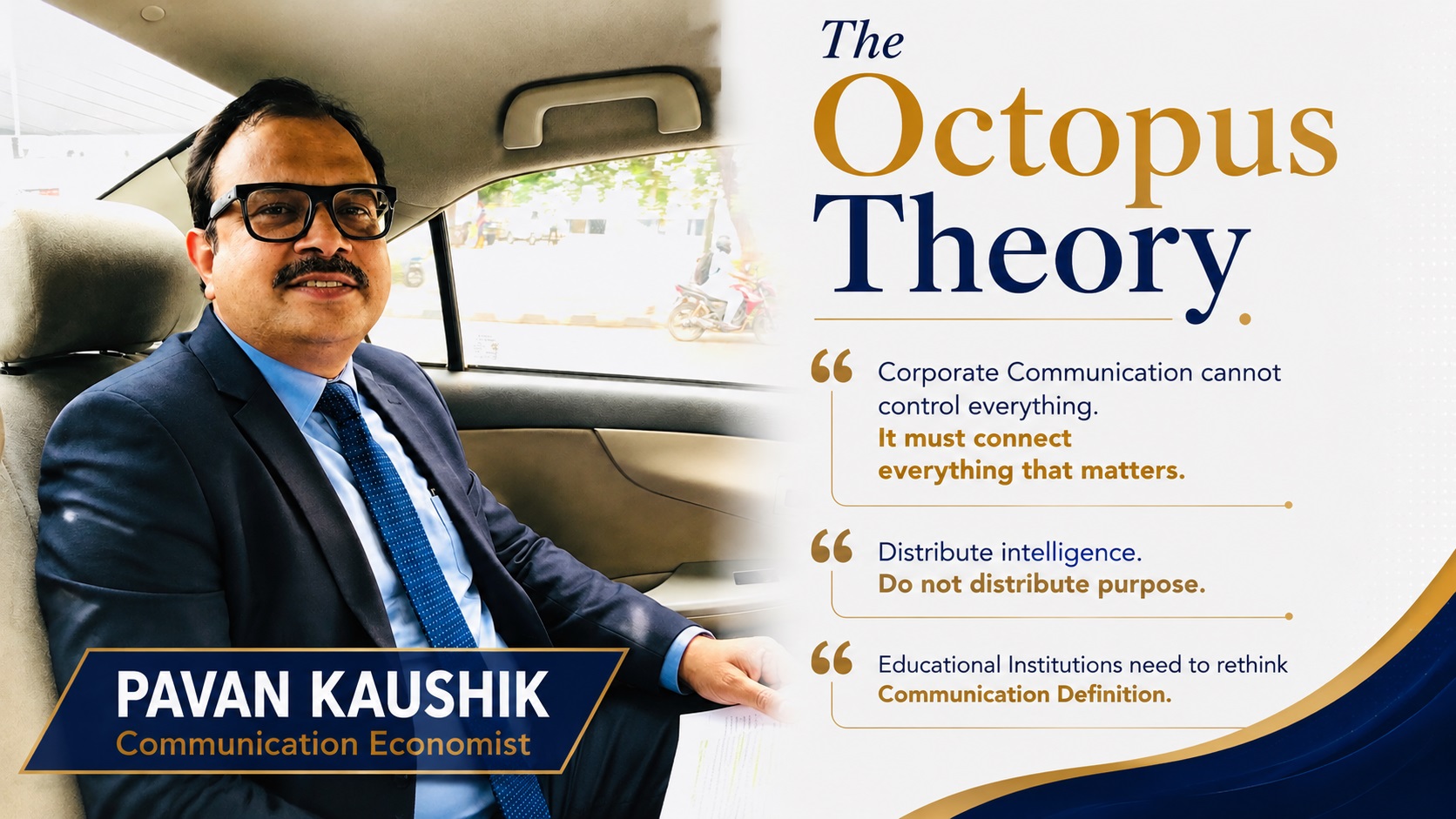
‘The Octopus Theory’ Redefines Corporate Communication’s Fragmented Approach: Pavan Kaushik, Communication Economist

India CSR by India CSR
September 3, 2026
in Articles
Reading Time: 5 mins read
India CSR
Share Share Share Share
WhatsApp icon
WhatsApp — Join Us
Instant updates & community
Google News icon
Google News — Follow Us
Get our articles in Google News feed
india csr awards
ADVERTISEMENT


NEW DELHI (India CSR): Drawing on 35 years of advising organisations, leaders and institutions across diverse sectors and geographies, Communication Economist and corporate communication veteran Pavan Kaushik has introduced ‘The Octopus Theory of Communication’ — a framework designed to redefine the fragmented approach to Corporate Communication by connecting it more closely with business strategy, organisational intelligence and stakeholder experience.

A Communication Economist is a specialist who bridges economic thinking and strategic communication – understanding how economic forces shape what organisations communicate, how information influences decisions, and how complex economic ideas can be translated into clear, credible and meaningful narratives for stakeholders, policymakers and the public.

Pavan Kaushik has held senior leadership roles in corporate communication with the Vedanta Group, Hindustan Zinc, DS Group, M3M India, OfBusiness and the Central Government. He is also the author of The Fifth Estate: Corporate Communication and has been advising communication strategies across mining, metals, infrastructure, manufacturing, engineering, heavy machinery, energy, sustainability and CSR, both nationally and internationally.
19th India CSR Leadership Summit 2026
ADVERTISEMENT

Pavan Kaushik says, ‘TheOctopus Theory of Communication’ framework is built on a simple premise: Corporate Communication cannot operate effectively as an isolated messaging function when information, intelligence and stakeholder experiences are being created across the organisation.”

FROM A COMMUNICATION FUNCTION TO A COMMUNICATION ORGANISM

‘The Octopus Theory of Communication’ draws inspiration from the octopus – eight arms, nine brains, three hearts and extraordinary flexibility. Its arms sense and respond to the environment, its distributed intelligence allows different parts to act independently while remaining connected, and its flexibility enables it to adapt to changing circumstances.

“These characteristics offer a powerful parallel for Corporate Communication,” says Pavan Kaushik. “Different communication interfaces can function independently, but they must remain connected to one strategic purpose.”

THE EIGHT ARMS

The eight arms represent eight key organisational and stakeholder interfaces:

Human Resources & Employees | Finance | Sales & Marketing | Operations | Legal | Vendors & Suppliers | Media & Investors | Regulatory & Institutional Stakeholders.

“These interfaces are not merely communication channels. They are sources of information, stakeholder experience and organisational intelligence. Each sees a different part of the organisation and can influence how the organisation is understood and experienced”, says Pavan Kaushik.

He believes, the changing communication environment has made this connected approach even more important. Social media has transformed stakeholders from passive recipients into active participants who can create, amplify and challenge narratives in real time. Information can originate anywhere and gain momentum instantly. Corporate Communication must therefore be able to sense what is moving across the digital ecosystem, interpret its significance and bring relevant intelligence back to the centre.

THE NINE BRAINS

The nine brains represent distributed communication intelligence – one central communication brain at the Nucleus, led by the Head of Corporate Communications, supported by eight communication brains within the arms, represented by Deputy Heads or senior communication leaders aligned with the respective functions.

Pavan Kaushik says, “The Nucleus provides integration, interpretation, alignment and strategic direction, while the eight communication brains bring intelligence closer to where it originates.Distribute intelligence. Do not distribute purpose.”

THE THREE HEARTS

The three hearts represent the forces that keep the communication organism aligned:Leadership & Stewardship | CEO & Business Direction | Stakeholder Trust.

“Leadership and stewardship establish organisational values and responsible behaviour; CEO and business direction provide strategic priorities and intent; and stakeholder trust reflects the confidence the organisation seeks to build through its actions and communication” he says.

Together, they influence communication priorities, decision-making and responsiveness.

The octopus’s flexibility represents Corporate Communication’s ability to adapt its approach to different stakeholders, circumstances and situations without changing the strategic purpose of the organisation.

THE NUCLEUS: CONNECTING STRATEGY AND INTELLIGENCE

At the centre of the framework is the Nucleus, where business intent, communication strategy, organisational intelligence, reputation and positioning come together.

The model operates through a continuous two-way architecture:Strategic Intent → Nucleus → Eight Arms → Stakeholder Experience → Intelligence → Nucleus.

“Corporate Communications cannot control everything. It must connect everything that matters. Strategic direction must move outward, while stakeholder intelligence must return to the centre. The Nucleus connects what the organisation intends to communicate with what stakeholders are actually experiencing,” says Pavan Kaushik.

The framework therefore seeks to move Corporate Communication beyond messaging, media relations, newsletters, corporate announcements and top – management visibility. These remain important outputs, but they are only one part of a larger communication ecosystem.

BREAKING THE SILOS

Pavan Kaushik believes Corporate Communication can become isolated from the functions and stakeholders that generate the information and intelligence it needs.

“As a Communication Economist, I examine how information, media and messaging influence organisational decision-making, stakeholder behaviour and ultimately business value. Communication should therefore be evaluated beyond visibility and output — through information flow, stakeholder intelligence, speed of response, cross-functional alignment, trust, reputation and contribution to business value.”

The Octopus Theory seeks to bridge these silos by creating stronger communication linkages across the organisation while retaining a clear strategic centre.

CREDIBILITY BEGINS AT THE NUCLEUS

The framework also places emphasis on credible information sharing by founders, promoters and CXOs.

“The Nucleus can only be as credible as the information that reaches it. Corporate Communications can connect, interpret and articulate information, but credibility has to begin with the organisation itself. When information is unnecessarily withheld, trust becomes difficult and reputation ultimately suffers,” says Pavan Kaushik.

A FRAMEWORK FOR ORGANISATIONS AND COMMUNICATION PROFESSIONALS

The Octopus Theory is intended for start-ups, small and mid-sized companies, unicorns and large enterprises.

Pavan Kaushik also believes it can provide a structured lens for organisations and professional advisory firms evaluating the effectiveness and maturity of Corporate Communication functions.

“I am very keen to engage with universities and professional institutions teaching Corporate Communications.Future communication professionals need to understand more than messaging and media. They need to understand business strategy, information flow, organisational behaviour, stakeholder experience and reputation. Much of this understanding comes through industry.”

THE FRAMEWORK IS BUILT AROUND

One Nucleus. Eight Arms. Nine Brains. Three Hearts. Two-Way Communication. One Strategic Communication Purpose.

“Communication may happen through many arms, but strategic communication needs one central point”, Pavan Kaushik concludes.

Tags: Pavan Kaushik
India CSR Image 1 India CSR Image 2

CSR, Sustainability, and ESG success stories hindustan zinc
ADVERTISEMENT
India CSR

India CSR

India CSR® is the largest media on CSR and sustainability offering diverse content across multisectoral issues on business responsibility. It covers Sustainable Development, Corporate Social Responsibility (CSR), Sustainability, and related issues in India. Founded in 2009, the organisation aspires to become a globally admired media that offers valuable information to its readers through responsible reporting.

Related Posts

Ameet Rele, Vice President – Communications & CSR, Nuvoco Vistas Corp. Ltd.
Articles

Beyond Compliance: The Next Chapter of CSR in India

Dr. Heera Lal Patel, IAS
Articles

From Beneficiaries to Custodians: What Corporate India Can Learn from Dr. Heera Lal’s Community-Led Development Model

India CSR
Articles

MSMEs Could Lead India’s Next Freight Revolution

Green Buildings
Articles

Beyond Green Buildings: How Real Estate Is Embracing Conservation as a Core Design Principle

AI Generated Image: Copyright India CSR
Articles

How Digital Intelligence Is Accelerating Green Freight in India

Dr Bhaskar Chatterjee
Articles

The Next Frontier of CSR 2.0: Backing India’s Innovation Ecosystem

Load More
bba
ADVERTISEMENT

Interviews

Vivek Prakash, Senior Vice President & Head, CSR at Jubilant Ingrevia Limited
Interviews

Didi Ki Dukaan is Helping Rural Women Become Independent Entrepreneurs: Vivek Prakash, Sr VP & Head–CSR, Jubilant Ingrevia

by India CSR

A hyper-local, community-centric model is central to both the commercial viability of the stores and the social value generated for...

Read moreDetails
India CSR

Responsible Business Must Turn Research into Real Impact: Prof Bob Doherty

Akanksha Sharma, Vice President – Sustainability, Subcontinent, Central Asia, Levant and; Egypt DP World

DP World’s Sustainability Strategy: Building Greener, Inclusive Logistics in India

Dr. V.K. Raju

Every Premature Baby Deserves the Right to Sight: Dr. V.K. Raju, Chairman, Goutami Eye Institute & Founder, Eye Foundation of America

Load More
Ad 1 Ad 2 Ad 3 Ad 4 Ad 5 Ad 6
ADVERTISEMENT

CSR UPDATES

Hindustan Zinc unveils Zinc Finisher Medal as Registrations Cross 7000 for the Vedanta Zinc City Half Marathon

CSR: Bank of Baroda supports Girl Child Education and Women’s Economic Empowerment in Sri Vijaya Puram

TREVOC Strengthens CSR With Recognition for Site Personnel and Safety Practices

Bannari Amman Sugars Spends Rs 4.28 Cr on CSR in FY 2025-26

Rachana Infrastructure Spends Rs. 9 Lakh on CSR in FY2025-26, Exceeds Mandatory Obligation

Shivam Chemicals Reports Nil CSR Expenditure for Second Straight Year; FY2025-26 Revenue Rises 30%

STEM Learning STEM Learning STEM Learning
ADVERTISEMENT
Facebook Twitter Youtube LinkedIn Instagram
India CSR Logo

India CSR is the largest tech-led platform for information on CSR and sustainability in India offering diverse content across multisectoral issues. It covers Sustainable Development, Corporate Social Responsibility (CSR), Sustainability, and related issues in India. Founded in 2009, the organisation aspires to become a globally admired media that offers valuable information to its readers through responsible reporting. To enjoy the premium services, we invite you to partner with us.

Follow us on social media:

Subscribe to Our Newsletter

Don't miss out on the latest updates in corporate social responsibility. Subscribe to our newsletter at indiacsr.in and be part of the positive change.
Please enable JavaScript in your browser to complete this form.
Loading

  • About India CSR
  • Team
  • India CSR Awards 2026
  • India CSR Leadership Summit
  • Partnership
  • Guest Posts
  • Services
  • ESG Professional Network
  • Content Writing Services
  • Business Information
  • Contact
  • Privacy Policy
  • Terms of Use
  • Donate

Copyright © 2026 - India CSR | All Rights Reserved

No Result
View All Result
  • Home
  • Corporate Social Responsibility
    • Art & Culture
    • CSR Leaders
    • Child Rights
    • Culture
    • Education
    • Gender Equality
    • Around the World
    • Skill Development
    • Safety
    • Covid-19
    • Safe Food For All
  • Sustainability
    • Sustainability Dialogues
    • Sustainability Knowledge Series
    • Plastics
    • Sustainable Development Goals
    • ESG
    • Circular Economy
    • BRSR
  • Corporate Governance
    • Diversity & Inclusion
  • Interviews
  • SDGs
    • No Poverty
    • Zero Hunger
    • Good Health & Well-Being
    • Quality Education
    • Gender Equality
    • Clean Water & Sanitation – SDG 6
    • Affordable & Clean Energy
    • Decent Work & Economic Growth
    • Industry, Innovation & Infrastructure
    • Reduced Inequalities
    • Sustainable Cities & Communities
    • Responsible Consumption & Production
    • Climate Action
    • Life Below Water
    • Life on Land
    • Peace, Justice & Strong Institutions
    • Partnerships for the Goals
  • Articles
  • Events
  • हिंदी
  • More
    • Business
    • Finance
    • Environment
    • Economy
    • Health
    • Around the World
    • Social Sector Leaders
    • Social Entrepreneurship
    • Trending News
      • Important Days
      • Great People
      • Product Review
      • International
      • Sports
      • Entertainment
    • Case Studies
    • Philanthropy
    • Biography
    • Technology
    • Lifestyle
    • Sports
    • Gaming
    • Knowledge
    • Home Improvement
    • Words Power
    • Chief Ministers

Copyright © 2026 - India CSR | All Rights Reserved

This website uses cookies. By continuing to use this website you are giving consent to cookies being used. Visit our Privacy and Cookie Policy.
