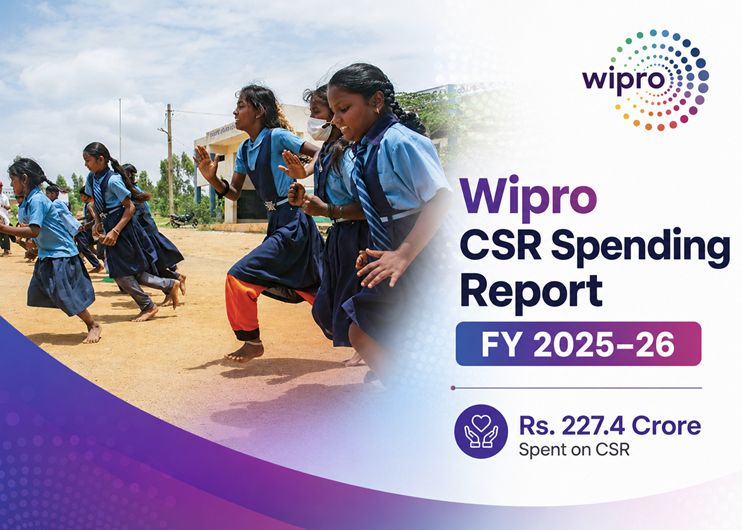


Wipro Limited spent Rs. 227.4 crore on CSR activities in FY 2025–26, exceeding its adjusted obligation of Rs. 130.4 crore.
Wipro Limited’s Corporate Social Responsibility (CSR) performance for FY 2025–26 reflects a mature, institution-led and impact-oriented approach to social development. The company’s CSR work is not presented merely as a statutory obligation. It is positioned as part of Wipro’s wider belief that business and society must advance together. This belief has shaped the company’s conduct over decades and continues to influence how it invests in communities, employees, institutions and the environment.
In FY 2025–26, Wipro spent Rs. 2,274 million, or Rs. 227.4 crore, on CSR activities. This amount was significantly higher than the company’s adjusted CSR obligation of Rs. 1,304 million for the year. The statutory two percent requirement, calculated on the average net profit under Section 135 of the Companies Act, 2013, was Rs. 2,042 million. However, Wipro set off Rs. 738 million from excess CSR spends of previous financial years. After this set-off, the net CSR obligation stood at Rs. 1,304 million. Against this, the company spent Rs. 2,274 million, creating an excess spend of Rs. 970 million for set-off in succeeding financial years.
This report examines Wipro’s CSR spending, governance, thematic focus, implementation structure, impact assessment, beneficiary reach and long-term social significance. It also analyses how Wipro’s CSR framework reflects a systems approach rather than a short-term project-based model.
CSR Spending Snapshot: Strong Spend, No Shortfall
Wipro’s FY 2025–26 CSR numbers show full compliance and a clear surplus over the statutory requirement. The company’s average net profit for CSR calculation stood at Rs. 102,102 million. Two percent of this amount was Rs. 2,042 million. There was no surplus arising from CSR projects or programmes of previous years. The amount required to be set off for the year was Rs. 738 million, comprising Rs. 227 million from excess spend in FY 2022–23, Rs. 250 million from excess spend in FY 2023–24 and Rs. 261 million from excess spend in FY 2024–25.
After the set-off, Wipro’s total CSR obligation for FY 2025–26 was Rs. 1,304 million. The company spent Rs. 2,274 million during the year. Out of this, Rs. 2,214 million was spent on CSR projects, including both ongoing and other-than-ongoing projects. Administrative overheads accounted for Rs. 58 million. Impact assessment expenditure stood at Rs. 2 million. Therefore, the total CSR expenditure for the year was Rs. 2,274 million.
The company reported no unspent CSR amount. No amount was required to be transferred to an Unspent CSR Account under Section 135(6). No amount was transferred to any fund specified under Schedule VII. This indicates that the company not only met its statutory spending requirement but also achieved timely deployment of funds during the reporting period.
Excess Spend and Future Set-Off
One of the important aspects of Wipro’s CSR spending is the excess amount available for set-off. The company spent Rs. 970 million more than its net CSR obligation for FY 2025–26. As there was no surplus arising out of CSR projects or programmes of previous years, the full excess amount of Rs. 970 million became available for set-off in succeeding financial years.
This is important from a CSR compliance perspective. It shows that Wipro has consistently spent above its minimum CSR requirement. The company also had excess spends in previous years, which were used to reduce its FY 2025–26 obligation. Despite using Rs. 738 million from previous excess spends, the company again generated a fresh excess spend of Rs. 970 million.
This pattern suggests that Wipro’s CSR is not driven only by the minimum legal requirement. It is guided by long-term programme commitments, institutional partnerships and multi-year social investments. Such an approach is important because deep social change often requires patient capital, continuity and trust with communities and civil society organisations.
CSR Governance and Institutional Structure
Wipro’s CSR work is institutionally led by Wipro Foundation. The Foundation acts as the CSR entity of Wipro Limited and is the institutional owner of the company’s CSR strategy, partnerships and long-term outcomes. The company’s CSR initiatives are implemented through multiple channels, including Wipro Foundation, select initiatives of Wipro Limited and its functions and groups, and employee participation through Wipro Cares.
This structure gives Wipro’s CSR programme both strategic direction and implementation depth. Wipro Foundation provides continuity, domain expertise and partnership management. Wipro Cares allows employees to participate in CSR through volunteering and monetary contributions. Wipro Limited and its internal functions support selected CSR actions and help align social responsibility with the company’s broader values.
The CSR governance model reflects a layered approach. It is not limited to cheque-writing. It involves strategy, partnerships, programme design, implementation, employee engagement, impact assessment and reporting. This is essential for large-scale CSR, especially when interventions are spread across education, ecology, healthcare, disaster response, digital skilling and urban systems.
CSR Committee Composition
Wipro disclosed that its Nomination and Remuneration Committee also acts as the Corporate Social Responsibility (CSR) Committee. The committee held 5 meetings during FY 2025–26.
| Sl. No. | Name of Director | Designation / Nature of Directorship | Role in CSR Committee | CSR Committee Meetings Held | Meetings Attended |
|---|---|---|---|---|---|
| 1 | Tulsi Naidu | Independent Director | Chairperson of the Committee | 5 | 4 |
| 2 | Patrick Dupuis | Independent Director | Member of the Committee | 5 | 5 |
| 3 | Deepak M. Satwalekar | Independent Director | Member of the Committee | 5 | 5 |
| 4 | Päivi Rekonen | Independent Director | Member of the Committee | 5 | 2 |
Notes: Ms. Tulsi Naidu was appointed Chairperson of the Committee with effect from July 1, 2025, in place of Mr. Patrick Dupuis. Mr. Dupuis continued as Member and retired as Independent Director with effect from the close of business hours on March 31, 2026. Ms. Päivi Rekonen was appointed as Member with effect from October 1, 2025; since her appointment, two CSR Committee meetings were held.
Wipro Foundation: Systems Perspective for Social Change
A notable feature of Wipro’s CSR work is its systems perspective. The company recognises that meaningful social change is cumulative, relational and anchored in strong institutions. Instead of creating parallel systems, Wipro Foundation prioritises long-term engagements that strengthen existing systems.
This includes supporting civil society organisations that work with public institutions, investing in organisational and leadership capacity, enabling learning and adaptation over time, and accepting that outcomes may emerge unevenly across different contexts. This is a realistic and mature understanding of social development.
In many CSR programmes, success is often measured through short-term outputs. Wipro’s approach appears to go beyond this. It focuses on institutional strengthening, long-term capability building and ecosystem-level change. This is particularly relevant in education, healthcare and ecology, where outcomes depend on multiple actors and sustained engagement.
Partner Ecosystem: Breadth and Continuity
Wipro Foundation works with a diverse partner ecosystem. Its partners include grassroots nonprofits, research institutions, public systems and domain experts. These partners are treated as collaborators with deep contextual knowledge and long-term community presence.
The partnerships are typically multi-year. This is significant because multi-year partnerships allow experimentation, course correction, learning and trust-building. They also reduce the risk of fragmented and one-time interventions. In sectors such as education, healthcare and ecology, continuity is essential for sustainable impact.
Wipro’s CSR model therefore reflects a partnership-based philosophy. It recognises that companies alone cannot solve complex social problems. Impact requires collaboration among companies, civil society, communities, governments and knowledge institutions.
Major CSR Domains
Wipro’s CSR initiatives cover five major domains: Education, Ecology, Primary Healthcare, Disaster Response, and Cities and Public Spaces. In addition, digital skilling and employee volunteering form important parts of the company’s social responsibility ecosystem.
These domains are aligned with national priorities and Schedule VII themes such as promoting education, healthcare, environmental sustainability, disaster management, livelihood support and inclusive development. The choice of domains also reflects Wipro’s identity as a technology and knowledge-led organisation with a strong belief in education, capability building and responsible citizenship.
Education: Strengthening Children, Teachers and Schools
Education remains one of the most important pillars of Wipro’s CSR work. The company’s education initiatives focus on helping children access quality education, supporting teachers and strengthening government schools so that they improve over time.
Wipro’s education work is spread across 26 states and four Union Territories. This geographic spread indicates that the company’s education interventions are not confined to a few urban centres. They reach diverse regions and social contexts.
The company’s FY 2025–26 goal for positive outcomes for children was 2.9 million, while the reported reach was 2.8 million. For children with disabilities, the FY 2026 goal was 150,000, and the reach was 148,467. These numbers show a strong focus on inclusion. Children with disabilities often face multiple barriers in education, including access, infrastructure, pedagogy and social attitudes. Wipro’s attention to this group reflects a commitment to equitable education.
The education approach is important because it combines access, quality and institutional strengthening. It is not merely about providing material support. It is about improving the conditions under which children learn and teachers teach.
Digital Skilling: Preparing Students for the Future
Wipro’s digital skilling initiatives focus on employability, faculty capability and institutional readiness for future skills. The company reported that faculty development initiatives reached 4,635 educators across engineering and science colleges in India.
The digital skilling programme covered 367,058 students against an FY 2026 goal of 341,114. This means the company exceeded its target in this area. Digital skilling is an important CSR domain for Wipro because it connects the company’s technological expertise with the country’s need for employability and future-ready talent.
India’s youth face a major challenge: formal education does not always translate into employability. By investing in digital skills, faculty development and institutional readiness, Wipro is addressing this gap. Such programmes can improve career opportunities for students, especially those from lower-income and middle-income backgrounds.
Digital skilling also has long-term economic significance. It helps build a talent pipeline, supports social mobility and strengthens India’s human capital base.
Higher Education and Skills Building
Wipro also conducted impact assessment for projects related to higher education for skills building. The objectives included bridging the gap between academic theory and industry practice, equipping participants with technical and professional skills, providing career readiness and aligning students with evolving IT industry needs.
The impact assessment found that practical and hands-on project-based learning helped students gain real experience while pursuing education. The programmes offered a blend of theoretical and practical knowledge, making students more industry-ready. The tuition-free model and financial assistance lowered financial barriers for students, especially those from lower- and middle-income households.
This is an important area of CSR because higher education can be a gateway to livelihood transformation. When students gain industry-relevant skills without heavy financial burden, the benefits extend beyond the individual. Families also benefit through reduced financial pressure and better future income possibilities.
Engineering Education: From Theory to Practice
Wipro’s engineering education interventions aimed to strengthen the quality and relevance of engineering learning through practical and application-oriented approaches. The programme focused on building industry-ready engineering talent by improving technical competencies and employability skills.
The impact assessment indicated that the programme catalysed a shift from theory-centric learning to project-based learning. It improved industry readiness and logical thinking among students. It also helped create specialised education pathways and a pipeline of skilled talent.
This is highly relevant in India, where many engineering graduates struggle with employability due to gaps between curriculum and industry requirements. By supporting engineering education reform, Wipro contributes to both individual career growth and the wider technology talent ecosystem.
Healthcare: Strengthening Primary Care for Vulnerable Communities
Wipro Foundation’s healthcare programmes focus on strengthening primary healthcare systems to improve access, continuity and quality of care for vulnerable communities. The programmes span primary healthcare, maternal and child health, disability support and preventive care.
The healthcare work is anchored through 21 partner organisations across 22 projects spanning multiple states. Improving children’s health outcomes remains a key focus. The FY 2026 goal for healthcare for women in the reproductive age group was 1 million, and the reported reach was 1 million. For healthcare and nutrition support for children, the FY 2026 goal was 1.7 million, and the reach was 1.7 million. For healthcare for children with disabilities, the FY 2026 goal was 7,500, and the reach was 7,600.
These figures show that Wipro met or exceeded its healthcare targets in key areas. The focus on women, children and children with disabilities is socially important. These groups often face barriers in accessing timely and quality care. Primary healthcare support can reduce preventable illness, improve nutrition, support maternal health and strengthen community resilience.
Disaster Response: Relief, Recovery and Stability
Wipro’s disaster response work in FY 2025–26 included continued support following the Wayanad landslides of 2024. Relief and recovery efforts reached over 4,255 people through community work. Support was delivered through local partners to restore access to essential services and livelihoods.
The company recognised that disasters often create prolonged disruptions to income, health systems and education. Therefore, interventions continued beyond immediate relief into FY 2025–26 to support longer-term recovery and community stability.
This approach is important. Disaster response cannot end with emergency relief. Affected communities often need support for livelihoods, medical care, education continuity, housing, local services and mental resilience. Wipro’s continuation of support beyond immediate relief reflects a recovery-oriented CSR model.
Beyond India, employee-led initiatives also complemented disaster response. In the Philippines, volunteers supported post-disaster efforts through sorting, packing and distributing essential supplies. This shows that Wipro’s CSR culture has a global employee engagement dimension.
Ecology and Environment: Urban Systems and Sustainability
Wipro’s ecology and environment initiatives strengthen urban ecological systems such as aquifers, waste systems and climate response. These initiatives are implemented across 12 cities and are grounded in sustained local engagement with communities and city-level institutions.
The work spans urban water and watershed systems, waste management, informal sector livelihoods, climate adaptation, biodiversity and community ecology. This is a broad and relevant portfolio because urban India faces severe ecological stress. Water scarcity, waste management, biodiversity loss, climate vulnerability and informal livelihood insecurity are deeply connected issues.
Wipro’s approach to ecology appears to be systems-based. It does not isolate environmental issues from social realities. For example, waste management is connected with informal sector livelihoods. Climate adaptation is connected with communities and city institutions. Water systems are connected with local governance and long-term sustainability.
Renewable Energy and Environmental Impact
Wipro also conducted impact assessment for renewable energy projects. The objective was to evaluate the extent to which renewable energy created positive environmental impact. The assessment found highly positive impact on environment, health and safety aspects. It also found substantial greenhouse gas and water consumption savings through adoption and use of renewable energy.
This connects Wipro’s CSR and sustainability agenda. Renewable energy initiatives create environmental value and demonstrate responsible corporate action. They also align with the company’s broader environmental commitments.
Cities and Public Spaces: Building Inclusive Urban Culture
A distinctive part of Wipro’s CSR portfolio is its support for cities and public spaces. Wipro supports public-spirited institutions that provide inclusive spaces for art, culture and intellectual conversations rooted in constitutional values.
This is an important but often under-recognised area of CSR. Cities need not only infrastructure but also spaces for dialogue, creativity, culture, civic participation and democratic engagement. By supporting such institutions, Wipro contributes to making cities more vibrant, inclusive and citizen-centric.
This pillar expands the meaning of CSR beyond conventional themes. It recognises that social development also includes public culture, civic imagination and shared spaces.
Employee Participation through Wipro Cares
Employee participation is enabled through Wipro Cares, the employee engagement pathway within Wipro Foundation’s CSR portfolio. Activities include blood donation, assistive device distribution, waste clean-ups, tree planting, access to solar lighting, mentoring and preparation of essential kits for women and children.
In FY 2025–26, 42,000 employees contributed through Wipro Cares. All donations were matched 1:1 by Wipro. The programme conducted more than 600 volunteering events across over 20 countries, reached more than 60,000 people and recorded 35,000 volunteering hours.
Employee volunteering outside India also showed steady participation. Across the Americas, Europe and APMEA, 3,575 employees contributed close to 10,000 volunteering hours across 138 events. The overseas programme was organised around four thematic priorities: Digital, Inclusion, Environment and Wipro Next Door.
This demonstrates that Wipro’s CSR is not only foundation-led but also employee-owned. Employee participation strengthens corporate culture, builds empathy and connects employees with social realities.
Impact Assessment: Accountability and Learning
Wipro conducted impact assessments for applicable CSR projects as required under Rule 8(3) of the Companies (Corporate Social Responsibility Policy) Rules, 2014. The assessed projects included higher education for skills building, engineering education and renewable energy.
Impact assessment is important because it moves CSR beyond spending. It asks whether programmes are creating meaningful outcomes. In Wipro’s case, the assessments highlighted practical learning, industry readiness, reduced financial barriers, socio-economic upliftment and environmental gains.
The company spent Rs. 2 million on impact assessment during FY 2025–26. This expenditure is small compared to the overall CSR spend but important for governance and accountability. Impact assessment helps the company understand what works, improve programme design and communicate outcomes to stakeholders.
No Capital Assets Created
Wipro reported that no capital assets were created or acquired through CSR amount spent during the financial year. This means the CSR expenditure was directed towards programmes, partnerships, services, interventions and activities rather than acquisition or creation of capital assets.
This is consistent with Wipro’s systems and institution-strengthening approach. The company’s emphasis appears to be on social outcomes, capacity building, education, health access, environmental sustainability and employee engagement rather than asset-heavy CSR.
Key Learnings from Long-Term Engagement
Wipro’s CSR experience points to several learnings. First, systemic change is cumulative and institutional. Structural challenges require patient engagement rather than short project cycles. Durable outcomes are closely linked to the strength of local institutions.
Second, capacity building multiplies effects and outcomes. When CSR invests in organisational and leadership capacity, partner organisations can influence systems beyond immediate interventions.
Third, trust enables scale. Long-standing relationships allow experimentation, learning and adaptation. This is particularly important when working with grassroots organisations and public systems.
These learnings are valuable for the larger CSR sector in India. They show that high-quality CSR is not just about annual expenditure. It is about continuity, trust, institutional capability and a willingness to learn.
Compliance Review
From a compliance point of view, Wipro’s FY 2025–26 CSR performance is strong. The company calculated the average net profit and statutory two percent obligation. It applied permissible set-off from previous excess spends. It spent more than the adjusted obligation. It disclosed spending across projects, administrative overheads and impact assessment. It reported no unspent amount and no shortfall. It also disclosed impact assessment details for applicable projects.
The absence of unspent amount is significant. Many companies face challenges in deploying CSR funds within the financial year, especially for ongoing projects. Wipro’s ability to spend the full amount and generate excess spend indicates strong planning and implementation capacity.
Strategic Significance of Wipro’s CSR
Wipro’s CSR has strategic significance at three levels. At the social level, it supports education, healthcare, ecology, disaster recovery, public spaces and digital skills. At the institutional level, it strengthens civil society organisations, public systems and community-based partnerships. At the corporate level, it reflects Wipro’s purpose-driven identity and reinforces employee engagement.
The company’s CSR is aligned with its values of integrity, stewardship, respect and responsibility. It also complements the broader philanthropic ecosystem associated with Wipro’s founder and the Azim Premji Foundation, although Wipro’s statutory CSR is institutionally led by Wipro Foundation.
Key CSR Numbers for FY 2025–26
Wipro’s CSR numbers for FY 2025–26 provide a clear picture of both compliance and commitment. The average net profit for CSR calculation was Rs. 102,102 million. The statutory two percent CSR requirement was Rs. 2,042 million. The amount available for set-off from previous years was Rs. 738 million. After the set-off, the total CSR obligation for the year was Rs. 1,304 million.
Against this obligation, the company spent Rs. 2,274 million. This included Rs. 2,214 million on CSR projects, Rs. 58 million on administrative overheads and Rs. 2 million on impact assessment. The excess amount available for set-off in future years was Rs. 970 million. The company reported zero shortfall and nil unspent CSR amount.
In crore terms, Wipro spent Rs. 227.4 crore on CSR during FY 2025–26. The adjusted CSR obligation was Rs. 130.4 crore. The excess spend available for future set-off was Rs. 97 crore. This demonstrates a strong CSR spending performance.
Why Wipro’s CSR Model Matters
Wipro’s CSR model matters because it offers a wider view of corporate responsibility. It does not treat CSR as a one-year expenditure cycle. It treats CSR as a social investment that requires long-term thinking, partnership and institutional patience.
The model is especially important in India’s development context. Many of the country’s challenges are complex and interconnected. Education is linked with poverty, health, livelihoods and social inclusion. Healthcare is linked with nutrition, gender, disability and local systems. Ecology is linked with water, waste, cities, climate resilience and livelihoods. Disaster recovery is linked with public services, local institutions and community strength.
A CSR model that only funds short-term activities may create visibility but not lasting change. Wipro’s model appears to focus on depth, continuity and systems. This makes its CSR portfolio more meaningful.
CSR and Corporate Purpose
Wipro’s CSR also reflects the company’s larger corporate purpose. The company describes itself as purpose-driven and committed to ensuring that progress in business and society is responsible, inclusive and sustainable. CSR is one way through which this purpose is translated into action.
The company’s CSR work also complements its environmental and governance priorities. Its focus on responsible technology, employee engagement, renewable energy, inclusion and community development shows that responsibility is embedded in different dimensions of the company.
Purpose-driven CSR is not about charity alone. It is about the relationship between business power and social responsibility. Wipro’s FY 2025–26 CSR performance indicates that the company sees social responsibility as part of long-term value creation.
(India CSR)