

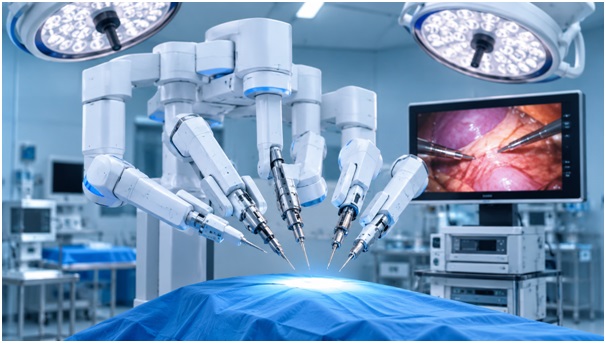


When patients are told that their operation can be done “robotically”, many imagine a machine operating on its own while the doctor watches from a distance. That is not how it works. In robotic-assisted surgery, the surgeon stays in full control throughout. The robot is a precise tool that turns the surgeon’s hand movements into smaller, steadier movements inside the body.
At Apex Hospitals, Malviya Nagar, Jaipur, robotic surgery is now part of treatment across several specialities. The hospital was the first in Rajasthan to perform robotic surgery using a Make in India robotic system, the SSI Mantra, and uses the CORI robotic system for knee replacement. Here is how the technology works and which conditions are treated with it at Apex.
How Robotic-Assisted Surgery Works
Robotic surgery is a form of minimally invasive surgery. Instead of one large cut, the surgeon makes a few small incisions through which thin robotic arms, carrying a camera and surgical instruments, are passed.
The surgeon sits at a console in the operating room and controls these arms. The camera gives a magnified, three-dimensional view of the area being operated on, and the instruments can bend and rotate further than the human wrist. This helps the surgeon work with greater precision in tight or deep spaces. A surgical team remains beside the patient at all times, and the operation can be switched to conventional surgery if needed.
Conditions Treated with Robotic Surgery at Apex Hospitals
Urology: The SSI Mantra system is used for complex surgeries of the prostate, kidneys and urinary tract. Robotic precision is particularly helpful in prostate surgery, where the surgeon works close to nerves that control urinary and sexual function. In kidney surgery, it can help the surgeon remove only the diseased part of the kidney and preserve as much healthy tissue as possible.
Gastrointestinal surgery: Robotic surgery is used for complex operations on the stomach, intestines and other digestive organs. Many of these procedures involve working deep inside the abdomen, where the magnified view and flexible instruments make a real difference.
Cancer surgery: In surgical oncology, robotic techniques are used for complex cancer operations. The aim is to remove the tumour accurately while protecting the surrounding healthy organs, nerves and blood vessels as far as possible.
Cardiac surgery: Robotic heart surgery allows certain procedures to be carried out through small openings between the ribs instead of opening the breastbone. At Apex, this includes repair of a hole in the heart, coronary bypass surgery and heart valve replacement. Avoiding a large chest incision can make recovery after heart surgery considerably easier for suitable patients.
Knee replacement: For orthopaedics, Apex uses the CORI robotic system for both partial and total knee replacement. During surgery, the system maps the patient’s knee and creates a three-dimensional model, which helps the surgeon plan and place the implant with a high degree of accuracy. In a partial knee replacement, only the damaged part of the knee is replaced, while the healthy parts are preserved. In a total knee replacement, the entire joint surface is replaced. Accurate implant positioning and balancing of the soft tissues around the knee are important for comfort and movement after surgery.
Possible Benefits for Patients
Because robotic surgery uses small incisions and offers greater control, patients may experience:
- less pain after surgery
- minimal blood loss
- a lower risk of wound infection
- a shorter hospital stay and quicker recovery
- smaller scars
These benefits vary from patient to patient and depend on the type of surgery, the patient’s condition and their overall health.
What Recovery Usually Looks Like
Recovery depends on the operation performed. For many procedures, patients are encouraged to sit up and walk within a day of surgery, which helps prevent complications such as blood clots and chest infections. After robotic knee replacement, physiotherapy usually begins early to help the patient regain movement and strength.
Most patients go home once they are eating normally, their pain is under control and the surgical team is satisfied with their progress. At home, they are usually advised to avoid heavy lifting for a few weeks, keep the small wounds clean and dry, and attend follow-up visits as scheduled. Fever, increasing pain or redness around the wounds should be reported to the doctor promptly.
Even though the cuts are small, the surgery inside the body is still significant, and giving the body enough time to heal is an important part of a good outcome.
Is Robotic Surgery Right for Everyone?
Not every patient or condition is suited to a robotic approach. Previous abdominal operations, the size and location of a tumour, and heart or lung conditions that affect anaesthesia all play a role in the decision. In some cases, open surgery or standard laparoscopic surgery remains the better option.
Patients considering robotic surgery may find it helpful to ask their surgeon:
- Is my condition suitable for a robotic approach?
- What are the alternatives, and how do they compare in my case?
- How long is the expected hospital stay and recovery?
- When can I return to work and normal activities?
A Tool That Supports the Surgeon
Robotic-assisted surgery is best understood as an advanced tool in the hands of a trained surgeon, not a replacement for one. Its value lies in precision, clear vision and access to difficult areas of the body. The availability of Make in India robotic systems is also helping bring this technology to more hospitals beyond the largest metro cities.
Patients who have been advised surgery for a urological, digestive, cancer or heart condition, or a knee replacement, can discuss with the robotic surgery team at Apex Hospitals whether a robotic approach is suitable for them.



