


• India CSR Awards 2026
  • India CSR Leadership Summit
  • Guest Posts
Tuesday, October 27, 2026
India CSR®
  • Home
  • CSR
    • Art & Culture
    • CSR Leaders
    • Child Rights
    • Culture
    • Education
    • Gender Equality
    • Around the World
    • Skill Development
    • Safety
    • Covid-19
    • Safe Food For All
  • Sustainability
    • Sustainability Dialogues
    • Sustainability Knowledge Series
    • Plastics
    • Sustainable Development Goals
    • ESG
    • Circular Economy
    • BRSR
  • SUMMIT
  • AWARDS
  • Interviews
  • SDGs
    • No Poverty
    • Zero Hunger
    • Good Health & Well-Being
    • Quality Education
    • Gender Equality
    • Clean Water & Sanitation – SDG 6
    • Affordable & Clean Energy
    • Decent Work & Economic Growth
    • Industry, Innovation & Infrastructure
    • Reduced Inequalities
    • Sustainable Cities & Communities
    • Responsible Consumption & Production
    • Climate Action
    • Life Below Water
    • Life on Land
    • Peace, Justice & Strong Institutions
    • Partnerships for the Goals
  • Articles
  • Events
  • हिंदी
  • More
    • Business
    • Finance
    • Corporate Governance
      • Diversity & Inclusion
    • Environment
    • Economy
    • Health
    • Around the World
    • Social Sector Leaders
    • Social Entrepreneurship
    • Trending News
      • Important Days
        • Festivals
      • Great People
      • Product Review
      • International
      • Sports
      • Entertainment
    • Case Studies
    • Philanthropy
    • Biography
    • Technology
    • Lifestyle
    • Sports
    • Gaming
    • Knowledge
    • Home Improvement
    • Words Power
    • Chief Ministers
No Result
View All Result
India CSR®
No Result
View All Result
Home Business

Translation Glasses at Work: Benefits, Limitations and Inclusive Communication

India CSR by India CSR
October 27, 2026
Reading Time: 6 mins read
India CSR®
Share Share Share Share
WhatsApp icon
WhatsApp — Join Us
Instant updates & community
Google News icon
Google News — Follow Us
Get our articles in Google News feed

Wearable translation could make cross-border collaboration easier, but responsible adoption requires accuracy checks, employee choice and clear rules for recorded speech.

A multilingual workplace does not become inclusive simply because everyone can hear the same presentation. Employees must also be able to ask questions, challenge assumptions and participate in decisions without language becoming an invisible barrier.

For Indian organisations working with overseas clients, regional teams, suppliers and community partners, that is a practical management issue. Translation glasses and other AI-powered tools offer new ways to support conversation. Their real value, however, depends on whether they help people communicate more confidently without introducing fresh inequalities or risks.

Why language access is a workplace inclusion issue

Language friction appears in ordinary moments: a technical briefing that moves too quickly, a hybrid meeting where colleagues hesitate to interrupt, or a site visit conducted in a language not everyone understands. The problem is not always that an employee lacks professional knowledge. Sometimes the language of the conversation prevents that knowledge from being heard.

HR, learning and development, diversity and inclusion, and corporate social responsibility (CSR) teams have an interest in these moments. Better communication can support onboarding, cross-border collaboration and more meaningful engagement with local communities. But organisations should avoid treating translation technology as a substitute for inclusive meeting practices or competent human interpretation.

What translation glasses actually do
India CSR®

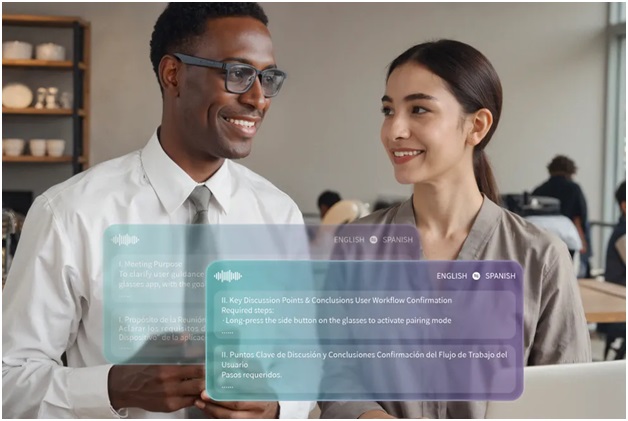
Translation glasses combine microphones with software that recognises speech, converts it into another language and delivers the result to the user. Depending on the design, the output may arrive through open-ear speakers or appear as text on a small display. Many systems also rely on a paired smartphone and an internet connection.

This distinction matters for workplace use. Audio-first glasses may help an employee follow a one-to-one conversation without holding a phone. Display-based glasses can provide translated text, which may be useful when the wearer needs to read rather than listen. Neither design guarantees that colleagues can see, hear or verify the same translated message.

Before choosing a device, procurement and people teams can consult a guide to translation glasses to understand the differences between audio translation, on-lens subtitles and phone-based processing. The right format depends on who needs the information, not simply on the number of supported languages.

Where wearable translation can make a difference

One-to-one discussions and site visits

Wearables may reduce the need to repeatedly unlock and position a smartphone during a short conversation. That can be useful when employees are touring a facility, meeting a visiting colleague or discussing routine issues while their hands are occupied. The benefit is conversational continuity, not guaranteed translation accuracy.

Training and international collaboration

A worker attending a bilingual workshop may find it easier to follow spoken instructions through translated audio or captions. Overseas project teams may also use translation tools to clarify straightforward questions before a formal meeting. These are reasonable pilot settings because speakers can pause, repeat points and correct misunderstandings.

Community engagement

CSR teams often communicate with people who prefer local or regional languages. Translation technology may help staff begin everyday conversations, but it should not be assumed that a device supports a particular dialect or understands community-specific expressions. Participation also depends on trust, literacy, accessibility and the ability to ask follow-up questions.

The limits become clear in complex conversations

AI translation is vulnerable to overlapping speakers, background noise, industry-specific vocabulary, accents and figurative language. A device may render the literal words yet miss the meaning that matters in a negotiation, grievance discussion or safety briefing.

Wearable translation can also be one-sided. An employee may hear a translation through the glasses while other participants receive nothing, making it difficult to check whether everyone understood the same instruction. Shared captions, translated written materials or a phone screen may be better options when a group needs a common reference.

The stakes determine the acceptable margin for error. Routine introductions and informal updates are different from medical advice, legal commitments, employment disputes or instructions involving physical safety. Those situations may require a qualified interpreter, bilingual documentation or a human review process rather than an automated translation alone.

Privacy and consent must be part of the decision

Translation glasses depend on capturing speech through microphones. Even camera-free models may record or transmit audio for processing. The absence of a camera should never be presented as proof that a device creates no privacy risk.

Before introducing wearables into meetings, organisations should establish when audio may be captured, how participants will be informed, where processing occurs, whether transcripts are retained and who can access them. Workplace policies and applicable data-protection obligations still matter. Employees should have a practical alternative when they are uncomfortable with a wearable microphone being used.

Accessibility deserves equal attention. Audio-only translation may be unsuitable for employees who need visible captions. On-lens text may create other fit or usability issues. A fair programme offers more than one communication format rather than assuming that a single wearable works for everyone.

How organisations can assess the technology responsibly

A small, voluntary pilot is more useful than buying devices on the strength of a product demonstration. Procurement and HR teams can agree on a few realistic use cases and assess whether the tool improves participation without increasing confusion.

  • Test real language pairs: Check the languages, accents and technical vocabulary used by the team, not just a headline language count.
  • Measure comprehension: Ask participants whether they understood decisions and could contribute, rather than measuring only device uptime.
  • Provide a fallback: Keep written summaries, shared captions, phone translation or interpreters available when the wearable falls short.
  • Review data practices: Check permissions, storage, retention, access controls and consent before using microphones in workplace conversations.
  • Invite feedback: Let employees identify uncomfortable, inaccessible or impractical situations without pressure to adopt the device.

These criteria shift the question from “Does the technology work?” to “Does it improve communication for the people who actually need it?” That is a more relevant test for organisations seeking responsible innovation.

Inclusive communication requires more than a device

Translation glasses are a useful addition to the multilingual workplace toolkit, particularly for brief, one-to-one exchanges and situations where hands-free listening is genuinely helpful. They do not replace shared understanding, clear meeting facilitation or accountable decision-making.

The more sustainable approach combines appropriate technology with multilingual documents, staff training, human interpretation where needed and respect for employees’ language preferences. The aim is not to remove every accent or make every conversation effortless. It is to ensure that fewer people are excluded from contributing because the workplace has chosen only one way to communicate.


csr education cybernetyx
ADVERTISEMENT
India CSR Image 1 India CSR Image 2

CSR, Sustainability, and ESG success stories hindustan zinc
ADVERTISEMENT
India CSR

India CSR

India CSR® is the largest media on CSR and sustainability offering diverse content across multisectoral issues on business responsibility. It covers Sustainable Development, Corporate Social Responsibility (CSR), Sustainability, and related issues in India. Founded in 2009, the organisation aspires to become a globally admired media that offers valuable information to its readers through responsible reporting.

Related Posts

India CSR®
Business

Top 5 Watch Storage Gifts for Him (Stylish and Practical)

Switching Demat Apps
Business

Switching Demat Apps? Understand Your Options Before You Move 

AI Video Generator
Business

Top 10 AI Video Generators With the Smartest AI Agents and Automation

India CSR®
Business

Urvann Invests in Own Farms to Enhance Plant Quality and Customer Experience

India CSR®
Business

Fast Food vs Natural Health: Nirvana Naturopathy on Healthy Eating Habits

India CSR®
Business

Is the New Tata Aeris Aiming to Reignite the Sub-compact Sedan segment?

Load More
csr education cybernetyx
ADVERTISEMENT
bba
ADVERTISEMENT

Interviews

Smitha Gopalkrishnan Asia Sustainability Leader & India CSR Leader 3M India-@India CSR
Interviews

“Water Security Is a Shared Responsibility”: Smitha Gopalkrishnan on 3M India’s Water Stewardship Work

by India CSR

3M's global water risk assessment identified Ranjangaon as being located in a highly water-stressed region, due to erratic rainfall and...

Read moreDetails
Manoj Lohia, Director, Merino Industries Ltd.-India CSR

Universal Weal Through Trade: Manoj Lohia on Merino’s CSR and Sustainability Journey

Vishwa Bandhu Bhattacharya, Director – Global Sustainability, Tata Consumer Products-India CSR

Our Focus Remains on Embedding ESG Priorities into the Fabric of the Organisation: Vishwa Bandhu Bhattacharya, Director – Global Sustainability, Tata Consumer Products

Dr Rajeev Gautam, President, HORIBA India @Indiacsr

“Wellness Doesn’t Replace Ambition, It Makes Ambition Sustainable”: Shilpa Bhagat, Co-Founder, Fitistan

Load More
Ad 1 Ad 2 Ad 3 Ad 4 Ad 5 Ad 6
ADVERTISEMENT

CSR UPDATES

Prakash Tewari Joins GFSI Board to Advance Women’s Empowerment and Inclusive Development

Chola Foundation Brings 80 Elite Players to Chennai for International Chess Open

“Sports Must Be a Fundamental Right”: Ranjit Bajaj Calls for Grassroots Football Revolution

“CSR Is Not Just Social Work”: Leena Deshpande, Bharat Forge Calls for Transformational Impact

Royal Enfield Pledges ₹3 Crore for Snow Leopard Conservation

STEMPlay Labs Partners with Funskool to Expand Reach of WonderBriks Across India

STEM Learning STEM Learning STEM Learning
ADVERTISEMENT
Facebook Twitter Youtube LinkedIn Instagram
India CSR Logo

India CSR® is the largest tech-led platform for information on CSR and sustainability in India offering diverse content across multisectoral issues. It covers Sustainable Development, Corporate Social Responsibility (CSR), Sustainability, and related issues in India. Founded in 2009, the organisation aspires to become a globally admired media that offers valuable information to its readers through responsible reporting. To enjoy the premium services, we invite you to partner with us.

Follow us on social media:

Subscribe to Our Newsletter

Don't miss out on the latest updates in corporate social responsibility. Subscribe to our newsletter at indiacsr.in and be part of the positive change.
Please enable JavaScript in your browser to complete this form.
Loading

  • About India CSR®
  • Team
  • India CSR® Awards 2026
  • India CSR® Leadership Summit
  • Partnership
  • Guest Posts
  • Services
  • ESG Professional Network
  • Content Writing Services
  • Business Information
  • Contact
  • Privacy Policy
  • Terms of Use
  • Donate

Copyright © 2026 - India CSR® | All Rights Reserved

No Result
View All Result
  • Home
  • CSR
    • Art & Culture
    • CSR Leaders
    • Child Rights
    • Culture
    • Education
    • Gender Equality
    • Around the World
    • Skill Development
    • Safety
    • Covid-19
    • Safe Food For All
  • Sustainability
    • Sustainability Dialogues
    • Sustainability Knowledge Series
    • Plastics
    • Sustainable Development Goals
    • ESG
    • Circular Economy
    • BRSR
  • SUMMIT
  • AWARDS
  • Interviews
  • SDGs
    • No Poverty
    • Zero Hunger
    • Good Health & Well-Being
    • Quality Education
    • Gender Equality
    • Clean Water & Sanitation – SDG 6
    • Affordable & Clean Energy
    • Decent Work & Economic Growth
    • Industry, Innovation & Infrastructure
    • Reduced Inequalities
    • Sustainable Cities & Communities
    • Responsible Consumption & Production
    • Climate Action
    • Life Below Water
    • Life on Land
    • Peace, Justice & Strong Institutions
    • Partnerships for the Goals
  • Articles
  • Events
  • हिंदी
  • More
    • Business
    • Finance
    • Corporate Governance
      • Diversity & Inclusion
    • Environment
    • Economy
    • Health
    • Around the World
    • Social Sector Leaders
    • Social Entrepreneurship
    • Trending News
      • Important Days
      • Great People
      • Product Review
      • International
      • Sports
      • Entertainment
    • Case Studies
    • Philanthropy
    • Biography
    • Technology
    • Lifestyle
    • Sports
    • Gaming
    • Knowledge
    • Home Improvement
    • Words Power
    • Chief Ministers

Copyright © 2026 - India CSR® | All Rights Reserved

This website uses cookies. By continuing to use this website you are giving consent to cookies being used. Visit our Privacy and Cookie Policy.
