

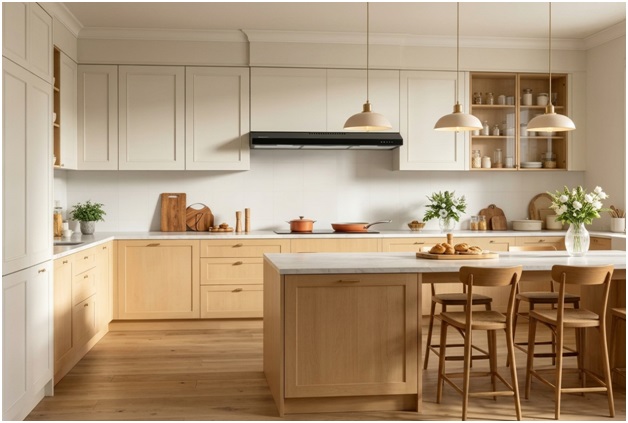



A compact kitchen can present ventilation challenges that are easy to overlook. Although a low-profile ductless range hood helps capture cooking emissions and reduce certain odors, its filtration system does not remove every pollutant generated during meal preparation. Air movement throughout the room also influences how smoke, grease particles, moisture, and cooking odors spread beyond the stovetop.
This makes whole-kitchen airflow an important consideration, particularly in smaller homes and open-plan layouts. Understanding how filtration, room circulation, and additional ventilation work together helps homeowners make more informed decisions about maintaining a comfortable cooking environment without relying on the range hood alone.

How a Low-Profile Ductless Range Hood Handles Cooking Air
A ductless range hood recirculates and filters air rather than exhausting it outdoors. Its fan draws cooking air through filters, then returns the filtered air to the kitchen. Typically, a metal mesh or other grease filter captures airborne grease droplets, while an activated carbon filter helps reduce certain cooking odors. This arrangement makes recirculating models useful where installing external ductwork is difficult or impractical. However, performance depends on filter condition, airflow, installation, and the type of cooking.
Understanding how a low-profile ductless range hood operates is important because its filtration process has specific limitations. Unlike an externally vented hood, it does not discharge cooking emissions outside the building or introduce replacement outdoor air. Some particles and gases may remain in the room even after air passes through the filters. Consequently, the appliance should be considered one part of a broader kitchen air-quality strategy rather than a complete ventilation solution.
Why Airflow Beyond the Cooking Surface Matters
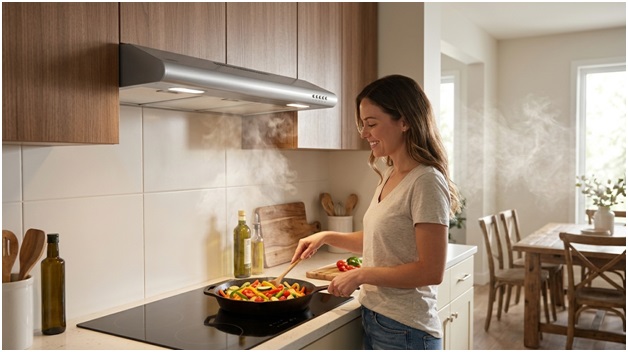
Cooking produces more than visible smoke and noticeable odors. Activities such as frying, roasting, grilling, and sautéing can release fine particulate matter, grease aerosols, and other airborne compounds. Gas cooking can also generate combustion-related pollutants, including nitrogen dioxide. These emissions don’t necessarily stay directly above the cookware. Once released, they can spread through the surrounding air and reach nearby cabinets, dining areas, and adjoining living spaces.
Whole-kitchen airflow influences how these emissions move and accumulate. For example, air currents from open doors, windows, ceiling fans, or nearby ventilation systems can redirect cooking pollutants away from the hood’s capture area. In an open-plan kitchen, this movement may carry odors and particles into connected rooms. Managing airflow therefore means considering the entire cooking environment, not just the fan above the stovetop.
How Kitchen Layout Influences Air Movement
Kitchen design can significantly influence how air travels around a cooking area. In a compact kitchen, walls, overhead cabinets, and limited openings may affect circulation and create areas where air movement is restricted. Meanwhile, open-plan kitchens allow cooking emissions to travel more freely into adjacent spaces. Neither layout automatically guarantees better air quality; the outcome depends on how the cooking area, ventilation openings, and surrounding airflow interact.
Appliance placement also matters. A range hood positioned above the cooking surface needs an unobstructed path to draw in rising emissions. Nearby windows or strong fans may create cross-drafts that push smoke away before it reaches the filters. Kitchen islands can introduce additional challenges because cooking surfaces may be more exposed to surrounding air currents. Considering these factors during kitchen planning helps homeowners avoid relying on filtration equipment to compensate for unsuitable airflow conditions.
The Role of Replacement Air and Room Ventilation
Replacement air is outdoor air that enters a building to replace air removed by an exhaust ventilation system. It matters most when a kitchen uses a ducted range hood or another mechanical exhaust fan. Without an adequate air supply, exhaust systems can create pressure imbalances that affect their operation. In some homes, these conditions may also influence how air moves through adjoining rooms and building openings.
A ductless range hood works differently because it returns filtered air to the same room instead of exhausting it outdoors. Therefore, it does not create outdoor air exchange or provide a fresh-air supply on its own. Natural ventilation through suitable windows and doors, or a properly designed mechanical ventilation system, may help dilute and remove indoor pollutants. The appropriate approach depends on outdoor air quality, weather, building design, and the household’s ventilation requirements.
What Ductless Filters Can and Cannot Remove
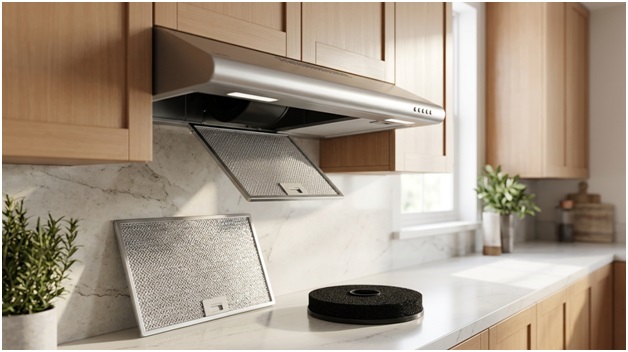
Understanding filter capabilities helps set realistic expectations for recirculating range hoods. Grease filters capture grease droplets and larger airborne particles before they enter the appliance. Activated carbon filters work through adsorption, allowing certain odor-causing compounds to attach to the carbon’s surface. Together, these filtration stages can improve recirculated cooking air, especially when installed and maintained correctly.
However, these filters do not provide complete air purification. Standard grease and carbon filters should not be assumed to remove all fine particulate matter, combustion gases, or excess water vapor. Their effectiveness also decreases when filters become saturated, dirty, or unsuitable for the cooking conditions. Homeowners should follow the manufacturer’s cleaning and replacement instructions rather than assuming that a filter will maintain its performance indefinitely.
Ductless Filtration vs. Whole-Room Ventilation
| Feature | Ductless filtration | Whole-room ventilation |
| Grease capture | Captures grease droplets through dedicated filters | Depends on the ventilation arrangement |
| Odor reduction | Carbon filters reduce certain odors | Outdoor air exchange can dilute and remove odors |
| Fine particles | Does not remove all airborne particles | Effectiveness depends on filtration and air exchange |
| Moisture removal | Does not exhaust moisture outdoors | Suitable exhaust ventilation can remove moisture |
| Fresh-air exchange | Returns filtered air to the room | Can introduce outdoor air and exhaust indoor air |
The distinction matters: filtration treats air passing through the appliance, while ventilation changes the air in the room. Both approaches serve different purposes and should not be treated as interchangeable.
Practical Ways to Improve Whole-Kitchen Airflow
Homeowners can take several practical steps to reduce cooking-related pollution and improve airflow in the kitchen. These measures are especially useful when an external exhaust connection isn’t available.
- Use the hood consistently: Turn it on whenever you cook to capture emissions as they develop.
- Choose suitable burner positions: Use the back burners when practical, as they can improve capture under many hood designs.
- Maintain the filters: Clean grease filters and replace carbon filters according to manufacturer instructions.
- Manage indoor air movement: Open suitable windows or doors when outdoor air quality and weather conditions permit.
- Reduce unnecessary smoke: Avoid excessively high cooking temperatures and burning food whenever possible.
Additional ventilation can also help address pollutants that recirculating filtration does not remove. A suitable window exhaust fan or appropriately selected portable air cleaner may provide supplementary support. Size portable air cleaners for the room and choose models that avoid ozone generation. The best combination depends on the kitchen layout and household needs.
Balancing Compact Hood Design With Kitchen Airflow
Compact range hoods offer practical space-saving advantages, particularly beneath cabinets or in kitchens where larger installations are difficult to accommodate. However, appearance and dimensions should not be the only selection criteria. Homeowners should consider the hood’s coverage, airflow specifications, filter compatibility, installation requirements, and suitability for their cooking habits. A compact appliance cannot automatically compensate for poor placement or inadequate room ventilation.
The wider cooking setup also deserves consideration when planning an efficient kitchen. Appliances such as the ciarra nosh oven may form part of the overall cooking arrangement, but their selection should be based on individual requirements and verified product specifications. Brands such as CIARRA Appliances are part of the broader compact kitchen appliance market. Ultimately, appliance selection and room ventilation should be considered together rather than as separate design decisions.
Conclusion
Whole-kitchen airflow plays an important role in maintaining a more comfortable cooking environment, especially when a ductless range hood is used. Although grease and carbon filters can capture certain cooking byproducts and reduce some odors, recirculating filtration does not replace outdoor ventilation. Kitchen layout, air movement, replacement air, and regular filter maintenance all influence how effectively cooking-related pollutants are managed. Homeowners should therefore consider the entire room when planning their ventilation approach, rather than focusing exclusively on the appliance above the stovetop.
Understanding these differences makes it easier to choose practical solutions for different kitchen layouts. For those exploring compact kitchen equipment, CIARRA Appliances is worth considering as part of their wider research.
Frequently Asked Questions
1. Why is whole-kitchen airflow important when using a ductless range hood?
Whole-kitchen airflow helps prevent cooking emissions, odors, and airborne particles from spreading throughout the room. Since ductless hoods recirculate filtered air rather than exhausting it outdoors, additional room ventilation remains important.
2. Can a ductless range hood remove all cooking smoke and odors?
No. Ductless range hoods use grease and activated carbon filters to capture grease droplets and reduce certain odors. However, they cannot eliminate all fine particles, combustion gases, or other cooking-related pollutants.
3. Does a ductless range hood provide fresh air to the kitchen?
No. A ductless range hood filters and recirculates existing indoor air. It does not bring in outdoor air or provide fresh-air exchange, so you may need additional natural or mechanical ventilation.
4. How does kitchen layout affect airflow around a range hood?
Cabinets, walls, windows, and nearby fans can influence how air moves around the cooking area. Poorly positioned openings or strong cross-drafts may redirect cooking emissions away from the hood’s capture area.
5. How often should ductless range hood filters be maintained?
Grease filters generally require regular cleaning, while activated carbon filters need periodic replacement. The exact maintenance schedule depends on cooking frequency, filter type, and manufacturer recommendations. Regular maintenance helps preserve filtration performance.



