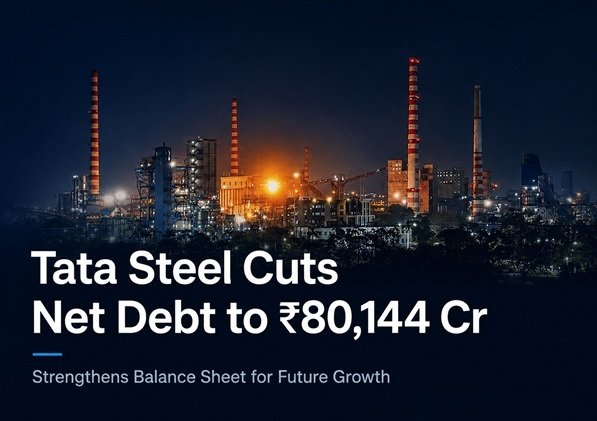



Tata Steel’s domestic capacity now stands at 26.1 MTPA, advancing its long-term 40 MTPA India growth ambition.
NEW DELHI (India CSR): Tata Steel, one of the world’s most geographically diversified steel companies and a leading integrated steel producer with operations across India, Europe, Southeast Asia and North America, has made significant progress in its deleveraging journey, reducing its consolidated net debt to Rs. 80,144 crore in FY2025-26, as the company continued to prioritise balance sheet discipline, cash generation and debt optimisation.
Another important part of Tata Steel’s deleveraging strategy was the sharp reduction in overseas debt exposure, which fell to 18% of total debt in FY2025-26 from about 50% in FY2020-21, helping the company reduce currency risk and strengthen its financial resilience.

“Your Company has also maintained a disciplined balance sheet, reducing the consolidated net debt to Rs. 80,144 crore, bringing Net Debt to EBITDA ratio to a healthy 2.3x.”, N Chandrasekaran, Chairman of Tata Steel said to stakeholders in his message.
The leading steel company has achieved a 24% EBITDA margin in the India business on the foundation of a transformative cost take out programme, improved product
mix and increased volumes.
According to Tata Steel’s Integrated Report and Annual Accounts 2025-26, deleveraging remains a core enterprise priority for the company. The reduction in net debt brought the company’s Net Debt to EBITDA ratio down to 2.3x, compared with 3.3x two years ago. The company also proactively prepaid around Rs. 7,556 crore of debt using internal cash flows.
The improvement was supported by strong operating performance during the year. Tata Steel reported consolidated revenue of Rs. 2,32,140 crore and consolidated EBITDA of ₹34,848 crore, up 35% year-on-year. The company also generated operating cash flows of Rs. 35,064 crore, helped by a working capital release of Rs. 5,442 crore, while maintaining liquidity of Rs. 45,237 crore.
Debt Onshoring Becomes a Key Lever in Tata Steel’s Long-Term Financial Discipline.
A key part of Tata Steel’s debt strategy has been the gradual onshoring of overseas debt to reduce exposure to rupee depreciation. The report says overseas debt has declined from around 50% of total debt in FY2020-21 to 18% in FY2025-26. Tata Steel said that without this proactive onshoring, its gross debt would have been higher by about Rs. 12,500 crore due to currency depreciation alone.
The company has also set a clear target to repay the remaining bonds issued by its overseas subsidiaries by FY2027-28. These measures, Tata Steel said, have helped reinforce its investment-grade credit ratings from S&P and Moody’s, while preserving financial flexibility for future investments in growth, value-added assets, new technologies and decarbonisation.
Tata Steel’s debt reduction comes at a time when the company is also pursuing major capital expenditure and transformation projects. During FY2025-26, it spent Rs. 14,559 crore on capital expenditure and plans to increase capex to around Rs. 20,000 crore in FY2026-27, with 60% allocated to India. Key investments include the Kalinganagar expansion, the Ludhiana scrap-based Electric Arc Furnace and future growth projects linked to NINL, downstream products and green steel technologies.
For FY2025-26, the Company delivered a consistent and robust financial performance with all-round improvement across all areas. Tata Steel is progressing steadily towards its long-term target of 40 million tonnes per annum (MTPA) capacity and has already begun planning for the next phase of growth, Chairman N Chandrasekaran said here on Thursday at the company’s 119th Annual General Meeting (AGM) conducted through videoconferencing from its Bombay House headquarters.
The company’s annual report said the inauguration of the Phase II expansion at Kalinganagar is a landmark event with a Rs. 27,000 crore investment that has increased domestic capacity to 26.1 MTPA, scaling the site capacity from 3 to 8 MTPA. With India’s largest blast furnace and a state-of-the-art Cold Rolling Mill, the Phase II expansion has pivoted flat products strategy towards high-value sectors like automotive and defence, marking a decisive step toward our 40 MTPA long-term ambition.
Key Financial Indicators
| Indicator | FY2025-26 Performance |
|---|---|
| Net Debt | ₹80,144 crore |
| Net Debt to EBITDA | 2.3x |
| Debt Prepaid | ₹7,556 crore |
| Overseas Debt Share | 18% of total debt |
| EBITDA | ₹34,848 crore |
| Operating Cash Flow | ₹35,064 crore |
| Liquidity Position | ₹45,237 crore |
| Cost Transformation Savings | ₹10,868 crore |
| Capex | ₹14,559 crore |