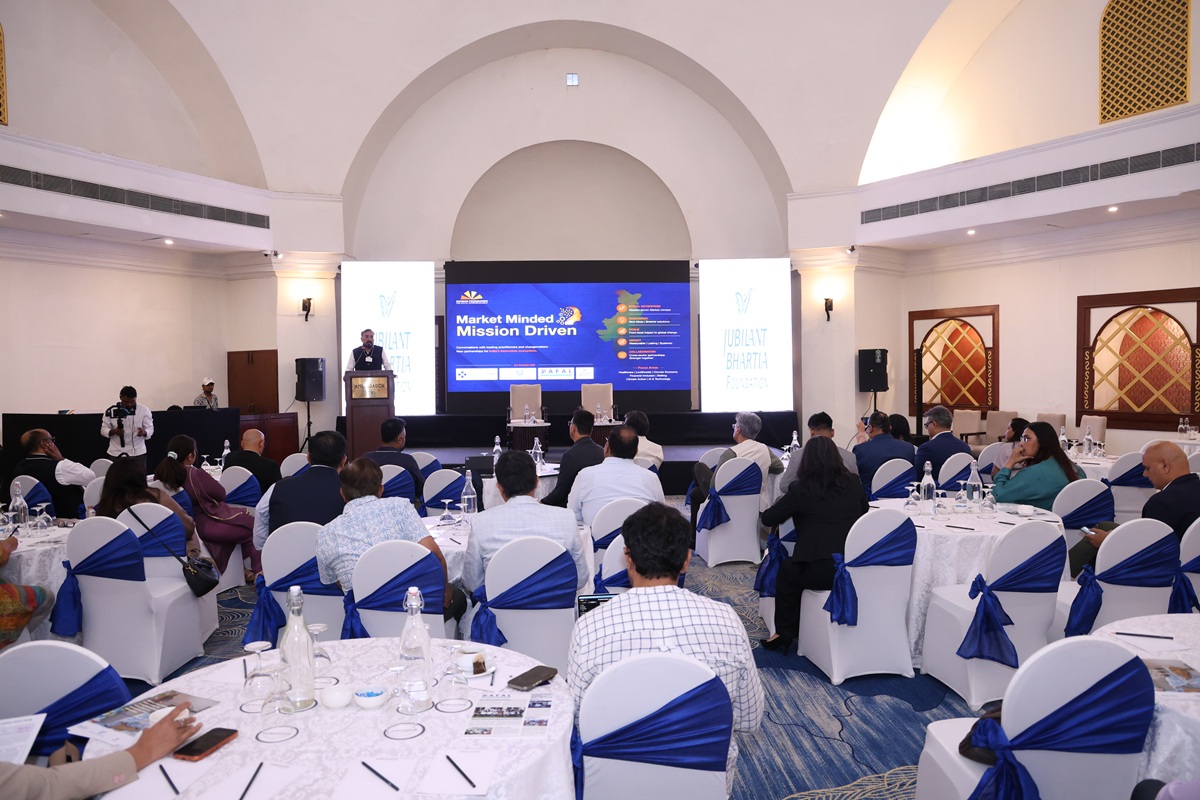



Ahead of the AVPN Global Conference, the Schwab Foundation for Social Entrepreneurship convened investors, corporates and social entrepreneurs in New Delhi to ask what it really takes to build enterprises that are financially disciplined and mission-true at the same time.
NEW DELHI (India CSR): A couple of days before Asia’s largest gathering of social investors opens its doors in the capital, a smaller and more pointed conversation took place at the Taj Ambassador Hotel on August 22, 2026. The Schwab Foundation for Social Entrepreneurship, in partnership with the World Economic Forum, hosted the Market-Minded, Mission-Driven India Convening — bringing its ongoing global dialogue on capital, scale and purpose to India for the first time, co-hosted by Hindustan Unilever Limited (through its Skills Academy for Advancement of Livelihoods), Somerset Indus Capital Partners, and the Jubilant Bhartia Foundation.
The Market-Minded, Mission-Driven workstream has spent the better part of three years travelling between Geneva, Davos, Mondragon and Lausanne, asking a single, deceptively simple question: can an enterprise stay true to a social mission while operating with the discipline of a market-facing business — and if so, what does that actually look like in practice? The workstream spans focus areas from healthcare and livelihoods to circular economy, financial inclusion, skilling, climate action and AI, and has, until now, largely played out in Europe and Latin America. The India convening was framed as its first stop in South Asia, timed deliberately to precede the AVPN Global Conference and to introduce a new cohort of Indian and Southeast Asian practitioners to the conversation.
Setting the Context
Dr. François Bonnici, Director of the Schwab Foundation and a member of the World Economic Forum’s Executive Committee, opened the afternoon by setting out one of the core missions of the platform: social entrepreneurs, he said, are too often left without a seat at the table where capital and policy decisions are actually made, and the Foundation’s role is to give them one. Dr. Shuchin Bajaj, Founder-Director of Ujala Cygnus Healthcare and a Schwab Fellow, joined him alongside Aniket Doegar, Founder & CEO of Haqdarshak and Pranshu Singhal, Founder & Director of Karo Sambhav, to frame the day’s proceedings — three practitioners whose organisations sit, in different ways, at the exact intersection the workstream is trying to map.

Fireside Chat: The 2026 Social Entrepreneur of the Year
The afternoon moved quickly into a fireside conversation with Nidhi Pant, Co-founder of S4S Technologies and 2026 Social Entrepreneur of the Year – India Awardee, in conversation with Vivek Prakash, Head of CSR at the Jubilant Bhartia Foundation, the award’s supporting partner. The slot was framed less as a retrospective on S4S’s own journey and more as a live case study for the day ahead — a founder who has had to make the same market-mission trade-offs the later panels would spend the afternoon debating in the abstract.
Voices From the Ground
The first panel of the afternoon, moderated by Aniket Doegar, pulled together corporate, non-profit and enterprise voices — including Yashika Singh of PepsiCo India, Divya Yachamaneni of Naandi Community Water Services, Shrashtant Patara of Development Alternatives and Shiv Kumar of The Catalysts — to talk through the changing landscape for social enterprise in India. Two threads ran through the discussion. The first was structural: panellists returned repeatedly to the difficulty of getting mainstream capital allocators — wealth managers among them — to treat social enterprises as investable rather than charitable, and what it would take to shift that instinct. The second was more practical: almost every speaker, regardless of sector, pointed to collaboration and cross-sector partnership as the precondition for anything else working at all. No single actor, corporate, investor or non-profit, has the full toolkit to solve access, livelihood or environmental problems alone.
The Schwab Foundation convened investors, corporates and social entrepreneurs in New Delhi to explore patient capital, governance and market-led social impact.
The Schwab Foundation and social innovation in India
Dr. Bonnici returned to the stage to walk the room through some of the Schwab Foundation’s main activities — identifying and supporting the world’s leading social innovators through a global fellowship, and connecting them to the capital, policy access and peer networks that let innovative models scale – also highlighting the innovative potential in India. The segment doubled as context-setting for why a convening like this one, rather than a one-off panel at a larger conference, was worth building from scratch.
Market Minded, Mission Driven: The Central Panel
The afternoon’s second panel, moderated by Dr. Bajaj, brought together Kanika Pal, Sustainability Director at HUL; Mayur Sirdesai, Founder and Managing Partner at Somerset Indus Capital Partners; Nidhi Bhasin, CEO of Digital Green Trust; Paresh Vaish, Senior Partner Emeritus at EY; and Dr. Bonnici. The conversation opened with the question that gives the workstream its name: how does an enterprise stay market-minded without sliding into pure capitalism, and what, globally, actually distinguishes the organisations that manage it? The panel’s answer converged on an ecosystem-first orientation — treating suppliers, employees and customers as participants in a shared outcome rather than inputs to be optimised.
A recurring theme from the corporate side of the table: a company’s own fortunes, several panellists argued, are inseparable from the fortunes of the communities it depends on — whether that’s the households that buy its products or the farmers that supply it.
Kanika Pal made the case from HUL’s own experience of enlightened self-interest, pointing to the scale of the company’s reach into Indian households as the reason marketing and sales roles are increasingly used as deliberate pathways of employability from rural to urban India — built to create sustainable entrepreneurs rather than one-off beneficiaries. From the investor’s chair, Mayur Sirdesai offered a parallel from PepsiCo’s positioning, which describes itself, tellingly, as an agriculture company first — a reminder that staying close to one’s operating truth, rather than reinventing it for a pitch deck, is often what keeps a mission-driven business honest as it scales.
Patience came up repeatedly, and not as a platitude. Several panellists argued that capital which cannot stay the course — that needs proof of return on a conventional venture timeline — is structurally unsuited to social enterprise, whatever its intentions. Simplicity, too, was framed as a discipline rather than a virtue: the more moving parts a model has, the harder it becomes to hold onto why it exists.
One of the sharper exchanges concerned what actually happens inside an organisation when a mission-driven enterprise begins to think like a market-minded one. The panel’s consensus was that the switch is legible in language before it shows up anywhere else — a shift toward ROI, unit economics, and the discipline of stating plainly what has been achieved, what is being aimed for over a defined horizon, and what it will cost to get there. That vocabulary, uncomfortable as it can feel to organisations built around a cause, was described less as a compromise than as evidence: the language a funder or investor needs in order to trust a number.
On capital design, the panel pushed past the usual complaint that funding is too scarce or too short-term, and instead asked where it structurally fails: the answer, several agreed, lies in starting from a need worth solving and only then asking whether profitability can be built around it — rather than the reverse. And on the question of what breaks as organisations scale, governance surfaced as the recurring failure point, alongside a sharper worry: how does an organisation bring in professional leadership without leadership quietly displacing the mission that built the organisation in the first place? The panel’s answer leaned on culture — an ownership mentality distributed through the organisation rather than concentrated in a founder, and space for leaders to bring their own imprint without losing the founding thread.
Asked to name two or three things stakeholders in the room should commit to over the next decade, the panel’s answers were unusually concrete: build talent, rather than assuming mission alone should substitute for compensation; treat collaboration as a discipline that surfaces the perspectives of every stakeholder in a value chain, not a courtesy; hold the patience to let a social enterprise actually become profitable rather than forcing the timeline; and resist the temptation to measure impact as a single number, when in reality it is heterogeneous across geographies, communities and outcomes.
Schwab Foundation: Way Forward
Dr. Bonnici was joined by Saloni Malhotra, CEO of Aspire Impact, for a dialogue on where the Schwab Foundation’s India engagement goes from here — moving the conversation from the day’s individual debates toward a more institutional question of what a standing platform for market-minded, mission-driven enterprise in India would need to look like, and who would need to build it alongside the Foundation.
Report Highlights and Partners Speak
HUL and Somerset Indus Capital Partners each shared highlights from their own work in the space — HUL through AFAL, its skilling initiative for livelihood advancement, and Somerset Indus through its portfolio of healthcare and consumer investments built around the same market-mission logic the day had been debating. A closing ‘Partners Speak’ segment turned the floor over to the co-hosts and sponsors more broadly, for shorter reflections on where market-minded and mission-driven enterprise in India is headed next.
Publications Shared on the Day
The convening also served as a platform for recent WEF and Schwab Foundation research. The Global State of Social Enterprise, a review of a decade of national-level data across more than 80 countries, was presented alongside AI for Impact, a study of how artificial intelligence is being applied — and underfunded — in social innovation globally, and The Corporate Social Innovation Compass, co-produced with Deloitte, on how corporate partnerships create both business and social value. Two further publications were highlighted as forthcoming: one co-authored by Dr. Bajaj alongside Javier Lozano of Clínicas del Azúcar and Adam Gavin of the WEF, on why social enterprises need a different approach to capital and growth; and a second by Sophia Otoo of the Schwab Foundation and Shona McDonald of Shonaquip, on how markets and missions are becoming allies for impact.
The day closed with Dr. Bonnici, Dr. Bajaj, Aniket Doegar and Pranshu Singhal returning to the stage together for key takeaways, before the room moved to dinner. The workstream’s next public moment is expected at Davos in January 2027, where the AI for Impact findings and a forthcoming State of Social Entrepreneurship in India report are set to be presented to a global audience.
As the closing slide put it: market-minded organisations, mission-driven impact, and stronger partnerships for India’s innovation ecosystem — a summary that, on the evidence of the afternoon, is easier to write on a slide than to build in practice, but one that a room full of investors, corporates and entrepreneurs in New Delhi spent an afternoon trying to close the gap on regardless.
The Schwab Foundation for Social Entrepreneurship
The Schwab Foundation for Social Entrepreneurship, a sister organisation of the World Economic Forum, identifies and supports the world’s leading social innovators, providing a global platform to accelerate their impact and connect them with the resources, networks and policymakers needed to scale.
© Copyright Disclaimer: All rights reserved. No part of this report may be reproduced, republished, distributed or transmitted in any form without prior written permission from India CSR®.
India Is One of the Great Engines of Global Social Entrepreneurship: Dr François Bonnici