

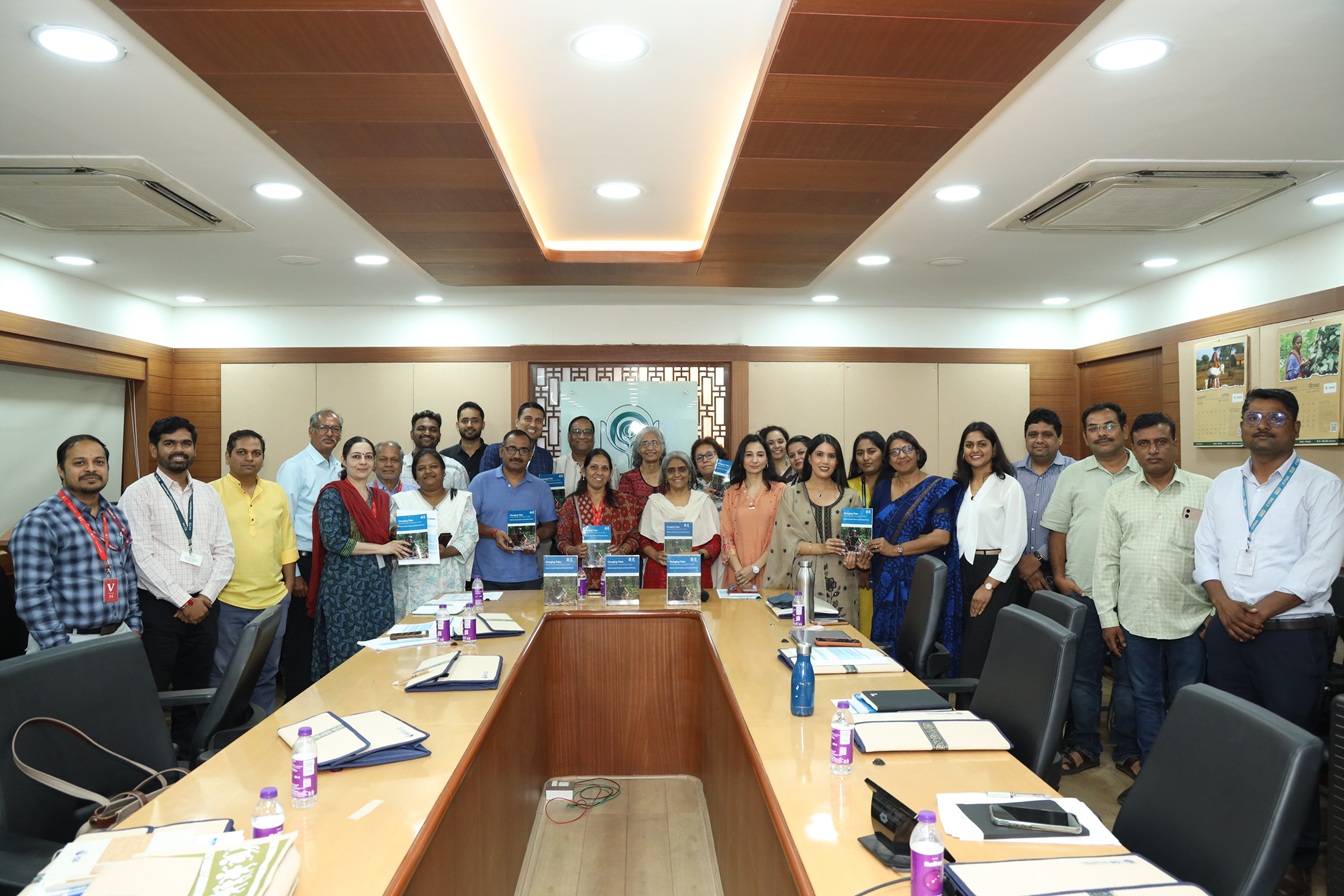


PUNE (India CSR): From acute water scarcity in Maharashtra’s drought-prone regions to increasingly frequent urban flooding in cities such as Pune, the state is experiencing the impacts of a changing climate in markedly different ways. How can policy and practice respond to these diverse and interconnected challenges? This question took centre stage at Changing Tides in Maharashtra, a workshop held in Pune on Friday that brought together researchers, policymakers, and practitioners to discuss evidence-based and community-led pathways for climate action.
The workshop drew on the recently published volume Changing Tides: Climate Action and Justice in
Held under the Platform for Development Research and Communication (PDRC) of the Indian School of Business’s Bharti Institute of Public Policy, the workshop was jointly organised with Pune-based non-profit Watershed Organisation Trust (WOTR), its research and think tank arm, the WOTR Centre for Resilience Studies (W-CReS), and FLAME University.
Setting the context, Prof. Anjal Prakash said, “Climate policy cannot operate in an academic or administrative vacuum; it must be deeply anchored in localised realities. Maharashtra reflects the complex dual burden India faces, from severe semi-arid water scarcity in Marathwada to recurrent urban deluge in cities like Pune. This workshop is intentionally designed to move beyond high-level theory, connecting grassroots practitioners directly with decision-makers to translate empirical research into immediate, actionable sub-national policies.”
Dr. Marcella D’Souza highlighted the importance of placing communities at the centre of climate action. She said, “True climate resilience is fundamentally an issue of justice, equity at the community level, economic viability, and ecological sustainability. As rural landscapes face increasing climate variability, our interventions from watershed restoration to sustainable livelihoods must center the lived experiences of vulnerable populations, especially women. The conversations we begin here must move beyond the workshop, translating evidence into practical action and stronger policies that empower communities to adapt to climate extremes.”
A key session focused on gender and groundwater management, with Dr. Eshwer Kale of W-CReS and Swati Sinha of BIPP- ISB, presenting research from 14 villages across Ahilyanagar and Jalna districts. The study highlighted how climate impacts are not gender-neutral and how social marginalisation can further increase vulnerability. It also presented examples of women taking leadership in water management, including a women-only group in Bhoyare Khurd, Ahilyanagar, that successfully led the technical implementation of water conservation initiatives, challenging established gender norms in water conservation.
Other sessions highlighted the success of the Lakhpati Kisan Programme presented by Ganesh Neelam from Sustain Plus, which has supported over 100,000 tribal households across four states, with 50% of participating households crossing the ₹1 lakh annual income threshold. Another session, led by Mr. CSR Murthy (Retd. CGM, NABARD), explored land management and rainfed agriculture in Maharashtra’s climate-vulnerable regions, with discussants from Advanced Centre for Water Resources Development and Management (ACWADAM) and Gokhale Institute of Politics and Economics (GIPE).
The presentations were followed by an engaging Q&A and discussions on Maharashtra-specific policy pathways. Prof. Prakash facilitated the open-floor discussion, followed by synthesis remarks from Dr. Nimisha Jain, Research Manager, Bharti Institute of Public Policy.
The key takeaway from today’s proceedings will be documented outlining actionable recommendations for Maharashtra’s agriculture, water resources, revenue, and urban development departments.
The Watershed Organisation Trust (WOTR) is a nationally and globally recognised non-profit organisation working towards sustainable rural development and climate resilience. Through its work on water availability, land and agricultural productivity, diversified livelihoods, women’s empowerment and community resilience, WOTR has contributed to transforming landscapes and strengthening vulnerable communities. Over 32 years, WOTR and its partners have worked across more than 8,600 villages in 10 states in India, positively impacting 9.7 million people.
The WOTR Centre for Resilience Studies (W-CReS) is the research arm of the Watershed Organisation Trust (WOTR). It generates practical, grounded evidence that helps improve how climate and development efforts are designed and delivered.



