


This paper examines the relationship between vehicle sales growth and the availability of original spare parts through an independent distributor network. It explores how independent service points, second-sales market technicians, roadside mechanics, and local garages contribute to customer confidence, vehicle retention, and long-term market growth.
The discussion primarily focuses on compact and sub-premium passenger vehicles. Premium, luxury, super-premium vehicles, and electric vehicles are outside the scope of this paper.
Introduction
The growth and long-term acceptance of an automobile brand are influenced by several interconnected factors. Traditionally, the automotive industry has relied upon six important pillars that determine the success of a product:
- Quality
- Reliability
- Durability
- Affordability
- Features
- Service Points
Collectively, these can be represented as Q-R-D-A-F-SP.
A successful product is expected to deliver high standards of quality, reliability, durability and affordability while offering competitive features. However, in today’s highly competitive automotive market, these parameters have become baseline expectations rather than differentiating advantages.
Modern automobile manufacturers have significantly narrowed the gap in engineering quality and manufacturing standards. Most leading brands today offer reliable products capable of competing effectively on quality, technology and durability.
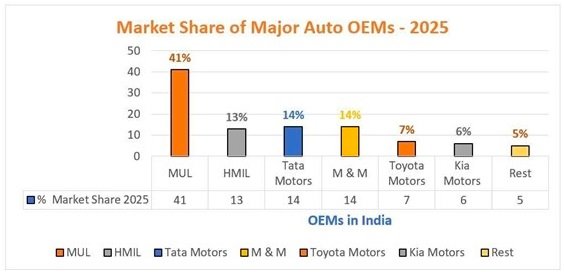
Yet, despite this convergence in product excellence, nearly 95 percent of the Indian passenger vehicle market continues to be dominated by only a handful of manufacturers, while several globally recognised brands compete for the remaining share.
This raises an important question.
If product quality alone determined market leadership, why do some brands with technologically advanced products struggle to expand their market presence, while others continue to dominate despite offering comparatively average features?
Clearly, product quality alone is not sufficient to determine market leadership.
Among the six parameters represented by Q-R-D-A-F-SP, one factor deserves significantly greater attention—the availability of service points.
The acceptability of an automobile extends far beyond the showroom. Customers evaluate not only the quality of the vehicle but also the ease with which it can be serviced, repaired and maintained over many years.
A strong service network reassures customers that assistance will be available whenever required. This confidence often becomes a decisive factor influencing purchasing decisions, particularly in a geographically diverse country like India.
Understanding the Dynamics of Automotive Growth
Assuming that an Original Equipment Manufacturer (OEM) successfully develops a product satisfying all six parameters of Quality, Reliability, Durability, Affordability, Features and Service Points, why do some manufacturers still struggle to establish themselves despite offering excellent products?
Conversely, why do some manufacturers continue to dominate the market even when competing products offer superior specifications and technology?
The answer probably lies beyond engineering excellence.
Two important contributors are:
- Product marketing and market strategy.
- Flexibility and adaptability of OEMs to respond to Indian business conditions and customer expectations.
Even after successful product demonstrations, competitive pricing, attractive financing and satisfactory test drives, customers continue evaluating one critical aspect—the availability of reliable after-sales support.
Service accessibility directly influences customer confidence.
Customers purchasing a vehicle are investing not only in transportation but also in a long-term ownership experience that includes maintenance, repairs and dependable support throughout the vehicle’s lifecycle.
Post-Sales Customer Ownership Behaviour
Customer behaviour changes considerably after the purchase of a vehicle.
Several ownership patterns have consistently emerged across the industry:
- After the complimentary service period, many vehicles never return to authorised dealerships.
- Once the warranty expires, customers increasingly prefer independent garages and local workshops for servicing and repairs.
- As vehicles age, owners become more conscious of maintenance costs, repair expenses and the overall cost of ownership.
These ownership trends present a significant opportunity for automobile manufacturers.
A broader and more accessible service ecosystem, supported by trained independent workshops and easy availability of genuine spare parts, can substantially enhance customer satisfaction while strengthening confidence in the brand.
To understand how these market forces influence long-term growth, it is useful to examine the experiences of leading automobile manufacturers.
Case Study 1: Hyundai Motor India – Building Customer Confidence Beyond the Product
When Hyundai Motor India entered the Indian market in 1998–99, it had virtually no presence in the country. Competing against established automobile manufacturers posed a significant challenge. However, Hyundai’s strategy extended far beyond introducing a new vehicle—it focused on creating an ecosystem that would build customer confidence and long-term brand acceptance.
The launch of the Hyundai Santro was supported by an aggressive marketing campaign, including the widely remembered positioning of the vehicle as “The Billion Dollar Car.” Extensive newspaper advertising and strategic brand communication generated strong public interest even before the product reached customers.
However, advertising alone did not drive Hyundai’s success.
The company recognised that a strong after-sales support system would be equally important in establishing trust among prospective buyers. Many of the initial dealership partners came with prior experience in the automotive industry and underwent extensive training to understand Hyundai’s customer-centric approach.
Dealer technicians, workshop managers and frontline sales teams received structured induction programmes designed not only to familiarise them with the product but also to deliver a superior customer experience. Every customer interaction—from the showroom to the workshop—was viewed as an opportunity to reinforce confidence in the brand.
Hyundai also invested significantly in expanding its dealership and service network across the country. As the network grew, the company introduced customer-connect initiatives, service campaigns and regular dealer engagement programmes that strengthened relationships with customers even after the sale of the vehicle.
An equally important contributor to Hyundai’s growth was its emphasis on employee engagement.
The organisation invested in recognising and rewarding employees through performance incentives, annual bonuses and appreciation programmes. Motivated employees became ambassadors of the brand, and their commitment reflected in dealer visits, customer interactions and service quality.
Regular dealer visits by sales and service teams were encouraged not merely as operational responsibilities but as opportunities to strengthen dealership relationships and understand market requirements.
Even in geographically challenging regions such as North-East India, Hyundai continued expanding its network and supporting its dealer partners. This long-term commitment helped establish customer confidence across diverse markets.
Hyundai’s success in India was therefore not built solely on engineering excellence or product features. It was the result of an integrated strategy combining product quality, marketing, customer care, employee engagement and a rapidly expanding after-sales service network.
The company’s experience demonstrates that sustainable market leadership requires much more than a successful vehicle launch—it requires continuous investment in customer confidence.
Case Study 2: FIAT India – When Superior Engineering Is Not Enough
The Indian automotive industry also offers examples where technologically superior products were unable to achieve sustained commercial success.
FIAT India serves as one such example.
Its flagship product, the FIAT Uno, was regarded by many as one of the most advanced small cars of its time. It offered several strengths that customers valued, including a fuel-efficient diesel engine, strong build quality, comfortable seating, dependable technology and reliable engineering.
From a product perspective, FIAT possessed many of the characteristics associated with long-term success.
Yet, despite these advantages, the brand gradually lost its presence in the Indian passenger vehicle market.
This raises an important question:
Why does a technically superior product sometimes fail to achieve lasting market acceptance?
One possible explanation lies beyond the product itself.
Compared with several competitors, FIAT’s marketing initiatives remained relatively limited. More importantly, the availability of service centres across the country was considerably smaller, making after-sales support less accessible for customers.
Another challenge emerged from the company’s co-selling arrangements, where FIAT products were marketed alongside competing brands. While this approach offered certain operational advantages, it limited the independent development of the FIAT brand identity and reduced opportunities to establish a distinct customer relationship.
As vehicle ownership extends over several years, customers increasingly value the confidence that comes from readily available service centres and dependable maintenance support.
Without an extensive service ecosystem, even an excellent product may struggle to build long-term customer trust.
The FIAT experience illustrates an important lesson for the automotive industry:
Engineering excellence alone cannot guarantee commercial success.
An outstanding product must be supported by effective marketing, strong after-sales service, accessible spare parts and an ownership ecosystem that assures customers throughout the vehicle’s lifecycle.
Key Learning
The contrasting journeys of Hyundai and FIAT demonstrate that market success is influenced by far more than vehicle specifications.
While Hyundai strengthened customer confidence through continuous investment in service infrastructure, dealer development and customer engagement, FIAT’s experience highlights the challenges that can arise when product excellence is not supported by an equally robust service ecosystem.
These examples reinforce the central argument of this paper—that product quality may attract customers, but service accessibility, customer confidence and after-sales support ultimately determine long-term market growth.
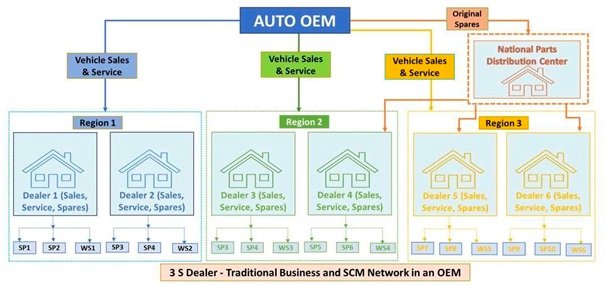
The next section examines the evolution of the traditional Sales–Service–Spares (3S) business model and how separating these functions created new opportunities for expanding service accessibility, improving original spare parts availability and strengthening vehicle sales.

Bhaskar Nandi is an automotive and manufacturing domain expert with more than 27 years of industry experience. Having worked with Hyundai, Honda, Mahindra & Mahindra, and leading technology organisations, he specialises in automotive business transformation, manufacturing operations, and aftermarket service strategies. His research focuses on identifying market dynamics that contribute to sustainable growth within the automotive industry.