


By Rusen Kumar
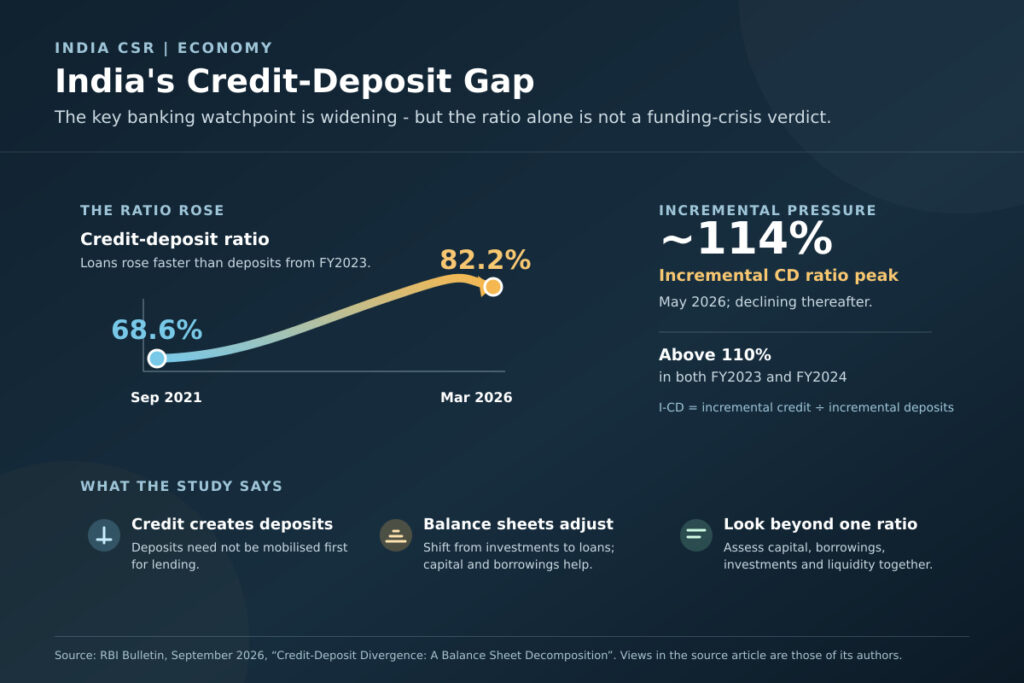
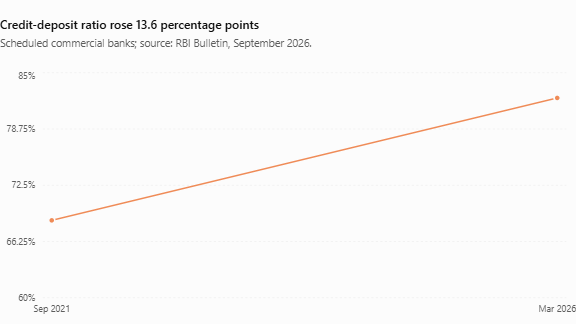
MUMBAI: India’s widening credit-deposit gap has become the banking system’s central balance-sheet watchpoint. A research article in the September 2026 RBI Bulletin, “Credit-Deposit Divergence: A Balance Sheet Decomposition”, finds that the credit-deposit (CD) ratio of scheduled commercial banks rose from 68.6 per cent in September 2021 to 82.2 per cent in March 2026. The incremental CD ratio – the relationship between newly created credit and incremental deposits – breached 110 per cent in both FY2023 and FY2024. It then peaked at around 114 per cent in May 2026 before declining.
The authors link the recent easing partly to an inflow of Foreign Currency Non-Resident (Bank), or FCNR(B), deposits. In a bank-dominated financial system, where bank credit accounts for more than 65 per cent of total resources flowing to the commercial sector, the trend deserves close attention.
Why It Matters
The concern is straightforward: if loans keep growing materially faster than deposits for an extended period, banks may have to depend more heavily on costlier or less stable sources of funds, or slow lending. They must also meet reserve requirements, capital norms, provisioning needs and liquidity rules as their loan books expand. This makes the gap more than a headline ratio. It is a test of the quality, stability and mobility of deposits, as well as the resilience of banks’ wider balance sheets. In normal conditions, the study notes, high credit demand often accompanies economic expansion and can lift the CD ratio.
India’s recent rise, therefore, should not be read automatically as a sign of distress. But it does raise a legitimate question: how is the system financing the additional credit, and whether the answer remains sustainable if deposit growth stays subdued?
India’s Credit-Deposit Gap:
What It Means for Your Savings, FDs and Loans
- For depositors: Banks may compete harder for deposits, so FD and savings rates could stay attractive or improve. There is no reason to panic or withdraw money merely because of this ratio.
- For borrowers: Home, vehicle, personal and business loans may not become cheaper quickly. If banks need costlier funding, lending rates can remain high or rise over time.
- For bank safety: The RBI Bulletin article indicates that banks presently have strong capital, liquidity and lower bad loans. So, the trend does not mean that banks are running out of money.
- For the economy: Credit is helping businesses and households borrow and grow. But if deposit growth remains weak for too long, banks may slow lending or seek more expensive funds.
Credit Creates Deposits
The article challenges the common assumption that banks must first collect deposits and then lend them. In a modern monetary system, a new bank loan simultaneously creates a matching deposit in the borrower’s account. Deposits, by themselves, are therefore not an absolute precondition for credit creation. That does not mean banks can lend without limit. Once funds move across banks or into currency and financial-market products, banks must manage the resulting liquidity transfers.
Lending is ultimately constrained by risk-adjusted profitability, capital adequacy, reserves, liquidity coverage, provisioning and the quality of assets. The practical lesson is that a rising CD ratio should be read as the outcome of several balance-sheet movements, not merely as a gap between a bank’s deposits collected and loans disbursed. It also explains why loan growth can initially run ahead of deposit mobilisation without immediately creating a funding rupture.
Balance Sheet Adjustments
The RBI Bulletin article finds that banks have responded to the current high-CD-ratio phase through adjustments on both sides of their balance sheets. On the asset side, banks have tilted away from investments towards loans and advances, using maturing investments, reserves and other balances to support greater credit demand. On the liability side, deposits have been complemented by higher capital, borrowings and other liabilities.
During the recent rising-CD-ratio phase, these non-deposit sources together contributed Rs. 40 for every Rs. 100 of deposit growth, compared with Rs. 32.1 during the 2002-08 rising phase. Capital deepening was the largest contributor: Rs. 15.5 per Rs. 100 of deposit growth, compared with Rs. 11.7 earlier. The study links this stronger capital position to higher bank profitability.
Savings Behaviour Changes
The widening wedge also reflects changing patterns in savings and money flows. The study identifies currency with the public as a prominent source of deposit leakage in the recent period, although its longer-term trend is declining, suggesting that this drain may weaken over time. At the same time, households have increasingly moved from conventional fixed deposits towards financial-market products, including mutual funds offered by non-bank financial intermediaries. Such funds may be placed with banks as higher-velocity deposits, carrying a greater run-off risk than stable household term deposits.
Non-bank institutions have also surpassed commercial banks as the largest holders of government securities; when they invest in government bonds, new bank deposits are not created in the same way as when banks make credit or investment decisions. By contrast, foreign capital inflows create fresh deposits. Recent FCNR(B) inflows have bolstered deposits and helped pull the incremental CD ratio down from its May peak.
Banks Remain Resilient
The data in the article nevertheless point to a banking system that is currently carrying meaningful buffers. The liquidity coverage ratio stood at 124.2 per cent in 2026, while the capital-to-risk weighted assets ratio was 17.7 per cent and the common equity tier 1 ratio was 15.3 per cent. Asset quality has improved sharply: gross NPAs were 1.8 per cent of gross advances and net NPAs were 0.4 per cent of net advances. Certificates of deposit accounted for only around 2.5 per cent of aggregate deposits, while the system’s return on assets and return on equity remained positive at 1.3 per cent and 12.5 per cent, respectively. These indicators do not remove the need for vigilance, but they support the authors’ conclusion that the present rise in the CD ratio is occurring alongside a profitable, well-capitalised and liquid banking system, rather than during a period of visible system-wide stress.
Watch Whole System
The main takeaway is not that India should ignore the credit-deposit gap; it is that the ratio alone is too narrow to diagnose funding vulnerability. Policymakers, banks, investors and depositors need to track the full funding picture: the pace of credit and deposit creation, deposit stability, currency leakage, the role of mutual funds and other non-banks, asset reallocation, capital accretion, borrowing costs, investment liquidity and foreign-currency inflows. A continuation of faster credit growth could intensify competition for deposits and increase reliance on market borrowing, especially if the composition of savings shifts further away from stable term deposits. Equally, the decline in the incremental CD ratio after May 2026 shows that the pressure is not fixed or one-directional. For India’s growing economy, the biggest banking trend is not simply a higher CD ratio; it is the way banks are reshaping their balance sheets to finance growth while preserving prudential strength.