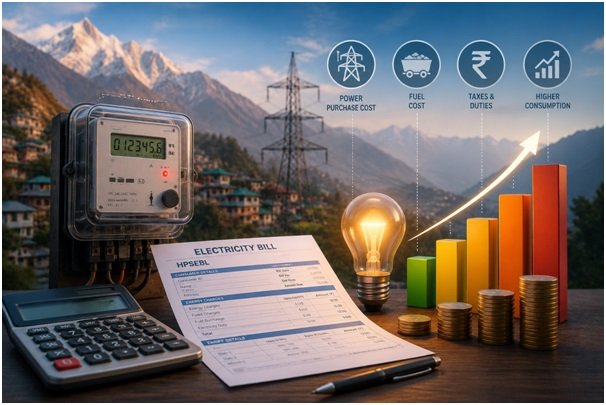



Himachal Pradesh runs largely on hydropower and generates more electricity than it consumes. Yet for many residents, the monthly electricity bill still raises questions. This article explains exactly how HPSEBL calculates what you owe.
If you live in Himachal Pradesh and pay an HPSEBL electricity bill, you may have wondered why the amount changes from month to month. The answer lies in how the tariff is structured. Once you understand the slabs, the subsidies, and the fixed charges, your bill stops being confusing.

Paying your HPSEBL bill on time is simple from wherever you are. Bajaj Pay lets you pay from your phone in minutes, without visiting a collection centre. In a state where many consumers live far from urban centres, that matters.
The board that powers Himachal Pradesh
HPSEBL stands for Himachal Pradesh State Electricity Board Limited. Established in 1971, it handles electricity distribution and transmission across the state. It is regulated by HPERC, the Himachal Pradesh Electricity Regulatory Commission, which sets tariff rates annually.
The current tariff came into effect on 1 April 2026. The average cost of supply for FY 2026-27 stands at Rs 6.75 per unit, down by 1 paisa from the previous year according to HPERC Tariff Order FY 2026-27. Rates have been reduced by 1 paisa per unit across all consumer categories this financial year.
Inside every HPSEBL bill
Your bill has three main components, each set by HPERC. Energy charges are the cost of units consumed. The rate depends on your monthly consumption, and which slab it falls into. Fixed charges are a flat monthly amount, paid regardless of how much electricity you use. For most domestic consumers this is Rs 85 per month, and Rs 55 for BPL and rural consumers on a lower load.
The Government of Himachal Pradesh subsidy is applied directly to eligible consumers’ bills. BPL households and ration card holders receive full or partial subsidy, meaning their effective bill can be significantly lower than the standard rate.
The slabs, in plain numbers
For domestic consumers not on a BPL or ration card subsidy, the current energy charges effective 1 April 2026 are as follows:
- Lifeline (0 to 60 units): Rs 4.71 per unit
- First slab (0 to 125 units): Rs 5.44 per unit
- Second slab (126 to 300 units): Rs 5.89 per unit
- Above 300 units: Rs 5.89 per unit
For BPL consumers and ration card holders, the state government covers the full tariff for lifeline and first slab consumption. The effective amount they pay for those units is zero.
A practical example: a non-subsidised consumer using 200 units pays Rs 5.44 for the first 125 units and Rs 5.89 for the remaining 75. That comes to Rs 1,124 in energy charges, plus Rs 85 in fixed charges.
When the amount goes up
If your bill looks higher than last month, one of three things has changed.
Consumption is the most common reason. Cold winters push heating appliance and geyser usage significantly higher. More units consumed means crossing into a higher slab and paying a higher rate on those extra units. Annual tariff revision is the second reason. HPERC revises rates each April. This year the revision works in your favour with a 1 paisa reduction across the board. The third reason is estimated billing. In remote areas with difficult terrain, meter reading is sometimes delayed. HPSEBL issues an estimated bill based on past consumption and adjusts it in the following cycle.
What consumers should know
Tracking your monthly consumption and comparing it to your bill is the most useful habit you can build. If you are eligible for the HP government subsidy and not receiving it, contact HPSEBL with your ration card details.
For consumers across Himachal Pradesh, paying your HPSEBL bill on time avoids late payment charges and keeps your account in good standing.
How to pay your HPSEBL electricity bill through Bajaj Finance
Here is how to pay through Bajaj Finance:
- Open the Bajaj Finance app or visit the website
- Go to Bajaj Pay and look for the Bills and Recharges section
- Select the relevant category (Electricity, Mobile Recharge, etc.)
- Choose the operator
- Enter the consumer or account number to pull up the account
- Current bill amount and due date appear on screen
- Pick preferred payment method: UPI, net banking, or a saved card
- Hit pay and confirmation arrives instantly
HPSEBL’s tariff structure is straightforward once you know the slabs. Subsidised households pay very little. Non-subsidised consumers move through two rate levels before the slab flattens above 300 units. Rates have come down slightly this year. Check your slab, track your usage, and pay on time.