

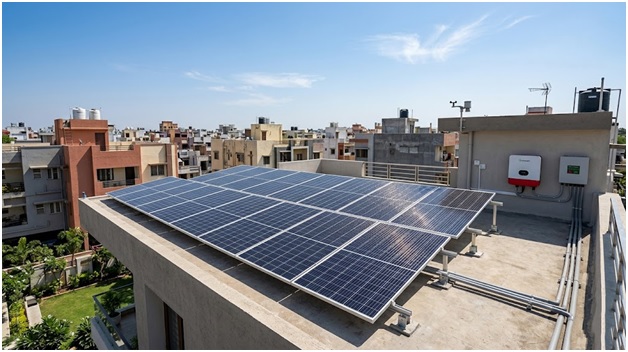


Installing solar panels can help households and businesses generate electricity from sunlight and manage their power expenses over time. However, the results depend on more than the panels themselves. The quality of the equipment, installation work, warranty and after-sales support all matter when choosing a solar company in Noida.
Before comparing quotes, understand what each installer offers, which approvals are required and how the system will meet your electricity needs. These checks can help you make an informed decision.
1. Check Certifications and Eligibility for Solar Subsidies
If you are installing rooftop solar at home, check whether the installer is registered under the applicable government scheme. Under the PM Surya Ghar: Muft Bijli Yojana, eligible residential consumers can receive central financial assistance of up to ₹78,000 for systems of 3 kW or higher. The amount depends on the system capacity and the scheme’s eligibility conditions.
You should also ask whether the proposed solar modules meet the applicable Approved List of Models and Manufacturers (ALMM) and domestic content requirements. These requirements depend on the scheme and project category. The Ministry of New and Renewable Energy (MNRE) publishes the relevant approved lists on its official website.
Before signing an agreement, confirm the installer’s registration status, the eligibility of the proposed equipment and the documents needed to apply for assistance. Do not assume that every solar installation qualifies for a subsidy.
2. Find Out Who Will Handle the Installation
Some solar companies use their own installation teams, while others work with subcontractors. Neither arrangement alone determines the quality of the work, but you should know who will be responsible for the project.
Ask the company who will conduct the site inspection, install the panels, complete the electrical connections and handle any issues after commissioning. A site assessment should consider available roof space, shading, roof condition and the property’s electricity use.
Request a written breakdown of the work included in the quote. It should specify the panels, inverter, mounting structure, wiring, protection devices, installation charges and any civil or electrical work required. Clear details make it easier to compare proposals from different companies.
3. Confirm DISCOM Approvals and Net Metering Support
Rooftop solar installations may require coordination with the local electricity distribution company (DISCOM). The relevant provider in Noida can depend on the property’s exact address, so check the name on your electricity bill before proceeding.
Ask whether the solar company will help with the application, required documents, inspection and meter-related procedures. You can also review the process through the PM Surya Ghar national portal.
Net metering allows eligible rooftop solar consumers to export surplus electricity to the grid, subject to the applicable rules and connection arrangements. Ask the installer to explain how the system will work with your property’s electricity connection and what approvals are needed before it can be commissioned.
4. Compare Solar Panel Technology and Specifications
Solar panels differ in their cell technology, power output, efficiency and construction. When comparing options, review the module’s rated capacity, efficiency, dimensions, product warranty and performance warranty. The right choice will depend on your roof area, energy requirements and budget.
N-type TOPCon is one solar cell technology buyers may come across when comparing newer modules. It is worth checking the specifications of the exact model being offered rather than relying on the technology name alone.
India also has domestic solar module manufacturing facilities. For example, Avaada Electro, one of the best solar companies in India, manufactures TOPCon solar modules at its facilities in Dadri, Uttar Pradesh, and Nagpur, Maharashtra. This is one example of the manufacturing options buyers may encounter while researching a solar company in Nagpur. The final selection should still be based on the module’s specifications, applicable approvals and suitability for the project.
For a fair comparison, ask each installer to identify the manufacturer and model number of the proposed panels. Check that these details match the product documentation and quotation.
5. Review Warranties and After-Sales Support
Solar systems are designed to operate for many years, so warranty terms and service arrangements deserve attention. A quotation may include separate warranties for the solar modules, inverter and installation work. Check each one individually instead of treating the entire system as covered under a single warranty.
Ask the company who will handle a fault, how to raise a service request and whether support is available locally. You should also clarify whether removing or replacing equipment during repairs will involve additional charges.
Read the warranty terms carefully to understand what is covered, which conditions apply and what could invalidate the warranty. Keep copies of the invoice, product details, installation documents and warranty certificates for future reference.
6. Compare Quotes and Understand the Total Cost
Solar installation costs vary according to system capacity, equipment, roof conditions and the work required at the site. A lower quote may exclude items that another company has included, so compare the complete scope rather than the final amount alone.
MNRE benchmark costs of ₹50,000 per kW for the first 2 kW and ₹45,000 for each additional kW. These figures are reference benchmarks, not guaranteed market prices or a final quote for every installation. Check the latest applicable rates and scheme terms before making a decision.
Ask each solar company to list the system capacity, panel and inverter models, installation charges, taxes, approvals and any additional work separately. For residential projects, check whether the quote shows the estimated subsidy separately from the upfront system cost. Do not assume that assistance will apply until eligibility is confirmed.
For businesses, the assessment should also consider daytime electricity use, available roof area and the expected pattern of solar generation. Ask the installer to explain the assumptions behind its generation estimates and savings calculations.
Conclusion
Choosing a solar company in Noida involves more than comparing prices. Check the installer’s credentials, understand who will carry out the work, confirm approval requirements and review the equipment specifications, warranties and service arrangements.
Leading solar panel companies like Avaada Electro offer another option to consider when evaluating solar solutions and comparing providers. Obtain written quotations from multiple providers and compare the same system capacity and scope wherever possible. With these details in hand, you can assess which proposal best suits your property, electricity needs and budget.