

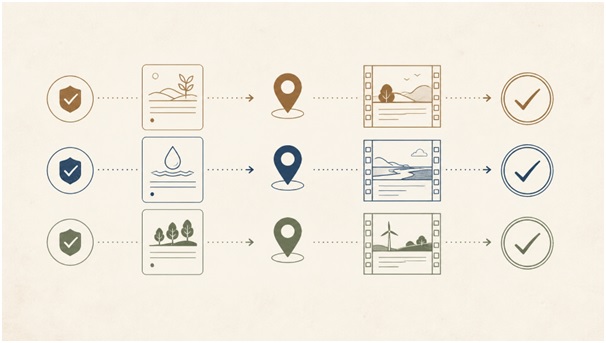



A social-impact film can lose trust before a camera is switched on. One scene compresses three years of work into a single success. A composite character repeats a quote that belonged to someone else. A location appears to prove a result that was measured in another district. Each choice may make the story smoother, but together they blur what a community, funder, or programme team can verify.
Revision becomes accountable when the team can answer three plain questions: what exactly is being claimed, who can verify its scope, and where will the audience encounter it? Until those answers are attached to a scene, polished narration and persuasive images can make an uncertain statement look settled.
Start With The Promise A Community Can Check
Before drafting scenes, reduce the film’s message to one promise that can survive scrutiny. “The programme changed lives” is too broad. “The new transport route cut the walk to the clinic for families in three villages” names an outcome, an affected group, and a boundary. The team can now ask what evidence exists and what the film must not imply.

The claim owner is the person or record responsible for verification. That may be a programme lead, monitoring specialist, field partner, finance team, or community representative. During review, an AI Script Writer can help that owner locate the line, scene, and connected planning material in Laper. Ownership still means the writer knows where to return when an edit changes the meaning of a number, timeline, place, or quotation.
Separate Verified Evidence From Dramatic Compression
Documentary and CSR films often compress time because an audience cannot watch every meeting, delay, and course correction. Compression becomes misleading when the film removes a condition that materially changes the outcome. If a two-year programme succeeds only after a local group redesigns the delivery method, a montage that credits one corporate decision rewrites the cause.
Write two lines beside each major claim: what is verified, and what is being compressed. The screenplay may combine routine visits, shorten a journey, or use a representative action. It should not transfer an outcome to a location that did not produce it or present a composite quotation as a verbatim testimony.
Map Every Claim To A Filmable Moment
A claim ledger should connect evidence to the exact scene where the audience receives it. This prevents approval from happening only at the end, when changing a voice-over line may require a new edit, graphic, or interview. The ledger can remain compact. Five fields usually expose the real risk.
- Name the public claim in plain language.
- Record the owner who can verify its scope.
- Point to the scene, line, or visible action carrying it.
- List the condition the film must preserve.
- Set the next review point before production locks.
This list is not a second screenplay. It is a review route. The page still determines what the audience sees and hears. The ledger tells the team which claim owner must return when a writer, director, or editor changes that moment.
Use Scene Headings As Location Evidence
A scene heading is more than formatting when the place carries meaning. Laper derives scenes and location entities from those headings. If the script says `EXT. RIVERBANK – MORNING`, the planning views can attach scouting notes and references to that location. Change the heading, and the team should reconsider what the new place proves.
Suppose a water project filmed a restored community well but the script relocates the conversation to a riverbank for visual variety. The new image may imply that river water is the intervention. Fixing the location in a scouting sheet alone is not enough. Correct the screenplay source, then review the attached scene and production material.
Give Numbers A Spoken And Visual Check
Numbers can enter through narration, interview, graphics, or visible records. Check both the spoken line and the picture beside it. “Three villages” over footage from one village is not automatically wrong, but the edit should not pretend the single image demonstrates the whole result. A simple caption or a change in narration may preserve the boundary.
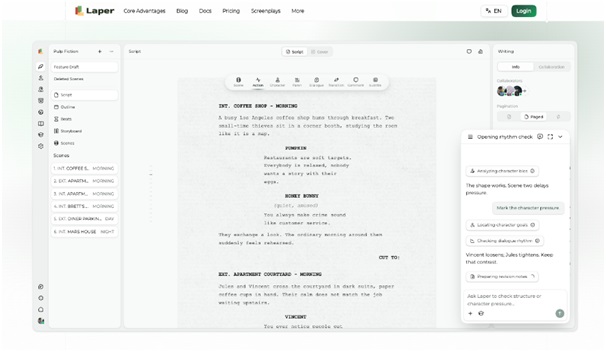
When a disputed claim spans several script elements, use AI for script writing to map the selected scene or range: which lines, headings, characters, and props depend on it? Review that map with the claim owner before authorising edits. The assistant can locate dependencies in structured material; it cannot certify the programme evidence.
Keep Production Notes Outside Story Truth
The screenplay cannot carry every scouting decision, consent status, interview release, measurement method, and visual reference. Forcing all of that into action paragraphs makes the page unreadable. Laper’s project model gives locations, characters, props, shots, and assets their own places while keeping them attached to the same work.
The boundary should remain explicit. A scene heading establishes that the story uses a health centre. Scouting notes describe access, power, sound, and filming permission. A character cue establishes who speaks in the screenplay. A profile can hold background and relationship material. Neither planning layer should silently change the words the audience will receive.
Review The Page At Three Moments
Run a claim review when the outline is stable, again before filming, and once more after the rough cut changes timing or context. These are not full legal or audit reviews. They are focused checks of the claims that carry reputational or community risk. A small set of owners can resolve them quickly when the scene links are already known.
At outline stage, confirm that the film’s causal story matches programme evidence. Before filming, confirm names, places, sequences, and what may be reenacted. At rough cut, check whether music, image order, or a shortened answer has created a stronger implication than the approved screenplay did.
Record Every Correction At Its Source
If a number changes, update the screenplay line and every planned graphic that depends on it. If a location is wrong, fix the heading before correcting the scene card. If a composite character becomes unnecessary, remove the cue and review the relationship and casting material around it. The aim is one correction that travels through known dependencies.
Laper can help by reading an outline first, locating relevant scenes, and applying an approved patch through the live editor. Use the smallest useful scope. A correction to one testimony does not justify a free-ranging rewrite of the entire film, especially when other claims have already passed review.
Approve The Meaning Before The Polish
A beautifully written CSR film can still fail its audience if viewers cannot tell what happened, where it happened, and who can stand behind the claim. Treat dramatic compression as a visible editorial choice, not a shortcut that disappears during approval.
The practical standard is simple: every material promise has an owner, every owner can find the scene carrying it, and every late correction returns to the page before the film asks a community to trust it.


