




New analysis finds significant gaps between the geography and scale of India’s development challenges and the direction of identifiable CSR funding across health, youth employment, women’s economic agency, groundwater and research.
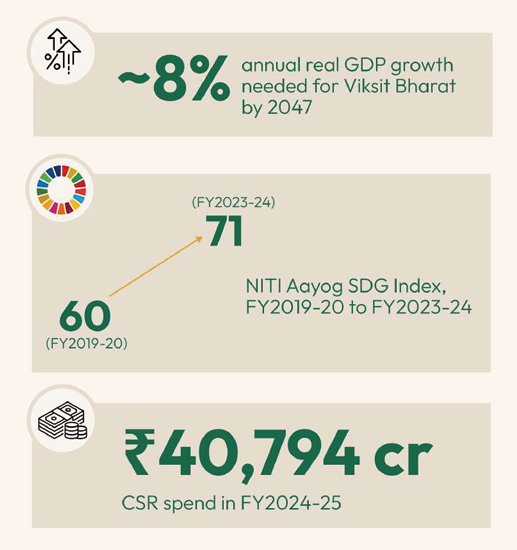
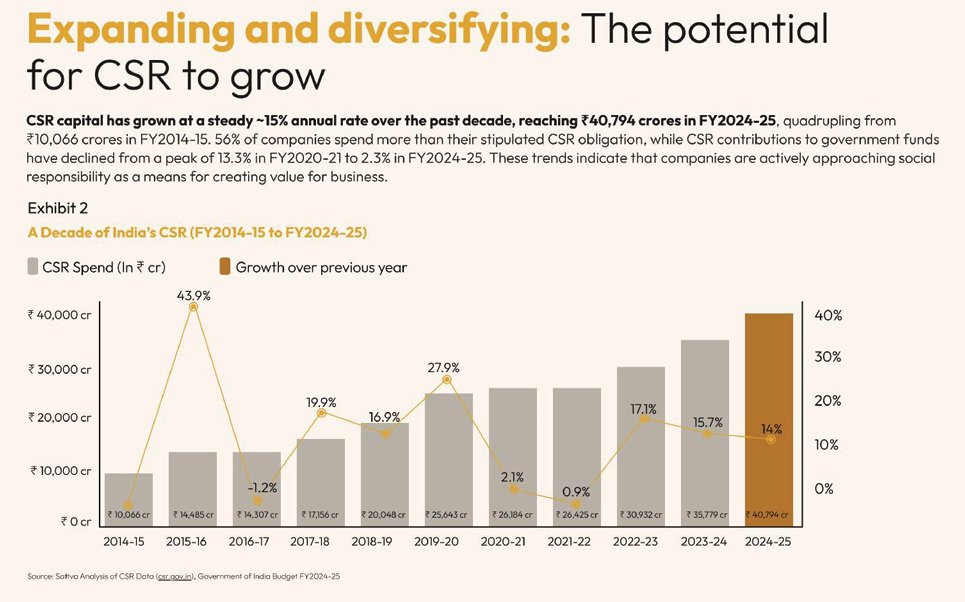
BENGALURU (India CSR): India’s corporate social responsibility spending reached Rs. 40,794 crore in FY 2024–25, recording a compound annual growth rate of 15% over the past decade. Yet, a new report by Sattva Consulting and India Data Insights finds that the distribution of CSR funding does not always align with the scale, severity or geography of India’s most pressing development challenges. The eighth edition of Sattva Consulting’s annual CSR report, Catalytic CSR: Where Focused Capital Can Move India’s Developmental Needle, examines five areas where funding patterns merit closer attention: non-communicable diseases, school-to-work transition, women’s economic agency, groundwater resilience, and innovation and research. The analysis draws on identifiable CSR projects of Rs. 25 lakh and above reported to the Ministry of Corporate Affairs between FY 2022–23 and FY 2024–25.
Capital Needs Agility
The report argues that the next phase of CSR must move beyond the question of expenditure size and focus more deeply on strategic relevance, adaptability and evidence-led allocation. Srikrishna Sridhar Murthy, Co-founder and CEO, Sattva Consulting, said, “CSR has brought size and predictability to funding. It now needs agility.” He added that CSR cannot replace the government, but it can be patient and risk-tolerant in ways that other capital often cannot. This gives corporates an opportunity to test unproven models, build evidence on what works and support wider adoption of effective approaches. “The question for corporates is no longer only how much they spend, but whether that spend is reaching the problems where it can make a difference,” Murthy said. The report positions CSR as catalytic capital that can help solve persistent gaps rather than merely supplement familiar programmes.
Cardiovascular Care Underserved
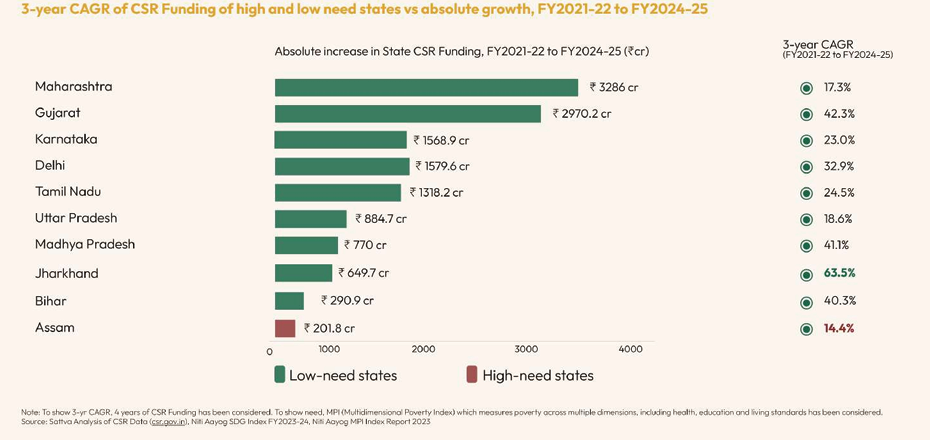
Non-communicable diseases account for around 60% of deaths in India, rising from 45% during 2004–06 to 60% in 2022–24, according to the report. Cardiovascular diseases alone account for approximately one-third of all deaths and more than half of NCD-related deaths. However, the funding pattern is markedly concentrated. Nearly 62% of identifiable NCD-related CSR funding is directed towards cancer, while cardiovascular diseases receive only about 12%. The finding does not suggest that cancer requires less attention; instead, it highlights the need for a more balanced response across the broader NCD burden. CSR can potentially support prevention, screening, community awareness, primary-care strengthening, treatment adherence and referral systems for heart disease and other chronic illnesses, particularly where early diagnosis and continuity of care remain critical challenges.
Transitions Need Support
India’s youth unemployment rate stands at around 9.9%, but the challenge becomes more acute among educated young people. The report notes that unemployment rises from 8.8% among those with higher-secondary education to 25.9% among graduates. While more than half of identifiable CSR funding for the school-to-work transition is directed towards academic support and skilling, crucial elements of the wider transition ecosystem receive relatively less attention. In FY 2024–25, for every Rs. 1 directed towards academic and skills support, only Rs. 0.24 went towards exposure to the world of work. This includes career guidance, internships, employer engagement, workplace readiness, mentorship and opportunities for young people to understand employment pathways. The report calls attention to the need for CSR programmes that help learners move successfully from classrooms and training centres into dignified, sustainable livelihoods.
Women Need Systems
Women’s economic agency receives Rs. 1,122.8 crore, or 29% of identifiable funding in the relevant dataset, making it the largest identifiable share among the areas examined. However, the report finds that nearly 77% of this funding is concentrated on skilling and livelihoods. While these are important interventions, the report stresses that women’s sustained economic participation also depends on structural enablers. India ranks 144th among 148 economies on economic participation and opportunity in the World Economic Forum’s Global Gender Gap Report 2025. The report identifies care infrastructure, safe mobility, market access, business networks, workplace retention and access to supportive institutions as important gaps. A more complete CSR response would help women not only gain skills or start enterprises, but also stay economically active, grow their businesses and progress into leadership and higher-value opportunities.
Water Stress Misaligned
Groundwater resilience presents one of the report’s sharpest geographic mismatches. Nearly one in seven groundwater assessment units in India faces critical extraction stress. Punjab, Rajasthan and Haryana together account for almost 49% of the country’s critical or over-exploited assessment units, yet these states receive only around 7% of identifiable groundwater-resilience CSR funding. The report also finds that 95% of identifiable funding is directed towards recharge and source sustainability. By comparison, water-use efficiency and demand management, water quality and source protection, and planning and management receive considerably smaller shares. This imbalance matters because water resilience requires more than replenishing sources. It also requires responsible use, efficient agriculture, local governance, better data, community participation and protection of water quality. CSR can support integrated approaches that connect recharge with demand-side management and local planning.
Research Needs Translation
The report identifies innovation and research as another area where catalytic CSR could play a greater role. India currently spends around 0.84% of GDP on research and development, compared with 2.5% to 5% in leading innovation economies. Sattva’s analysis identifies approximately Rs. 298 crore in CSR funding for innovation and research across development sectors between FY 2022–23 and FY 2024–25. No industry, however, directs more than 1.2% of its total CSR spending towards innovation. The report highlights research translation as a key gap—the process of moving scientific discoveries, social innovations and promising ideas through validation, deployment and market adoption. Corporates can help bridge this space by backing pilots, evidence generation, technology adaptation and models that make research more usable for communities, governments and development institutions.
Data Must Guide
The report outlines three shifts for CSR to move from scale to agility: continuously reassessing programmes through data, outcome measurement and learning loops; moving closer to critical and persistent needs where other forms of capital may not flow; and acting as a multiplier through partnerships, innovation and technology. It notes that non-communicable diseases and school-to-work transition are persistent constraints within already well-funded sectors such as health and education, while women’s economic agency, groundwater resilience, and innovation and research are cross-cutting or emerging areas where the CSR response is still maturing. The five areas are not presented as an exhaustive list of India’s development challenges. Rather, they offer a framework for corporates to examine where their capital, expertise, networks and evidence can create the greatest additional value.
Key Facts: Growth, Change and Funding Gaps
| Indicator | Earlier / Benchmark | Latest Finding | Change / Gap |
|---|---|---|---|
| India’s CSR spending | — | ₹40,794 crore in FY 2024–25 | 15% CAGR over the past decade |
| NCD-related deaths | 45% of all deaths in 2004–06 | 60% in 2022–24 | +15 percentage points; a 33.3% relative increase |
| Cardiovascular disease funding | Cancer receives 62% of identifiable NCD CSR funding | Cardiovascular diseases receive 12% | 50 percentage-point gap; cancer receives over 5 times more funding |
| Youth unemployment | 8.8% among higher-secondary educated youth | 25.9% among graduates | +17.1 percentage points; graduate unemployment is nearly 3 times higher |
| School-to-work funding | ₹1 for academic and skilling support | ₹0.24 for exposure to the world of work | Work-exposure funding is 76% lower than academic and skilling support |
| Women’s economic agency | — | ₹1,122.8 crore; 29% of identifiable funding | 77% goes to skilling and livelihoods; only 23% supports other enablers |
| Groundwater stress states | Punjab, Rajasthan and Haryana hold 49% of critical/over-exploited units | Receive only 7% of identifiable groundwater CSR funding | 42 percentage-point mismatch; funding is about 86% lower than the share of groundwater stress |
| Groundwater funding allocation | — | 95% directed to recharge and source sustainability | Only 5% remains for demand management, water quality, source protection and planning |
| India’s R&D investment | Leading innovation economies invest 2.5–5% of GDP | India invests 0.84% of GDP | Gap of 1.66–4.16 percentage points |
| Innovation CSR funding | — | ₹298 crore between FY 2022–23 and FY 2024–25 | No industry allocates more than 1.2% of its total CSR spend to innovation and research |



