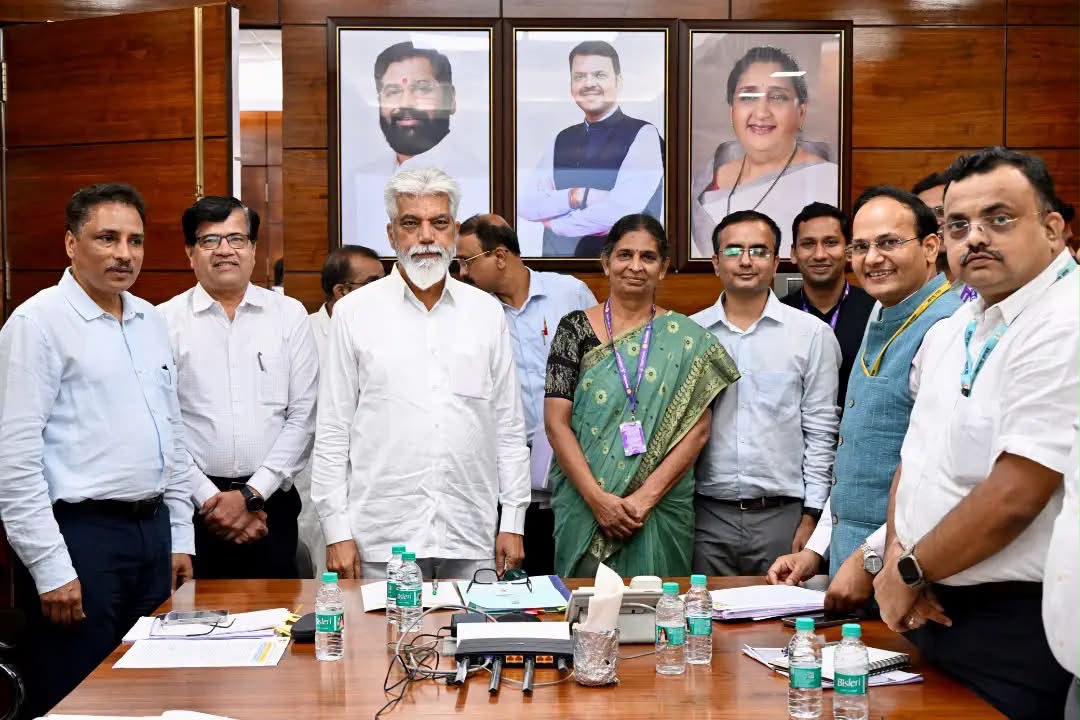


MUMBAI (India CSR): State Council of Educational Research and Training, Maharashtra in collaboration with Kotak Education Foundation announced the launch of ‘AI Saathi for Educators’ in Mantralaya on July 14th, 2026. The Education Minister, Dadaji Bhuse, launched the AI Saathi course.
The launch was attended by the Chief Secretary of School Education and Sports Department, Ranjit Singh Deval, Education Commissioner Sachindra Pratap Singh, Director of SCERT Dr. Hemant Vasekar, President of Maharashtra State Examination Council, Nandkumar Bedse, Director of Secondary Education Mahesh Palkar, Director of Primary Education Sharad Gosavi, Deputy Director of SCERT Varsharani Bhopale, Sub-division Chief Rajendra Wakade, Dr. Sandip Mulay, Deputy HOD, IT Department and Alka Pagare, Mr. Milind Pandey and Deepak Pathak on behalf of Kotak Education Foundation.
Key members of the core project development team who championed the initiative also include Dr. Kamaladevi Awate, Joint Director, Jyoti Shinde, Deputy Director, IT Department and Nivas Kamble, Superintendent, IT Department. A first-of-its-kind structured professional development program designed to build foundational Artificial Intelligence (AI) literacy among teachers, ‘AI Saathi for Educators’ enables meaningful integration of AI in education.
AI Saathi is the first virtual course to be selected as a mandatory training programme under the Maharashtra State School Education Department’s online training policy. As part of the state’s 20-hour mandatory online professional development framework, the AI Saathi course has been allotted four hours of certified training.
The course will be compulsory for approximately 7.5 lakh teachers and officers across Maharashtra, covering educators from Grades 1 to 12. According to SCERT, AI Saathi was selected from a pool of 10 courses submitted for evaluation, marking a significant milestone and recognition of Kotak Education Foundation’s contribution towards AI-enabled teacher capacity building in the state.
Leadership Perspective
Commissioner (Education), Sachindra Pratap Singh (IAS) said, “The AI Saathi online course has been developed for all teachers of the state and officials of the Education Department. Through this course, I am fully confident that AI will become a companion for teachers in their day-to-day academic work. With this online course, the state has taken a significant step towards integrating AI into education.”
Director, Dr. Hemant Vasekar (IAS) said, “AI has entered every sphere of life and has the potential to become a trusted companion for teachers. I strongly believe that through this course, educators will be able to work more effectively and efficiently.”
Ganesh Raja, CEO, Kotak Education Foundation, said: “Teachers remain at the heart of education, and AI must evolve as a tool that strengthens their capabilities, not replaces them. Through AI Saathi for Educators, we are enabling teachers across Maharashtra to confidently understand, adapt to, and responsibly use AI in their classrooms. What makes this initiative especially meaningful is its accessibility in Marathi and its focus on practical classroom integration. We are building a future-ready educator ecosystem that is inclusive, practical, and deeply rooted in classroom realities.”
Jayasree Ramesh, COO, Kotak Education Foundation, said: “AI Saathi is proof that cutting-edge technology and grassroots impact are not at odds. For the first time, Maharashtra’s teachers have a resource that speaks to them, literally, in Marathi, building the AI literacy that no device alone can deliver. When educators lead with confidence and ethical grounding, every child in that classroom benefits. That is the transformation we are here to drive.”
Kotak Education Foundation began integrating AI into its teacher capacity-building initiatives in 2023, with a focus on helping educators use emerging technologies confidently, responsibly, and meaningfully in classrooms. During 2024–25, KEF conducted webinars on practical AI applications such as lesson planning, content creation, classroom engagement, assessments, and ethical AI use. These efforts were further strengthened through INSPIRE 2025, KEF’s national innovation summit, which explored AI’s role in enhancing teaching and learning while reinforcing that technology is an enabler, not a replacement for teachers. Building on this momentum, SCERT Maharashtra partnered with Kotak Education Foundation to develop a scalable AI course tailored to teachers’ needs.
A Structured, Tiered Learning Approach
AI Saathi is designed as a progressive, three-level program- Basic, Intermediate, and Advanced ensuring inclusivity for teachers at varying levels of digital readiness:
- Basic Level: Introduces foundational AI concepts and simple applications such as lesson planning, assessments, video creation, and effective prompting.
- Intermediate Level: Focus on effective integration of pedagogy with AI in the classroom, enabling teachers to use AI for inquiry-based learning, project-based learning, personalised instruction, and student engagement.
- Advanced Level: Prepares educators to become leaders and innovators in AI-enabled education, empowering them to design and scale AI-driven solutions within schools.
This step-by-step structure ensures that teachers can gradually build confidence and capability in using AI for both academic and non-academic tasks.
The AI Saathi course has been developed entirely in Marathi to ensure accessibility for teachers across Maharashtra. Hosted on the DIKSHA platform, the self-paced programme combines videos, learning resources, and assessments, with the potential to reach nearly 600,000 teachers across the state. The project was implemented in phases, beginning with SCERT approval in July 2025, followed by content development, review, and rollout. Progress and impact will be monitored through SCERT dashboards tracking enrolment, participation, and completion metrics.
Aligned with National and Global Frameworks
The course aligns with the NEP 2020 and the UNESCO Teacher Competency Framework, emphasising the knowledge, skills, and ethical considerations required of educators in the age of AI. It focusses on three core pillars:
- AI Foundations and Applications
- AI for Pedagogy
- Ethics of AI, including privacy, bias, and responsible usage
Kotak Education Foundation
Kotak Education Foundation is the primary implementing agency for the education-focused CSR initiatives of the Kotak Mahindra Group. Kotak Karma serves as the overarching Corporate Social Responsibility (CSR) identity of the Group.
It has been a rewarding nineteen years since we embarked on our mission to equip economically disadvantaged children and youth with education and foundational skills, galvanising them towards a better future. Our ‘Inch Wide Mile Deep’ approach, home-grown projects focused on quality education for the low-income segment, have been instrumental in shaping the success of our projects across India. KEF’s approach is primarily three-pronged –
a. holistic interventions with children and educators in school,
b. equitable scholarships for higher studies, and
c. vocational education and skills training for livelihood.
Strengthening school leadership and building teacher capacity, creating digital-first learning environments, equipping middle school students with confidence in communicative English, and enabling educators to deliver Foundational Literacy and Numeracy are among the key interventions led by Kotak Education Foundation (KEF) across Maharashtra, Andhra Pradesh, Goa, and Gujarat.
Expanding access to opportunity, Kotak Education Foundation (KEF) has built a robust scholarship ecosystem designed to support students at critical stages of their educational journey. The Kotak Kanya Scholarship, launched in 2021, empowers meritorious girl students from economically disadvantaged backgrounds across India to pursue professional higher education, offering sustained financial support, academic guidance, and holistic development opportunities.
The Kotak Junior Scholarship supports high-potential students from the Mumbai Metropolitan Region as they transition into Grades 11 and 12, ensuring continuity in education through financial aid, mentorship, and academic support. At the higher education level, the Kotak Graduate Scholarship enables deserving students to pursue undergraduate studies, equipping them with the resources and guidance needed to successfully navigate college and career pathways.
KEF’s vocational education programme focusses on skilling unemployed youth from economically weaker sections, equipping them with IT skills, spoken English, life skills, and personality development. With a strong placement focus, the programme ensures that eligible participants are prepared to enter and succeed in professional environments with confidence.
Today, KEF stands at a pivotal moment in its journey. Building on its deep on-ground experience, the organisation is now expanding both the depth and breadth of its interventions. Its approach is evolving from a ‘school-as-a-unit’ model to a larger vision of district- and state-level education transformation. Through this shift, KEF aims to drive systemic reform and enable long-term, sustainable impact at scale.