

• India CSR Awards 2026
  • India CSR Leadership Summit
  • Guest Posts
Sunday, September 27, 2026
India CSR®
  • Home
  • Corporate Social Responsibility
    • Art & Culture
    • CSR Leaders
    • Child Rights
    • Culture
    • Education
    • Gender Equality
    • Around the World
    • Skill Development
    • Safety
    • Covid-19
    • Safe Food For All
  • Sustainability
    • Sustainability Dialogues
    • Sustainability Knowledge Series
    • Plastics
    • Sustainable Development Goals
    • ESG
    • Circular Economy
    • BRSR
  • Corporate Governance
    • Diversity & Inclusion
  • Interviews
  • SDGs
    • No Poverty
    • Zero Hunger
    • Good Health & Well-Being
    • Quality Education
    • Gender Equality
    • Clean Water & Sanitation – SDG 6
    • Affordable & Clean Energy
    • Decent Work & Economic Growth
    • Industry, Innovation & Infrastructure
    • Reduced Inequalities
    • Sustainable Cities & Communities
    • Responsible Consumption & Production
    • Climate Action
    • Life Below Water
    • Life on Land
    • Peace, Justice & Strong Institutions
    • Partnerships for the Goals
  • Articles
  • Events
  • हिंदी
  • More
    • Business
    • Finance
    • Environment
    • Economy
    • Health
    • Around the World
    • Social Sector Leaders
    • Social Entrepreneurship
    • Trending News
      • Important Days
        • Festivals
      • Great People
      • Product Review
      • International
      • Sports
      • Entertainment
    • Case Studies
    • Philanthropy
    • Biography
    • Technology
    • Lifestyle
    • Sports
    • Gaming
    • Knowledge
    • Home Improvement
    • Words Power
    • Chief Ministers
No Result
View All Result
  • Home
  • Corporate Social Responsibility
    • Art & Culture
    • CSR Leaders
    • Child Rights
    • Culture
    • Education
    • Gender Equality
    • Around the World
    • Skill Development
    • Safety
    • Covid-19
    • Safe Food For All
  • Sustainability
    • Sustainability Dialogues
    • Sustainability Knowledge Series
    • Plastics
    • Sustainable Development Goals
    • ESG
    • Circular Economy
    • BRSR
  • Corporate Governance
    • Diversity & Inclusion
  • Interviews
  • SDGs
    • No Poverty
    • Zero Hunger
    • Good Health & Well-Being
    • Quality Education
    • Gender Equality
    • Clean Water & Sanitation – SDG 6
    • Affordable & Clean Energy
    • Decent Work & Economic Growth
    • Industry, Innovation & Infrastructure
    • Reduced Inequalities
    • Sustainable Cities & Communities
    • Responsible Consumption & Production
    • Climate Action
    • Life Below Water
    • Life on Land
    • Peace, Justice & Strong Institutions
    • Partnerships for the Goals
  • Articles
  • Events
  • हिंदी
  • More
    • Business
    • Finance
    • Environment
    • Economy
    • Health
    • Around the World
    • Social Sector Leaders
    • Social Entrepreneurship
    • Trending News
      • Important Days
        • Festivals
      • Great People
      • Product Review
      • International
      • Sports
      • Entertainment
    • Case Studies
    • Philanthropy
    • Biography
    • Technology
    • Lifestyle
    • Sports
    • Gaming
    • Knowledge
    • Home Improvement
    • Words Power
    • Chief Ministers
No Result
View All Result
India CSR®
No Result
View All Result
Home Health

AI Brain Fry: Why AI Use Can Cause Mental Exhaustion

India CSR by India CSR
September 27, 2026
in Health
Reading Time: 6 mins read
India CSR®
Share Share Share Share
WhatsApp icon
WhatsApp — Join Us
Instant updates & community
Google News icon
Google News — Follow Us
Get our articles in Google News feed
india csr awards
ADVERTISEMENT

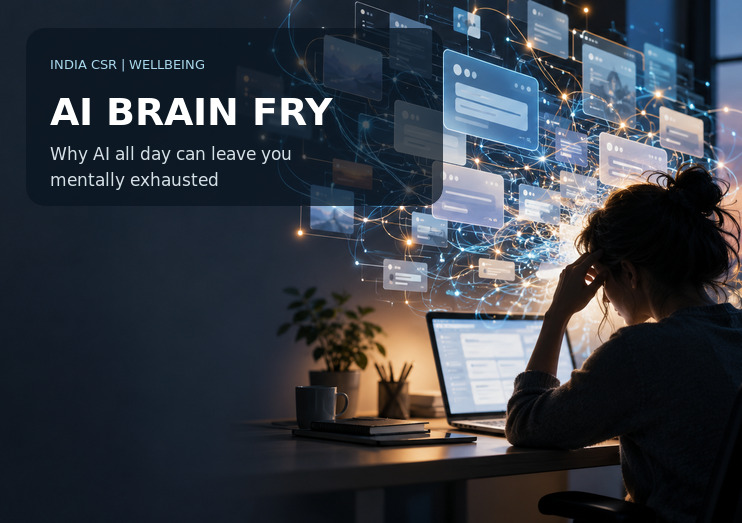
AI brain fry is not a medical diagnosis, but doctors explain how prolonged AI use can contribute to cognitive overload, attention fatigue and mental exhaustion.

You ask AI to draft an email. Then you ask it to rewrite the answer. You compare two versions, correct a factual error, refine a prompt, check another tool’s response and move between tabs while trying to decide which output is actually useful. By the end of the day, you may not have done the work entirely yourself, but your brain can still feel as though it has run a marathon.

The increasingly popular phrase “AI brain fry” describes this sense of mental exhaustion after prolonged or intensive interaction with artificial intelligence tools. It is not a recognised medical diagnosis, and there is no established condition officially called AI brain fry. But doctors and researchers say the experience of cognitive overload is real, and emerging research is beginning to examine whether interacting with AI creates its own particular form of fatigue.
19th India CSR Leadership Summit 2026
ADVERTISEMENT

“AI brain fry” can involve mental fatigue, reduced concentration, difficulty sustaining attention and a feeling of being overwhelmed by information. Dr Abhinit Kumar, Senior Consultant, Psychiatry, ShardaCare-Healthcity, says it can occur when people rely heavily on AI for reading, writing, brainstorming, decision-making or processing large volumes of information.

Why AI can be mentally tiring

If AI is doing some of the work, why should using it leave you more exhausted? Part of the answer lies in what happens around the AI-generated answer.

“When we work with AI, the brain is constantly evaluating prompts and comparing different outputs, correcting mistakes and making decisions,” says Dr Surbhi Chaturvedi, Consultant – Neurology and Head of Stroke Program, Aster Whitefield Hospitals.

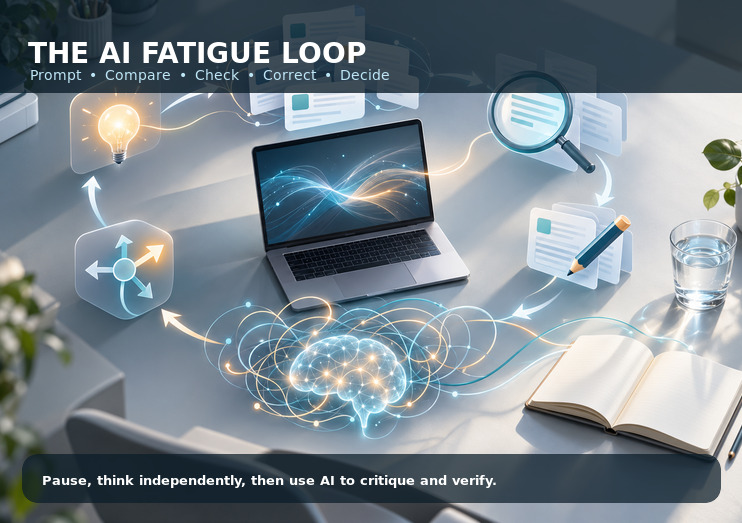
A person might ask an AI tool to summarise a report, for example, but the task does not necessarily end there. The summary has to be checked. Important details may need to be verified. The prompt may have to be rewritten. Another version may be generated. Different answers may need to be compared. Instead of sustained attention on one task, the user can end up repeatedly switching between generating, checking, editing and deciding.

Dr Kumar says constant movement between AI-generated information, multiple prompts, applications and tasks can increase cognitive load. “Instead of allowing the brain to focus deeply on one task, people may continuously scan, compare, edit and evaluate information,” he says.

This can leave people feeling mentally exhausted or distracted. Poor sleep, excessive screen time, inadequate breaks and a lack of physical activity can compound the problem.

India CSR®
Dr Surbhi Chaturvedi, Consultant – Neurology and Head of Stroke Program, Aster Whitefield Hospitals. Image: India CSR

The hidden problem of cognitive offloading

There is another question beyond fatigue: what happens when we routinely allow AI to do the thinking for us?

Humans have always used external tools to reduce cognitive effort. We use calculators for arithmetic, calendars to remember appointments and search engines to retrieve information. AI takes this a step further by generating summaries, arguments, ideas, explanations and even decisions on demand. This is known as cognitive offloading, where some mental work is shifted from the individual to an external system.

“AI can make tasks considerably easier, but using it for every small decision or problem may reduce opportunities for independent recall, reasoning and creative exploration,” Dr Kumar says.

That does not mean cognitive offloading is inherently harmful. The concern is what happens when assistance becomes substitution. A 2025 MIT study offers an early indication of why researchers are interested in this question. The study involved 54 participants who wrote essays using either an LLM, a search engine or no external tool, with a smaller group taking part in a fourth session under a different condition. EEG recordings showed differences in brain connectivity between the groups, with the LLM group showing the weakest connectivity during the task. The researchers also reported lower ownership of the resulting essays among LLM users.

But there is an important caveat. The study was relatively small, focused specifically on essay writing and was published as a preprint rather than a peer-reviewed paper. MIT itself describes the findings as preliminary and says they should not be generalised to all AI use or all users.
India CSR®
Image: India CSR

AI fatigue is becoming a research question

There is, however, growing interest in the broader phenomenon of AI fatigue. A 2026 study involving four studies and 717 participants developed and validated a 15-item AI Fatigue Scale. Researchers identified four dimensions of AI fatigue: cognitive, emotional, physical and behavioural. Greater AI fatigue was associated with lower current AI use and stronger intentions to reduce future AI use.

This is important because “AI fatigue” is broader than simply feeling tired after staring at a screen. The researchers were examining the strain associated with prolonged human-AI interaction itself.

Dr Chaturvedi describes the emerging picture as involving several overlapping processes, including cognitive load, decision fatigue, fragmented attention and cognitive offloading. The result can be particularly noticeable in jobs where AI does not remove responsibility but changes the nature of the work.

When AI becomes another thing you have to supervise

Paul Salnikoff, Managing Director and CEO, The Executive Centre, describes this as a shift from performing tasks to supervising and interpreting AI-generated work. A person may delegate a task to AI, but still has to formulate the prompt, assess the response, identify errors, fact-check information and decide what can actually be used.

“It is a type of exhaustion caused by continuous supervision,” Salnikoff says.

This shift, he adds, is redefining the role of the office. “Workspaces are no longer just centres of productivity but also environments for cognitive recovery and mental clarity. There is a growing need for places that offer a perfect combination of intensity and pause, with calm spaces, sunlight, greenery and environments that allow individuals to reset and refocus.”

Try a ‘brain-first’ approach

Dr Chaturvedi recommends a more deliberate approach to AI use- think before asking.

“Try to think of, write, or remember something on their own before engaging with the AI,” she says, with the technology then used for critique and verification.

For example, instead of immediately asking an AI tool to generate ideas for a presentation, spend five minutes listing your own ideas first. Instead of asking it to summarise something you have not read, read the material and form your own understanding before using AI to identify gaps or clarify difficult sections.

Dr Kumar similarly recommends introducing periods of AI-free deep work, taking regular screen breaks and avoiding constant switching between applications and AI tools.

Reading long-form material, writing or brainstorming without AI from time to time can also preserve opportunities for active cognitive engagement.

The basics matter as well. Adequate sleep, hydration, physical activity and meaningful offline social interaction remain important for concentration and overall cognitive health.

When brain fog should not be blamed on AI

Feeling mentally tired after several hours of intense AI-assisted work is one thing. Persistent cognitive symptoms are another.

Dr Kumar cautions that people should not automatically attribute ongoing brain fog, memory problems, headaches, sleep disturbances, anxiety or difficulty functioning to AI use.

“These symptoms can have several underlying causes and may warrant discussion with a healthcare professional,” he says.

Tags: AI BrainDr Abhinit KumarDr Surbhi Chaturvedi
csr education cybernetyx
ADVERTISEMENT
India CSR Image 1 India CSR Image 2

CSR, Sustainability, and ESG success stories hindustan zinc
ADVERTISEMENT
India CSR

India CSR

India CSR® is the largest media on CSR and sustainability offering diverse content across multisectoral issues on business responsibility. It covers Sustainable Development, Corporate Social Responsibility (CSR), Sustainability, and related issues in India. Founded in 2009, the organisation aspires to become a globally admired media that offers valuable information to its readers through responsible reporting.

Related Posts

Preventive Healthcare
Health

Ayushman Bharat at 8: 13.25 Crore Admissions and ₹2.03 Lakh Crore Treatment Support

Radiation After Breast Surgery: How Many Sessions, and What Daily Life Looks Like
Health

Radiation After Breast Surgery: How Many Sessions, and What Daily Life Looks Like

India CSR®
Health

Apollo Hospitals Greams Road Crosses 2,000 Robotic-Assisted Orthopaedic Surgeries

India CSR®
Health

Dialysis Procedure Explained: Steps, Duration and Aftercare

Apollo Teynampet Becomes 300-Bed Multi-Speciality Hospital
Health

Apollo Teynampet Becomes 300-Bed Multi-Speciality Hospital

India CSR®
Health

Simple Ways to Lower Your Health Insurance Premium Legally

Load More
csr education cybernetyx
ADVERTISEMENT
bba
ADVERTISEMENT

Interviews

India CSR®
Interviews

Interview: Ravi Mahajan on India’s Shift from Diesel to Solar-Powered Telecom Towers

by India CSR

Ravi Mahajan of Vedang Cellular Services discusses solar energy, battery storage, AI and IoT in building efficient and resilient telecom...

Read moreDetails
Sanjay Hande, Head Of Manufacturing And Technology Management, Bosch India @india csr

Giving Becomes Participation, and Participation Creates a Deeper Connection: Sanjay Hande, Bosch India

Vivek Prakash, Senior Vice President & Head, CSR at Jubilant Ingrevia Limited

Didi Ki Dukaan is Helping Rural Women Become Independent Entrepreneurs: Vivek Prakash, Sr VP & Head–CSR, Jubilant Ingrevia

India CSR®

Responsible Business Must Turn Research into Real Impact: Prof Bob Doherty

Load More
Ad 1 Ad 2 Ad 3 Ad 4 Ad 5 Ad 6
ADVERTISEMENT

CSR UPDATES

CSR: Wellspur Foundation Supports 38 Students With JEE, NEET Coaching

CSR: ICCPL Foundation Gives Rs 50,000 to UMEED Vocational Training Centre

CSR: Coca-Cola Foundation, HCCB Strengthen PET Collection at Four Ganpati Locations

CSR: SKF India’s Gram Unnati to Support 1,000+ Households Across Five Villages in Gujarat

CSR: IIFL Foundation, Yashlok Welfare Foundation Provide Recycled PVC Raincoats to Mumbai Police

CSR: Shree Refrigerations Funds AI, Robotics, STEM Education in Maharashtra

STEM Learning STEM Learning STEM Learning
ADVERTISEMENT
Facebook Twitter Youtube LinkedIn Instagram
India CSR Logo

India CSR® is the largest tech-led platform for information on CSR and sustainability in India offering diverse content across multisectoral issues. It covers Sustainable Development, Corporate Social Responsibility (CSR), Sustainability, and related issues in India. Founded in 2009, the organisation aspires to become a globally admired media that offers valuable information to its readers through responsible reporting. To enjoy the premium services, we invite you to partner with us.

Follow us on social media:

Subscribe to Our Newsletter

Don't miss out on the latest updates in corporate social responsibility. Subscribe to our newsletter at indiacsr.in and be part of the positive change.
Please enable JavaScript in your browser to complete this form.
Loading

  • About India CSR®
  • Team
  • India CSR® Awards 2026
  • India CSR® Leadership Summit
  • Partnership
  • Guest Posts
  • Services
  • ESG Professional Network
  • Content Writing Services
  • Business Information
  • Contact
  • Privacy Policy
  • Terms of Use
  • Donate

Copyright © 2026 - India CSR® | All Rights Reserved

No Result
View All Result
  • Home
  • Corporate Social Responsibility
    • Art & Culture
    • CSR Leaders
    • Child Rights
    • Culture
    • Education
    • Gender Equality
    • Around the World
    • Skill Development
    • Safety
    • Covid-19
    • Safe Food For All
  • Sustainability
    • Sustainability Dialogues
    • Sustainability Knowledge Series
    • Plastics
    • Sustainable Development Goals
    • ESG
    • Circular Economy
    • BRSR
  • Corporate Governance
    • Diversity & Inclusion
  • Interviews
  • SDGs
    • No Poverty
    • Zero Hunger
    • Good Health & Well-Being
    • Quality Education
    • Gender Equality
    • Clean Water & Sanitation – SDG 6
    • Affordable & Clean Energy
    • Decent Work & Economic Growth
    • Industry, Innovation & Infrastructure
    • Reduced Inequalities
    • Sustainable Cities & Communities
    • Responsible Consumption & Production
    • Climate Action
    • Life Below Water
    • Life on Land
    • Peace, Justice & Strong Institutions
    • Partnerships for the Goals
  • Articles
  • Events
  • हिंदी
  • More
    • Business
    • Finance
    • Environment
    • Economy
    • Health
    • Around the World
    • Social Sector Leaders
    • Social Entrepreneurship
    • Trending News
      • Important Days
      • Great People
      • Product Review
      • International
      • Sports
      • Entertainment
    • Case Studies
    • Philanthropy
    • Biography
    • Technology
    • Lifestyle
    • Sports
    • Gaming
    • Knowledge
    • Home Improvement
    • Words Power
    • Chief Ministers

Copyright © 2026 - India CSR® | All Rights Reserved

This website uses cookies. By continuing to use this website you are giving consent to cookies being used. Visit our Privacy and Cookie Policy.
